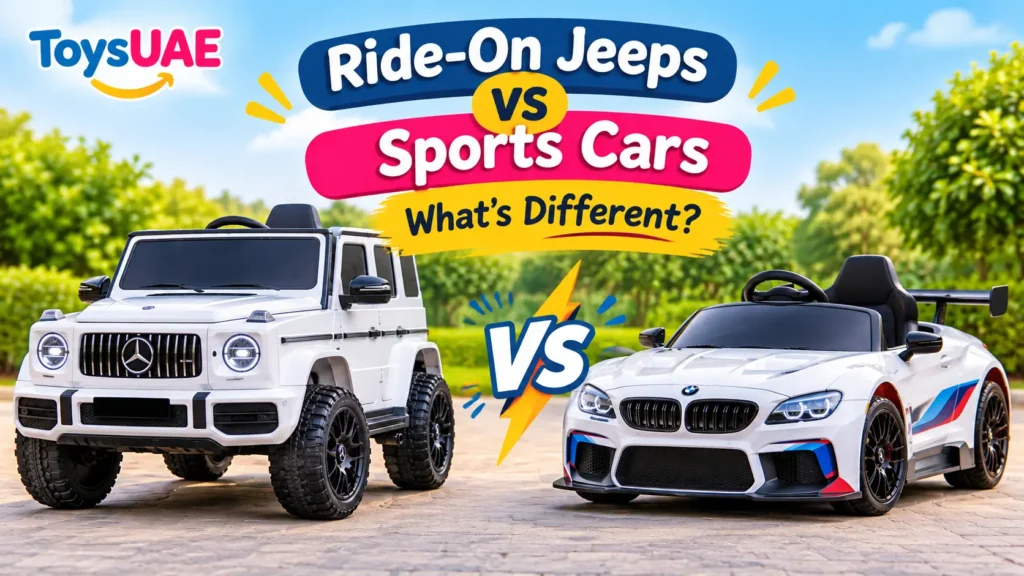
Choosing a kids car can be more interesting when parents explore the different designs available. Some children love the bold look of off-road jeeps, while others prefer the stylish appearance of sports cars inspired by real luxury vehicles. Although both types offer an enjoyable driving experience, they have different designs, features, and intended uses. Understanding these differences can help parents select a vehicle that matches their child’s interests and play environment.
1. Design and Appearance
One of the biggest differences between ride-on jeeps and electric sports cars is their overall appearance.
Ride-On Jeeps
Ride-on jeeps usually have a large body, a high seating position, and a strong-looking exterior. Many designs are inspired by real SUVs and off-road vehicles. They may include wide front grilles, large wheels, roof details, and opening doors.
Some models also come with two seats, allowing two children to enjoy the ride together when the manufacturer permits it.
Electric Sports Cars
Sports cars have a different appearance. Their designs usually focus on smooth body shapes, low profiles, and stylish details. Many models are inspired by famous sports car brands such as Lamborghini, Ferrari, and Porsche.
They often include features such as sporty front lights, realistic dashboards, attractive wheel designs, and compact seating arrangements.
The choice between these styles often comes down to what type of vehicle a child finds more exciting.
2. Tyres and Wheel Design
Tyres are another feature that makes these two vehicle styles different.
Ride-on jeeps often have wider wheels with a more rugged appearance. Some models also include suspension systems and rubber or EVA tyres to support a comfortable ride on suitable outdoor surfaces.
Sports cars usually have smaller-looking, stylish wheels designed to match their sleek appearance. Their tyres are generally intended for smoother driving surfaces, such as flat driveways and paved areas.
However, appearance alone does not determine performance. Parents should check the actual tyre material, wheel size, and manufacturer’s recommended riding surfaces before choosing a model.
3. Driving Experience and Performance
Ride-on jeeps are often designed to give children a more adventurous driving experience. Depending on the model, they may have multiple motors, four-wheel-drive systems, and suspension features.
These features can make certain jeep models more suitable for outdoor play on appropriate surfaces.
Sports cars, on the other hand, focus more on a stylish and realistic driving experience. Their designs are inspired by road-going performance vehicles and often include detailed dashboards, steering wheels, music, and working lights.
Both types can offer forward and reverse movement, accelerator pedals, and parental remote controls. Actual speed and performance depend on the battery, motor, weight, and construction of each vehicle.
4. Seating Space and Comfort
Seating arrangements can also influence the buying decision.
Many ride-on jeeps are available with wider seats or two-seat configurations. This can be useful for families looking for a model that accommodates two children, provided the product’s seating and weight limits allow it.
Sports cars are commonly designed with a single seat and a more compact interior. Their seating arrangements are often inspired by the cockpit of a real sports vehicle.
When comparing comfort, parents should check the seat size, available legroom, seat material, seat belt, and maximum weight capacity rather than relying only on the vehicle’s external size.
5. Battery and Motor Options
Both vehicle styles are available with different battery and motor configurations.
Some smaller models use 6V or 12V battery systems, while larger and more powerful options may use 24V systems or higher.
For example, a ride-on jeep with multiple motors may provide more power than a smaller model with a single motor. Similarly, a sports car with a stronger motor may perform better than a basic jeep.
When comparing a kids electric car, parents should look at the complete specifications instead of choosing based only on the vehicle’s appearance.
Important details include:
- Battery voltage and capacity.
- Number and power of motors.
- Maximum speed.
- Estimated running time.
- Charging time.
- Maximum weight capacity.
These details provide a more accurate idea of how each vehicle will perform.
6. Extra Features and Technology
Modern ride-on vehicles can include several features that make driving more enjoyable.
Features commonly found in ride-on jeeps:
- Parental remote control.
- Suspension systems.
- Opening doors.
- Front and rear lights.
- Music and sound effects.
- Two-seat arrangements in selected models.
- Forward and reverse gears.
Features commonly found in sports cars:
- Realistic sports-style dashboards.
- LED-style headlights.
- Music and sound controls.
- Steering wheel with additional buttons.
- Parental remote control.
- Stylish body designs inspired by real sports cars.
These are common examples, not fixed rules. Some sports cars may have suspension or multiple seats, while certain jeeps may have fewer features.
7. Examples of Ride-On Jeeps and Sports Cars
Looking at actual products makes the comparison easier.
The ToysUAE cars collection includes several examples of both styles.
Ride-On Jeep Examples
- Gambol Jeep Replica Style Actual 4×4: A jeep-inspired design with parental remote control, suspension, music effects, and front and rear lights.
- Gambol Big Jeep 4×4: A larger 24V model with four motors, four-wheel suspension, two seats, and parental remote control.
Electric Sports Car Examples
- Gambol Limited Edition Lamborghini Ride-On: A sports car design inspired by Lamborghini styling.
- BMW M6 GT3 Kids Licensed Electric Ride-On: A sporty design inspired by a racing car, with a distinctive exterior.
These examples show how different designs can offer different experiences. Parents should compare the specifications of each model before making a final decision.
8. Which One Should Parents Choose?
There is no single answer because the right choice depends on the child’s interests and the family’s requirements.
A ride-on jeep may be a suitable option for children who enjoy larger vehicles, adventurous designs, and outdoor-style play. Models with wider seating may also be worth considering for families looking for a two-seater option.
A sports car may be a better match for children who enjoy stylish vehicles, racing-inspired designs, and realistic sports car details.
Before purchasing, parents should consider the child’s age, weight, driving experience, available space, and the recommended riding surface.
Frequently Asked Questions
1. Are ride-on jeeps better than electric sports cars?
Neither is automatically better. Jeeps often have larger bodies and rugged styling, while sports cars focus on sleek designs. The best option depends on the child’s preferences and the product specifications.
2. Can ride-on sports cars be used outdoors?
Yes, many models can be used on suitable flat outdoor surfaces. However, parents should check the manufacturer’s recommendations before using them on grass or uneven ground.
3. Do ride-on jeeps have more power than sports cars?
Not always. Power depends on the battery, motor configuration, and overall design. Some sports cars can be more powerful than smaller jeep models.
4. Are two-seater ride-on vehicles available?
Yes. Some jeeps, UTVs, and sports car models are available with two seats. Always check the seating arrangement and maximum weight capacity.
5. Do both vehicle types come with parental remote control?
Many models offer parental remote control, but it is not available in every product. Check the individual product description before purchasing.
6. Which vehicle is suitable for younger children?
The right option depends on the manufacturer’s recommended age, weight limit, speed settings, and safety features. Parents should select a model that matches the child’s abilities rather than its appearance alone.
Final Thoughts
Ride-on jeeps and electric sports cars offer different styles of play. Jeeps generally focus on rugged designs, larger bodies, and adventure-inspired features, while sports cars offer sleek appearances and racing-inspired details.
Both can provide an enjoyable driving experience when selected according to a child’s age, interests, and abilities. Comparing the design, seating, motor power, battery, and safety features will help parents make a more informed decision.