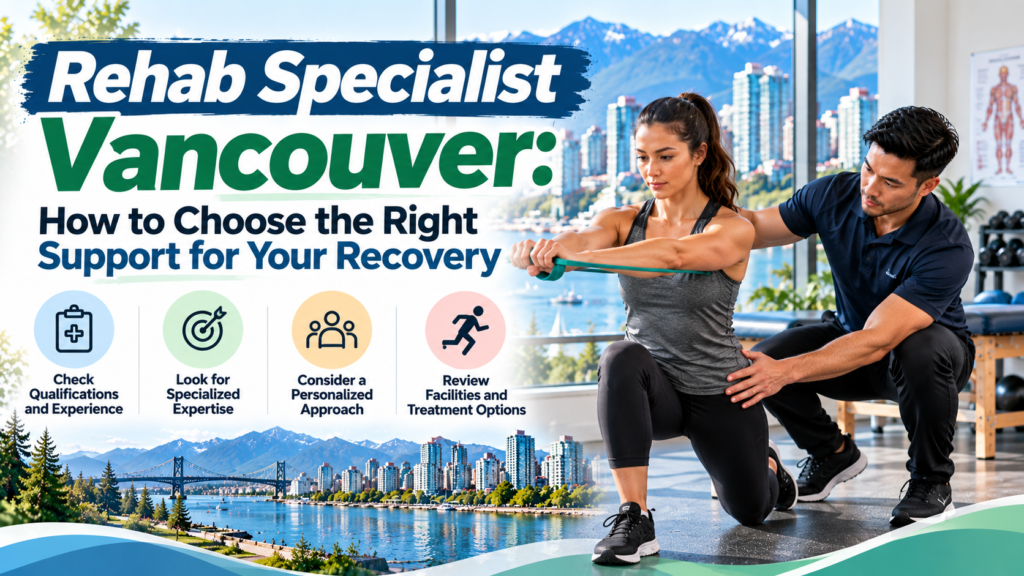
Finding the right rehab specialist in Vancouver can feel confusing, especially when several different professionals may be involved in your recovery.
You might start with a doctor or physiotherapist after an injury and later find yourself looking for help rebuilding strength, improving movement or getting back to the activities you enjoy.
That later stage matters.
Being able to perform basic daily movements does not necessarily mean you are ready to return to your normal workout, job or sport. There can be a gap between recovering from an injury and being physically prepared for everything you want to do again.
Exercise-based rehabilitation can help bridge that gap.
At SNS Fitness & Rehab, the approach is centred on individualized training and rehabilitation, with programs built around a person’s physical condition, goals and stage of recovery.
What Is a Rehab Specialist?
The term rehab specialist can describe professionals working in different areas of rehabilitation, so it is important to understand what a particular provider actually does.
In an exercise-based setting, a kinesiologist may help people rebuild physical capacity through structured movement and exercise.
This can involve working on:
- Strength
- Mobility
- Balance
- Conditioning
- Coordination
- Movement control
- Functional capacity
- Return to exercise
- Return to sport
The appropriate approach depends on the person.
Someone recovering from a knee injury may need a very different program from someone returning to activity after a shoulder problem or a period of prolonged inactivity.
What Does a Kinesiologist Do in Rehabilitation?
Kinesiology focuses on human movement and exercise.
A professional kinesiologist may work with people who are recovering from injuries, managing physical limitations or trying to improve their physical capacity.
In British Columbia, the British Columbia Association of Kinesiologists (BCAK) has professional membership requirements covering education, relevant experience and competency. Professional applicants must meet the applicable academic and work-experience requirements and successfully complete the BCAK Professional Competency Examination.
BCAK also identifies kinesiologists as allied health professionals and highlights the importance of evidence-based practice, professional accountability and competency in clinical settings.
That makes professional credentials worth checking when you are comparing rehabilitation providers.
What Can Exercise-Based Rehabilitation Help With?
Rehabilitation is not limited to one particular injury or age group.
Depending on the provider’s expertise and your circumstances, exercise-based rehabilitation may be used to help people:
- Recover after an injury
- Rebuild strength following inactivity
- Improve physical conditioning
- Return to recreational exercise
- Prepare to return to sport
- Improve movement capacity
- Build confidence with physical activity
- Manage physical limitations
The goal should be specific to the person.
For one client, success might mean walking comfortably for longer.
For another, it could mean returning to resistance training.
For an athlete, the goal may eventually be getting back to sprinting, jumping, changing direction or competing.
Rehab Is More Than Treating the Injured Area
It is easy to focus entirely on the place where an injury occurred.
But your body does not operate as a collection of completely separate parts.
A knee problem, for example, can affect how someone walks, climbs stairs or performs lower-body exercises.
Similarly, a shoulder issue can change how someone lifts, reaches or trains their upper body.
A rehabilitation program may therefore address more than the original area of discomfort.
Depending on the individual’s needs, training can include:
Strength
Progressive resistance can help rebuild physical capacity after periods of reduced activity.
Mobility
Controlled movement can help restore the range and movement quality required for everyday activities or exercise.
Balance and Coordination
These qualities can be important when returning to normal movement or more demanding activities.
Cardiovascular Fitness
Periods of inactivity can affect endurance. Gradually rebuilding conditioning can make everyday activity and exercise easier to tolerate.
Functional Movement
The exercises can eventually become more closely related to the tasks the person needs to perform at home, work, in the gym or during sport.
When Should You See a Rehab Specialist in Vancouver?
There is no single point in recovery when everyone should begin exercise-based rehabilitation.
Your needs depend on the injury, treatment you’ve already received and your current physical capacity.
A rehab specialist may be particularly useful when you are:
- Coming to the end of formal rehabilitation
- Still feeling physically deconditioned
- Nervous about returning to exercise
- Struggling to rebuild strength
- Preparing to return to sport
- Returning to physically demanding work
- Looking for a structured exercise program
If you have a new, severe or unexplained injury, medical assessment may be appropriate before beginning an exercise program.
Rehabilitation should complement appropriate medical care rather than replace it.
Rehab Specialist vs Physiotherapist: What’s the Difference?
This is one of the most common questions people have.
A physiotherapist and a kinesiologist can both be involved in recovery, but their training and roles are different.
Broadly speaking, physiotherapy can involve clinical assessment, treatment of physical conditions, manual techniques and therapeutic exercise.
Kinesiology generally places greater emphasis on movement, exercise and progressive physical conditioning.
The two approaches can complement one another.
For example, someone may initially work with a physiotherapist to address an injury and later work with a kinesiologist to progressively rebuild strength, endurance and physical confidence.
There is no need to view the two professions as competing options.
The more useful question is:
What type of support do I need at this stage of recovery?
What Does a Rehabilitation Program Look Like?
A good program should have a reason behind it.
1. Start With Your History
Your rehab specialist should understand:
- What happened
- What activities are currently difficult
- What treatment you have already received
- What your normal activity level was
- What you want to return to
2. Assess Your Current Ability
The starting point should reflect your current capacity rather than your pre-injury fitness.
3. Build a Program
Exercises are then selected around your needs.
This could include strength work, mobility, conditioning, balance or functional movements.
4. Progress Gradually
As your capacity improves, exercises can become more demanding.
That might mean:
- More resistance
- More repetitions
- Greater range of motion
- More complex movements
- Increased conditioning
- More activity-specific exercises
5. Reassess and Adjust
Recovery is not always linear.
Your program may need to change based on your progress, symptoms, schedule and goals.
What Does “Personalized Rehabilitation” Actually Mean?
Personalized rehabilitation should mean more than putting your name at the top of a generic exercise sheet.
Two people with the same injury can have very different needs.
Consider two people recovering from knee problems.
One may already be physically active and want to return to recreational skiing.
The other may have spent months inactive and simply want to walk comfortably and regain basic strength.
Their programs should not look identical.
A personalized approach considers where you are now, what you need to do and how much training you can currently tolerate.
Returning to Sport After an Injury
For athletes, rehabilitation often has another layer.
Being able to perform normal daily activities is not necessarily enough to return to competition.
Sport can involve:
- High-speed movement
- Repeated acceleration
- Deceleration
- Jumping
- Landing
- Direction changes
- Contact
- High training volumes
A return-to-sport program therefore needs to progress beyond basic rehabilitation where appropriate.
The later stages may become increasingly specific to the athlete’s sport.
For example, someone returning to soccer may eventually need to tolerate repeated running and direction changes. A basketball player may need progressive jumping and landing demands.
The progression should reflect the sport rather than simply adding more weight to a gym exercise.
Returning to Work
Rehabilitation can also have a practical workplace goal.
If your job requires:
- Lifting
- Carrying
- Standing
- Walking
- Climbing
- Repetitive movement
- Prolonged sitting
then your training may eventually need to prepare you for those demands.
This is especially relevant when someone feels much better during normal daily activities but still struggles with the physical requirements of their job.
How to Choose a Rehab Specialist in Vancouver
If you are comparing providers, credentials are only the starting point.
Consider these questions.
Does Their Experience Match Your Needs?
Someone recovering from a motor vehicle injury may have different requirements from an athlete returning to competition.
Look for relevant experience.
Do They Assess You First?
A proper starting assessment helps establish what you can currently do.
Is the Program Individualized?
Your exercise program should reflect your current ability and goals.
Is There a Clear Progression?
Ask how the program will change as you improve.
Do They Communicate With Other Professionals?
Depending on your situation, rehabilitation may involve several healthcare providers. Good communication can help keep the overall recovery process coordinated.
Do They Explain Why You Are Doing an Exercise?
You should understand how the exercises relate to your recovery.
A long list of exercises is less useful if you do not understand what they are intended to accomplish.
Questions to Ask Before Booking
If you are searching for a rehab specialist in Vancouver, consider asking:
- What professional qualifications do you hold?
- Are you a practicing BCAK member if you work as a professional kinesiologist?
- Do you regularly work with people recovering from injuries?
- What types of rehabilitation do you specialize in?
- How do you assess new clients?
- How do you measure progress?
- How do you modify training if symptoms change?
- Can the program be adapted for work or sport?
- Do you coordinate with other healthcare professionals when appropriate?
- What should I expect during the first session?
BCAK provides information about its professional membership requirements, including academic, experience and competency requirements.
What Should You Expect at the First Session?
Your first appointment should give the specialist a better understanding of your situation.
Depending on the reason for the visit, the conversation may cover:
- Your injury history
- Current symptoms or limitations
- Previous treatment
- Exercise history
- Work demands
- Sports or recreational activities
- Your recovery goals
A movement or physical assessment may then help establish a starting point.
At SNS Fitness & Rehab, the clinic describes an individualized approach to training and rehabilitation rather than a one-size-fits-all program. The team also emphasizes assessment and training based on the client’s goals.
That distinction is important.
Your first session should not simply be a test of how much weight you can lift.
It should help establish where you are starting from.
Common Rehabilitation Mistakes
Trying to Return to Your Old Workout Immediately
Your previous workout reflects your previous capacity.
After an injury, that capacity may have changed.
Avoiding Exercise Indefinitely
Fear of reinjury can sometimes make people reluctant to move.
An appropriately progressed exercise program can help rebuild both physical capacity and confidence.
Focusing Only on Pain
Pain is important information, but recovery can involve much more than whether something hurts.
Strength, endurance, movement quality and function may all matter.
Progressing Too Quickly
Feeling good during one session does not necessarily mean your body is ready for a major increase in workload.
Progress should be gradual.
Following Someone Else’s Rehabilitation Program
An exercise that works well for one person may not be appropriate for another.
Your program should reflect your own circumstances.
Frequently Asked Questions
What is a rehab specialist?
“Rehab specialist” is a broad term that can refer to professionals working in different areas of rehabilitation. In an exercise-based setting, a kinesiologist may help clients rebuild strength, movement, conditioning and physical function through progressive exercise.
Is a kinesiologist a rehab specialist?
A professional kinesiologist can provide exercise-based rehabilitation within their professional scope and training. BCAK’s professional membership standards include academic, work-experience and competency requirements for professional practice.
Should I see a physiotherapist or kinesiologist?
It depends on your needs and stage of recovery. Physiotherapy and kinesiology have different roles and can complement one another. Someone may work with a physiotherapist during one stage of recovery and a kinesiologist as they rebuild strength and physical capacity.
Can a rehab specialist help me return to sports?
Exercise-based rehabilitation can be part of a return-to-sport process. The program can gradually increase the strength, conditioning and movement demands needed for the athlete’s particular activity.
Can rehabilitation help if I am not an athlete?
Absolutely. Rehabilitation can focus on everyday goals such as walking, climbing stairs, returning to work, exercising or simply becoming more physically capable.
How long does rehabilitation take?
There is no standard timeline. Recovery depends on the type of injury, current physical capacity, consistency, training demands and individual circumstances.
What should I bring to my first appointment?
Bring relevant medical or rehabilitation information, details about previous treatment and a clear idea of what you want to return to doing. If another healthcare professional has provided specific instructions, those may also be useful.
Final Thoughts
Finding the right rehab specialist in Vancouver is less about finding the person with the longest list of services and more about finding someone whose expertise fits your situation.
You want a professional who understands where you are starting, knows what you are trying to get back to and can build a sensible path between the two.
That path might involve rebuilding basic strength.
It might involve improving mobility and conditioning.
Or, if you are an athlete, it might eventually lead to more demanding sport-specific training.
The important thing is that the program should evolve with you.
At SNS Fitness & Rehab, the focus is on individualized training and rehabilitation designed around the client’s physical needs and goals.