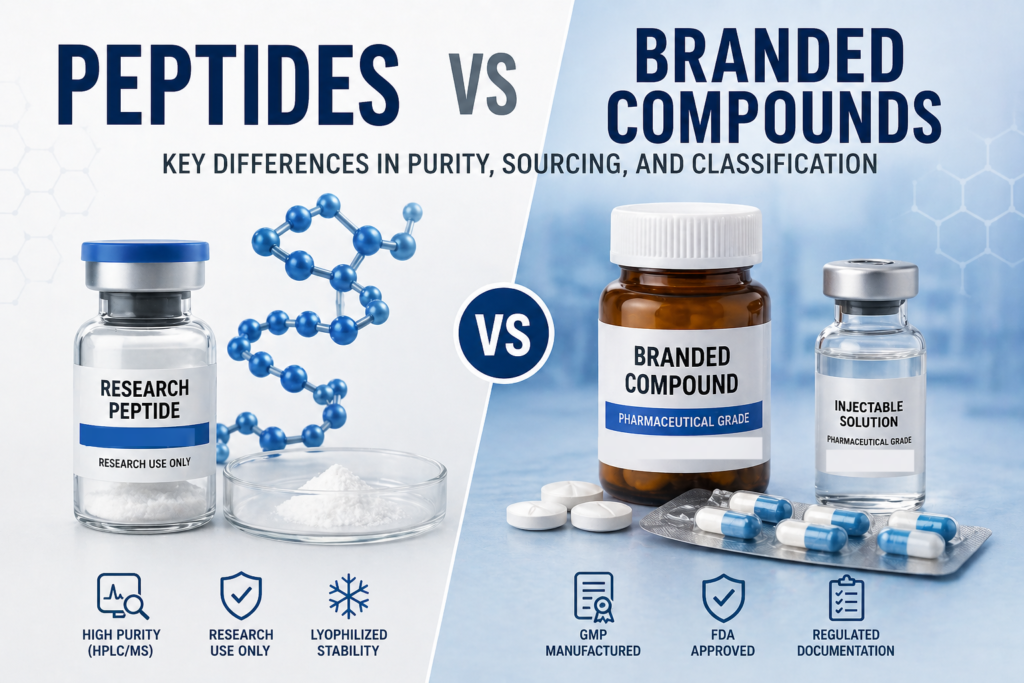
In research chemistry, precision isn’t optional, it’s foundational. Two broad categories of compounds frequently appear in laboratory procurement discussions: research peptides and branded pharmaceutical compounds. While both may share overlapping molecular targets on paper, their classification, manufacturing processes, purity documentation, and sourcing frameworks differ substantially. Understanding these distinctions isn’t just academic; it shapes every procurement, analytical, and archival decision a laboratory makes.
This article examines the key structural and procedural differences between research-grade peptides and branded compounds from a purely scientific and compliance-focused lens. No clinical applications, outcomes, or recommendations are discussed here.
What Are Research Peptides? A Structural and Chemical Overview
Peptides are short-chain amino acid polymers connected via peptide bonds. Depending on chain length, these molecules are classified as dipeptides, oligopeptides, or polypeptides. In a research context, synthetic peptides are designed to replicate or modify naturally occurring amino acid sequences for analytical investigation.
Their synthesis typically follows one of two routes:
- Solid-Phase Peptide Synthesis (SPPS): The most widely used method, where amino acids are assembled sequentially on a solid resin support, then cleaved and purified.
- Solution-Phase Peptide Synthesis: Used for larger or more complex sequences where SPPS yields are suboptimal.
Both methods require careful monitoring of coupling efficiency at each step. A single failed coupling can introduce truncated sequences, a significant contamination variable in final product purity.
Research peptides available through suppliers like Element CRP are characterized by their lyophilized powder form, which maximizes long-term stability during storage and shipment.
Branded Compounds — Classification and Regulatory Context
Branded compounds refer to molecules that carry a proprietary commercial name and are typically produced under pharmaceutical Good Manufacturing Practice (GMP) standards. These are distinct from research-grade compounds in several important ways:
| Feature | Research Peptides | Branded Compounds |
| Regulatory Status | Not FDA-approved; for research use only | FDA-approved (NDAs/BLAs) for defined indications |
| Manufacturing Standard | ISO-grade or in-house QC | GMP (21 CFR Parts 210/211) |
| Purity Documentation | COA with HPLC/MS data | Pharmacopeial standards (USP/EP) |
| Labeling | Research use only disclaimers | Prescription labeling, package inserts |
| Sourcing | Specialty chemical suppliers | Licensed pharmaceutical distributors |
This distinction is not merely semantic. A branded compound carries a specific approved formulation, excipient profile, and concentration standard that doesn’t apply to research peptides sourced from chemical suppliers.
Purity Standards: HPLC, Mass Spectrometry, and Certificate of Analysis
Purity is the defining quality metric for research compounds. However, how purity gets measured and what standard constitutes “acceptable” diverges significantly between peptides and branded compounds.
HPLC Purity in Research Peptides
High-Performance Liquid Chromatography (HPLC) is the gold-standard analytical method for assessing peptide purity. It separates molecular components by differential affinity to a stationary phase. A typical research peptide specification of “99%+ purity” means that 99% or more of the detected peak area corresponds to the target peptide sequence.
Reputable research peptide suppliers, including Element CRP, publish batch-specific Certificates of Analysis that include:
- HPLC chromatogram with retention time
- Purity percentage (area under the curve method)
- Mass spectrometry confirmation of molecular weight
- Sequence identity verification
Third-party laboratory testing provides an additional validation layer. When a supplier contracts an independent lab to verify purity claims, it removes internal bias from the quality assertion.
Purity Standards for Branded Pharmaceutical Compounds
Branded compounds operate under pharmacopeial monographs. The United States Pharmacopeia and European Pharmacopoeia define specific assay ranges, impurity thresholds, dissolution profiles, and physical characteristics for each approved substance. These aren’t optional benchmarks, they’re regulatory requirements enforced through inspection and lot release testing.
The regulatory framework around branded compounds also mandates stability testing per ICH Q1A guidelines, covering temperature, humidity, and light exposure over multi-year timelines.
Synthesis vs. Pharmaceutical Manufacturing: Process Differences
Understanding how each compound type gets made illuminates why their purity profiles and documentation differ so substantially.
Peptide Synthesis Workflow
The SPPS process involves the following sequential steps:
- Resin loading: The C-terminal amino acid attaches to a solid resin support.
- Deprotection: Fmoc or Boc protecting groups are removed to expose the amine group.
- Coupling: The next activated amino acid couples to the exposed amine.
- Washing: Excess reagents are removed after each cycle.
- Cleavage: The assembled peptide chain cleaves from the resin.
- Purification: Preparative HPLC removes impurities and truncated sequences.
- Lyophilization: Water removal produces a stable, storable powder.
Element CRP uses both automated and manual peptide synthesizers, applying in-house HPLC and Mass Spectrometry at each production stage to verify sequential fingerprints before a batch passes quality control.
Pharmaceutical Manufacturing of Branded Compounds
Branded drug manufacturing involves formulation science beyond raw synthesis. A pharmaceutical active ingredient (API) must be combined with precisely characterized excipients, then manufactured in validated facilities under:
- 21 CFR Part 211 (Finished Pharmaceuticals)
- ICH Q7 (Active Pharmaceutical Ingredient GMP)
- Batch record documentation and full chain-of-custody traceability
Every manufacturing deviation requires documentation, investigation, and potentially regulatory notification. The documentation burden in branded compound production far exceeds that of research peptide manufacturing.
Sourcing Considerations for Research Laboratories
Where a compound comes from matters as much as its molecular structure. The sourcing landscape for research peptides and branded compounds operates through entirely different supply chains.
Research Peptide Sourcing
Research peptides flow through specialty chemical and peptide suppliers. Key sourcing criteria for laboratory procurement include:
- Origin and manufacturing location (domestic vs. overseas synthesis)
- Availability of third-party COAs from accredited analytical laboratories
- Lyophilization method and storage documentation
- Batch-to-batch consistency data
- Shipping conditions (cold chain, desiccant packaging)
Element CRP sells its research peptides domestically in the United States, providing third-party HPLC and Mass Spectrometry validation for each product line. Their catalog includes commonly researched sequences such as BPC-157 , TB-500 , and GHK-Cu, each supplied with batch-specific analytical data.
Branded Compound Sourcing
Branded compound procurement channels are tightly regulated. Licensed pharmaceutical wholesalers (3PLs) authorized under the Drug Supply Chain Security Act (DSCSA) manage the distribution network. Laboratories procuring branded compounds for research generally interact with:
- Authorized drug distributors with DEA registration (where applicable)
- Hospital and institutional pharmacies for reference standards
- Certified reference standard suppliers like Sigma-Aldrich or USP Reference Standards
Counterfeit and substandard branded compounds represent a documented risk in unregulated purchasing channels, a concern largely absent in the research peptide space, where COA transparency remains the primary accountability mechanism.
Formulation and Physical Presentation Differences
Research peptides and branded compounds rarely exist in the same physical form. This has direct implications for laboratory handling, storage, and reconstitution protocols.
| Attribute | Research Peptides | Branded Compounds |
| Primary Form | Lyophilized powder (vials) | Tablets, capsules, solutions, injectables |
| Reconstitution | Requires bacteriostatic or sterile water | Ready-to-use or per prescribing info |
| Storage Temperature | −20°C (long-term), 4°C (short-term) | Varies by formulation (2–8°C to room temp) |
| Shelf Life Post-Reconstitution | Days to weeks (refrigerated) | Defined by manufacturer stability data |
Reconstitution diluents matter in peptide research. Bacteriostatic water, sterile water containing 0.9% benzyl alcohol, is standard for peptide reconstitution in research settings, as benzyl alcohol inhibits microbial growth during the multi-use vial period.
Classification Under Research and Regulatory Frameworks
The regulatory classification of research peptides versus branded compounds creates two fundamentally different legal and institutional frameworks.
Research peptides occupy the “research chemical” or “investigational compound” space. They don’t carry an IND application unless a sponsor initiates formal clinical investigation. Most research peptide procurement falls under general laboratory supply regulations not pharmaceutical law.
Branded compounds, conversely, are defined substances with approved labeling, pharmacokinetic data in their prescribing information, and post-market surveillance obligations. Using a branded compound outside its approved indication even in a research context may trigger FDA regulatory considerations depending on jurisdiction and institutional review protocols.
For procurement teams and institutional review boards, understanding this classification gap ensures appropriate documentation, storage segregation, and use-tracking for each compound category.
Analytical Methods Used in Purity Verification
Both compound categories rely on overlapping analytical tools, though application scope differs:
- Reverse-Phase HPLC (RP-HPLC): Separates peptide components by hydrophobicity. Most peptide purity reports use this method.
- Mass Spectrometry (MS/LCMS): Confirms molecular weight and identifies impurity masses. Essential for sequence verification in synthetic peptides.
- NMR Spectroscopy: Used more frequently for small-molecule branded compound characterization than for peptide work.
- Elemental Analysis: Confirms empirical formula; used in raw API characterization for pharmaceutical manufacturing.
- Karl Fischer Titration: Measures residual moisture in lyophilized peptide powders critical for stability.
In a well-structured research peptide COA, HPLC and LCMS data appear side by side one confirming purity by peak area percentage, the other confirming identity by molecular mass match to the theoretical value.
A Note on GLP-1 Analogues and Structural Classification
GLP-1 receptor agonists present an interesting classification case. Compounds like Semaglutide and Tirzepatide exist in both branded pharmaceutical form and as research-grade analogues available through peptide suppliers. The structural similarity doesn’t erase the classification difference.
Research-grade GLP-1 analogues are intended strictly for analytical and investigational laboratory work. Their purity documentation and sourcing pathway differ entirely from the branded pharmaceutical versions. Researchers must clearly document which form they procure, as institutional compliance requirements vary by compound category.
Summary: Key Differentiators at a Glance
The table below consolidates the primary differentiators across both compound categories:
| Category | Research Peptides | Branded Compounds |
| Synthesis Method | SPPS or solution-phase | API synthesis + GMP formulation |
| Purity Benchmark | 99%+ HPLC (COA provided) | USP/EP pharmacopeial monographs |
| Regulatory Status | Research use only | FDA-approved (NDA/BLA) |
| Sourcing Channel | Specialty peptide suppliers | Licensed pharmaceutical distributors |
| Documentation | COA, HPLC/MS data | Batch records, GMP audit trails |
| Physical Form | Lyophilized powder | Various (tablets, injectables, solutions) |
Whether you’re evaluating compounds for laboratory procurement, conducting analytical method development, or building a sourcing compliance program, these distinctions remain fundamental. Research-grade peptides and branded pharmaceutical compounds occupy different regulatory universes and treating them as interchangeable creates significant scientific and institutional risk.
For laboratories sourcing high-purity research peptides with third-party verified COAs, the Element CRP catalog offers a range of analytically verified compounds including BPC-157, TB-500, CJC-1295, Ipamorelin, Sermorelin, and GLP-1 analogues all manufactured in the United States and documented to 99%+ HPLC purity standards.