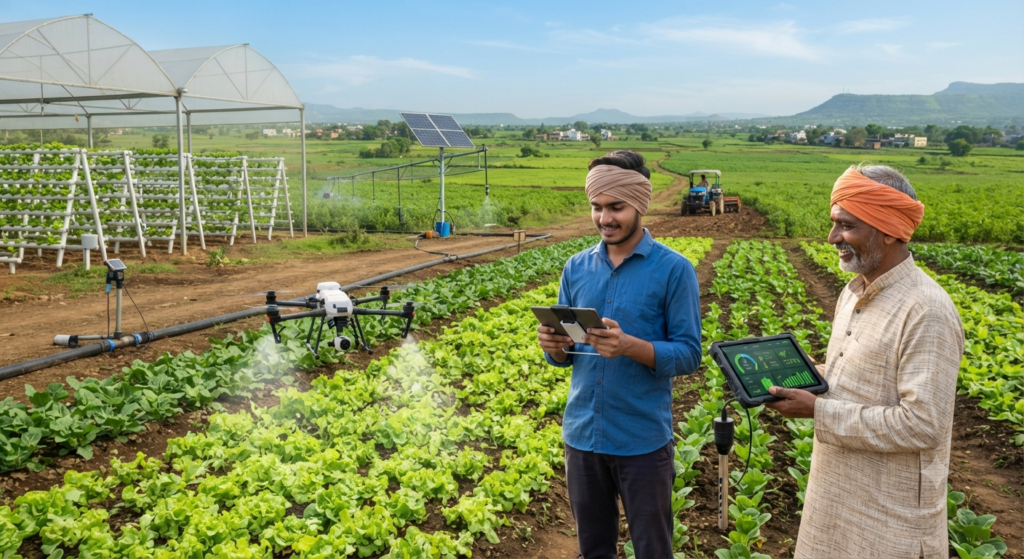
Agriculture is changing rapidly as farmers face challenges such as climate change, water scarcity, rising production costs, soil degradation, and increasing food demand. Traditional farming practices remain important, but new technologies and scientific techniques are helping farmers produce more efficiently while using fewer resources.
The rise of Modern Farming Methods of Agriculture is creating new opportunities for farmers to improve productivity, protect natural resources, and build more sustainable agricultural systems. From precision agriculture to hydroponics, these approaches combine technology, data, and innovative cultivation techniques to address the needs of modern food production.
Why Modern Farming Is Important
Modern agriculture focuses on achieving higher productivity without unnecessarily increasing the use of land, water, fertilizers, and other inputs. Modern Farming Methods Of Agriculture combine digital technologies, automation, improved irrigation systems, and controlled growing environments to help farmers make more informed decisions, improve efficiency, and support sustainable crop production.
These techniques can also help reduce waste and improve the quality of agricultural products. For both small-scale and commercial farmers, adopting suitable innovations can make farm management more efficient and adaptable to changing environmental conditions.
Here are ten important approaches shaping the future of agriculture.
1. Precision Agriculture
Precision agriculture uses technology and data to manage crops according to the specific conditions of different areas within a farm. GPS, sensors, satellite imagery, drones, and farm-management software can provide valuable information about soil moisture, crop health, nutrient levels, and field conditions.
Instead of applying the same amount of water or fertilizer across an entire field, farmers can target specific areas that require attention. This approach can improve resource efficiency, reduce unnecessary input use, and support better crop management.
Precision agriculture is particularly valuable for large farms, although affordable sensors and digital tools are increasingly making aspects of this technology accessible to smaller producers.
2. Hydroponic Farming
Hydroponics is a cultivation technique in which plants grow without traditional soil. Instead, their roots receive nutrients through a carefully managed water-based solution.
Because hydroponic systems can operate in controlled environments, they can be used in places where fertile agricultural land or sufficient water is limited. Indoor farms, greenhouses, and urban growing facilities often use this technique.
Another advantage is that water can be recirculated within the system, potentially reducing water consumption compared with conventional cultivation. Proper monitoring of nutrients, temperature, pH, and lighting is essential for successful production.
3. Vertical Farming
Vertical farming involves growing crops in stacked layers, often inside buildings or specially designed structures. This method makes it possible to produce food in locations where horizontal land availability is limited.
Controlled environments allow growers to regulate lighting, temperature, humidity, and nutrients. Crops can therefore be cultivated throughout much of the year, depending on the system and crop type.
Vertical farming is particularly relevant to urban agriculture and is considered one of the Modern Farming Methods Of Agriculture, because production facilities can be located closer to consumers. Shorter supply chains may help reduce transportation requirements for certain fresh produce while supporting efficient and innovative food production in urban areas.
4. Drip Irrigation
Efficient water management is becoming increasingly important as many agricultural regions experience water shortages. Drip irrigation delivers water directly to the root zone of individual plants through a network of pipes, emitters, and valves.
This can reduce water losses caused by evaporation and runoff when compared with less targeted irrigation methods. Farmers can also combine drip systems with timers and moisture sensors to adjust watering according to crop requirements.
For water-intensive crops and regions facing irrigation challenges, efficient watering systems can play an important role in improving farm productivity and conserving resources.
5. Smart Greenhouse Farming
Smart greenhouses combine traditional greenhouse cultivation with automation and digital monitoring. Sensors can measure variables such as temperature, humidity, soil moisture, light intensity, and carbon dioxide levels.
Automated systems can then adjust ventilation, irrigation, lighting, and other environmental factors according to predetermined conditions.
This controlled approach allows farmers to create favorable growing conditions while reducing dependence on external weather conditions. Smart greenhouse technology can be particularly useful for high-value vegetables, herbs, flowers, and other crops that benefit from controlled environments.
6. Aquaponics
Aquaponics combines fish farming with plant cultivation in a connected ecosystem. Fish produce nutrient-rich waste, which is processed by beneficial bacteria and made available to plants. The plants absorb nutrients while helping filter the water, which can then return to the aquatic system.
This integrated model can make productive use of water and space. However, aquaponics requires careful management because fish health, plant nutrition, water quality, and system balance are closely connected.
With appropriate design and monitoring, Modern Farming Methods Of Agriculture can provide an innovative way to combine crop and aquatic food production.
7. Drone-Based Crop Monitoring
Drones are becoming useful tools for observing large agricultural areas quickly. Equipped with cameras and specialized sensors, they can capture aerial information about crop growth, irrigation conditions, pest damage, and areas of plant stress.
Instead of manually inspecting every part of a field, farmers can use drone imagery to identify locations that require closer examination.
When combined with other data sources, drone monitoring can support timely decisions and help farmers detect potential problems before they spread throughout a crop.
8. Artificial Intelligence in Agriculture
Artificial intelligence is increasingly being applied to agricultural decision-making. AI systems can analyze large amounts of information from weather forecasts, satellite imagery, soil sensors, historical crop records, and field observations.
These systems can assist with crop monitoring, disease identification, yield estimation, irrigation planning, and other farm-management tasks.
For example, image-recognition technology may help identify signs of plant disease from photographs. Although AI does not replace practical farming knowledge, it can provide additional information that supports more informed decisions.
9. Automated Farm Machinery
Automation is changing how many agricultural operations handle repetitive and labor-intensive tasks. Modern machinery can use GPS, sensors, cameras, and software to perform activities such as planting, harvesting, spraying, and field navigation with increasing precision.
Automated equipment can help reduce manual workload and improve consistency. In areas experiencing agricultural labor shortages, automation may also provide a way to maintain productivity.
The suitability of automated machinery depends on factors such as farm size, crop type, terrain, infrastructure, and investment costs.
10. Regenerative and Sustainable Farming
Not every modern approach depends on advanced machinery. Sustainable and regenerative practices are also important parts of the future of agriculture. Crop rotation, cover cropping, reduced soil disturbance, composting, integrated pest management, and agroforestry can support soil health and biodiversity.
These practices aim to improve the long-term condition of agricultural land while maintaining productive farming systems. Understanding Modern Farming Methods Of Agriculture can help farmers and communities explore innovative approaches that improve efficiency, resource management, and sustainable production. Organizations such as F2DF can contribute to greater awareness of agricultural innovation by helping audiences understand emerging farming practices and their potential applications.
Benefits of Modern Agricultural Techniques
The adoption of Modern Farming Methods of Agriculture can provide several potential benefits when the right technique is matched with local farming conditions.
Key benefits include:
- Improved resource management
- More efficient water use
- Better crop monitoring
- Potentially higher productivity
- Reduced input waste
- Improved farm decision-making
- Greater adaptability to changing climate conditions
- Opportunities for year-round cultivation in controlled environments
- Better utilization of limited agricultural space
However, farmers should evaluate costs, technical requirements, maintenance, market demand, and local environmental conditions before adopting any particular method.
The Future of Agriculture
The future of farming will likely involve a combination of traditional agricultural knowledge and new technologies. Not every farmer needs to adopt every innovation. Instead, the most useful approach may be selecting technologies and practices that address specific challenges on a particular farm.
For example, a farmer dealing with water shortages may benefit from precision irrigation, while an urban producer with limited space could consider vertical or hydroponic cultivation. Similarly, a large farm may gain value from drone monitoring and automated machinery.
Education and access to reliable information will also be essential. As Modern Farming Methods Of Agriculture and agricultural technologies become more sophisticated, farmers will need practical knowledge to understand how these systems work and how to use data effectively.
Conclusion
The agricultural sector is moving toward systems that are more precise, resource-efficient, technology-driven, and environmentally conscious. Precision agriculture, hydroponics, vertical farming, smart greenhouses, aquaponics, drones, artificial intelligence, automation, and regenerative practices each offer different opportunities.
The goal of adopting Modern Farming Methods of Agriculture is not simply to introduce new technology. It is to develop farming systems that can produce food efficiently while responding to economic, environmental, and social challenges.
By carefully evaluating available techniques and combining innovation with proven agricultural knowledge, farmers can prepare their operations for a changing agricultural landscape.
FAQs
Q1. What are modern farming methods?
Modern farming methods are agricultural techniques that use improved technologies, scientific practices, automation, data, or resource-efficient systems to improve crop production and farm management.
Q2. Which modern farming method saves the most water?
Drip irrigation and carefully managed hydroponic systems can significantly improve water efficiency. Actual savings depend on the crop, climate, system design, and management practices.
Q3. Is modern farming suitable for small farmers?
Yes. Small farmers can adopt selected technologies such as drip irrigation, soil sensors, protected cultivation, or mobile farm-management tools. The appropriate choice depends on budget, crop type, local conditions, and expected returns.
Q4. How does technology improve agricultural productivity?
Technology can help farmers monitor crops, manage irrigation, apply inputs more precisely, identify problems earlier, automate repetitive activities, and make decisions using real-time or historical data.
Q5. What is the future of modern agriculture?
The future is likely to combine digital technology, automation, sustainable resource management, controlled-environment farming, improved crop varieties, and data-driven decision-making with established agricultural knowledge.