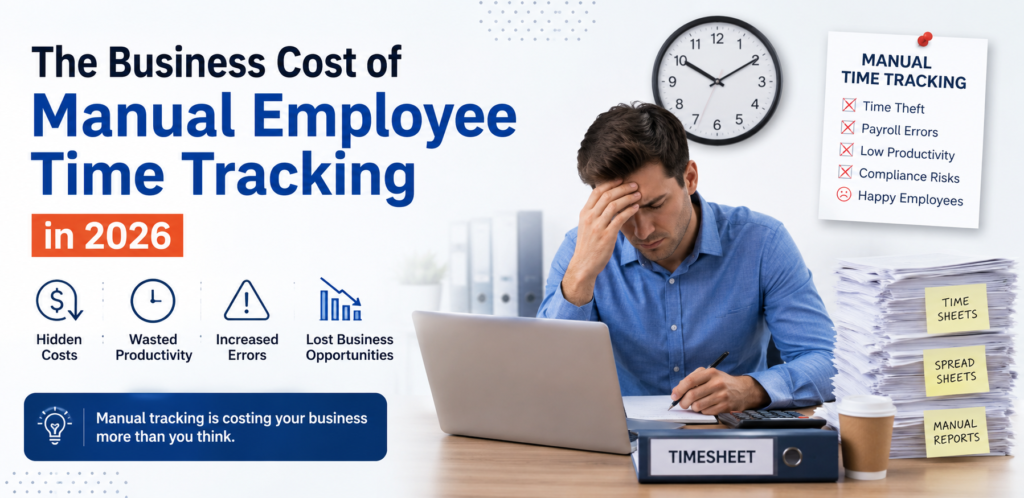
Why Manual Tracking Costs Millions vs Employee Time Tracking Software
Deploying automated employee time tracking software has transformed from a simple IT upgrade into a critical financial safeguard necessary to protect corporate profit margins. In the highly competitive corporate landscape of 2026, operational efficiency is no longer just a metric for success—it is a baseline requirement for business survival. As organizations navigate the complexities of artificial intelligence integration, economic shifts, and distributed teams, maximizing every single working hour has become paramount. Yet, thousands of small-to-midsize businesses (SMBs) and large enterprise organizations continue to bleed capital through a surprisingly archaic administrative vulnerability: manual time logging.
This comprehensive article details how relying on paper timesheets, manual stopwatches, and retroactive spreadsheet entries silently drains company revenue. By analyzing modern workflow complexities, the piece exposes the true, multifaceted financial burdens that manual tracking imposes on contemporary businesses.
1. The Revenue Drain of Lost Billable Hours
The primary financial leak affecting modern service-based organizations stems from unrecorded billable hours. Industry research indicates that businesses regularly lose 15% to 20% of their billable baseline purely due to human error and retroactive guessing at the end of a work week.
When employees are forced to manually reconstruct their schedules on Friday afternoons, short client consultation calls, rapid task-switching, and minor project adjustments are entirely forgotten. These minor daily omissions, which seem insignificant in isolation, compound into tens of thousands of dollars in lost billing opportunities annually. Implementing a background-running employee time tracking software ensures that every second of active work is automatically captured with 100% accuracy, directly converting lost time back into real corporate revenue.
2. Hidden Productivity Leaks and Context Switching
Beyond missing hours, manual tracking completely fails to capture how time is actually utilized within a digital workspace. The destructive phenomenon of “hidden productivity leaks,” such as bloated internal meetings, administrative overhead, and constant context switching, quietly destroys daily output. Without real-time data transparency, management remains completely blind to these deep efficiency bottlenecks.
Implementing automated employee time tracking software serves as a vital diagnostic tool to solve this issue. By categorizing application and website usage based on individual job roles, managers gain deep workforce analytics. This data-driven visibility empowers leadership to expose, address, and eliminate up to 30% of daily operational waste, shifting the team’s focus back onto high-value, revenue-generating tasks.
3. Fragmented Silos in the Hybrid Workplace
Managing a modern, distributed workforce in 2026 presents a unique logistical challenge for operations managers. Fragmented data silos emerge quickly when field staff, remote workers, and office personnel utilize entirely separate tracking mechanisms. Relying on manual field reports leads to guesswork, administrative delays, and a complete lack of real-time visibility for stakeholders.
Organizations require a unified employee time tracking software capable of bridging the gap between distinct operational environments. By connecting office biometric systems with geofenced mobile GPS tracking inside a single dashboard, companies can seamlessly monitor desk workers and on-the-ground field teams simultaneously, completely eliminating fragmented operational data silos.
4. Project Budget Overruns and Invoice Disputes
Inaccurate time data carries severe downstream consequences for client relations and brand reputation. Flawed initial tracking leads to highly inaccurate project cost estimations, forcing 2026 businesses to suffer severe budget overruns that quietly erode client trust. When a budget uses up to 138% of its estimated allocation due to unmonitored hours, profitability plummets.
Furthermore, the lack of verifiable, automated proof leaves organizations highly vulnerable to protracted billing disputes that delay critical invoice payments. Secure accountability options via comprehensive employee time tracking software—which tracks specific file paths and offers privacy-first screenshot intervals—mitigate these issues instantly by providing clients with indisputable, professional evidence of work performed.
Conclusion & Editorial Takeaway
This analysis proves that continuing with manual systems is a risk modern companies cannot afford. This guide is explicitly tailored for Chief Financial Officers (CFOs), HR Directors, Operations Managers, and agency owners operating in highly competitive service, manufacturing, or software development sectors. Readers will leave with a clear, mathematical understanding of the immediate financial return on investment (ROI) that modern, background-running automation provides over manual alternatives. Ultimately, investing in an automated platform frames employee time tracking software not as an intrusive monitoring tool, but as an essential asset to optimize human resources, secure sensitive company data, and scale business profitability in 2026.