Introduction
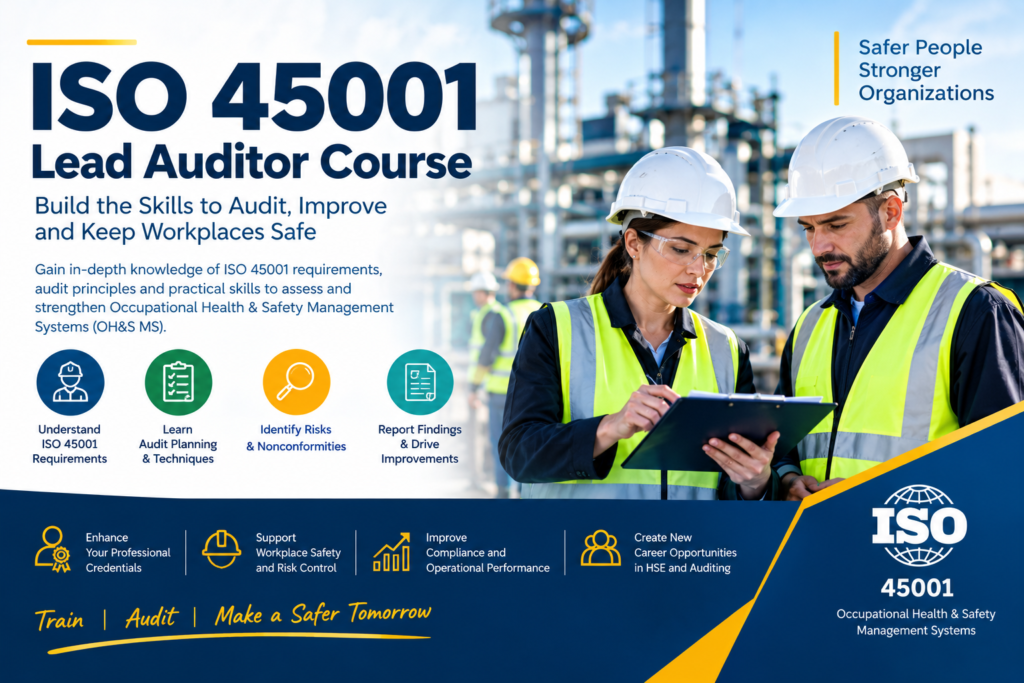
Workplace health and safety is a major priority for organizations across industries. Businesses must identify workplace hazards, control risks, and protect employees from occupational injuries and illnesses. The ISO 45001 Lead Auditor Course helps professionals develop the knowledge and skills required to audit Occupational Health and Safety Management Systems (OH&S MS) effectively.
ISO 45001 is an international standard that provides a framework for managing occupational health and safety risks. This course explains the standard’s requirements and teaches participants how to plan, conduct, report, and follow up on audits. It is suitable for professionals who want to strengthen their auditing abilities and support safer working environments.
What Is an ISO 45001 Lead Auditor Course?
An ISO 45001 Lead Auditor Course provides detailed training on auditing an occupational health and safety management system against the requirements of ISO 45001. Participants learn how to evaluate whether an organization’s safety management processes are properly implemented, maintained, and effective.
The course generally covers audit principles, risk-based auditing, audit planning, evidence collection, interviews, reporting, and corrective actions. Many programs also include practical exercises, case studies, and assessments to help learners apply their knowledge in real workplace situations.
Completing the course can support professional development in occupational health and safety, auditing, and compliance. However, certification requirements and recognition depend on the training provider and the relevant certification scheme.
Who Should Attend This Course?
The ISO 45001 Lead Auditor Course is useful for professionals responsible for workplace safety, risk management, and management system auditing. It is particularly suitable for:
- Health and safety managers and HSE professionals.
- Internal auditors and compliance officers.
- Occupational health and safety consultants.
- Quality and environmental management professionals.
- Safety supervisors and department managers.
- Risk management specialists.
- Professionals planning to become lead auditors.
The training can benefit people working in construction, manufacturing, oil and gas, mining, logistics, healthcare, engineering, and other industries where workplace safety is essential.
Key Benefits of ISO 45001 Lead Auditor Training
Develop Professional Auditing Skills
The course helps participants understand how to prepare audit plans, conduct opening and closing meetings, interview employees, review documentation, and collect objective evidence. These skills are important for carrying out systematic and effective audits.
Improve Workplace Safety
Auditors help organizations identify gaps in their occupational health and safety management systems. By recognizing weaknesses and reporting nonconformities, they can support improvements in hazard identification, risk control, and safety procedures.
Strengthen Compliance
ISO 45001 lead auditor course explains how to assess an organization’s processes against applicable management system requirements. This knowledge helps professionals evaluate documented procedures, monitor corrective actions, and support continual improvement.
Expand Career Opportunities
Professionals with relevant auditing knowledge may pursue roles in HSE management, internal auditing, compliance, consulting, and management system auditing. Practical experience and recognized qualifications can further strengthen career prospects.
What Topics Are Covered in the Course?
A comprehensive ISO 45001 Lead Auditor Course commonly covers the following topics:
- Overview and requirements of ISO 45001.
- Occupational health and safety management principles.
- Hazard identification and risk assessment.
- Legal and other compliance obligations.
- Audit principles and risk-based audit planning.
- Audit checklists, interviews, and evidence collection.
- Identification and reporting of nonconformities.
- Corrective actions and audit follow-up.
- Audit reporting and closing meetings.
- Continual improvement of the OH&S management system.
These topics prepare participants to assess management system performance in a structured and professional manner.
How to Choose the Right Training Provider
Before enrolling, review the course syllabus, trainer qualifications, practical activities, examination requirements, and certificate recognition. Check whether the program aligns with ISO 45001 and recognized auditing guidance, such as ISO 19011 where applicable.
Choose a provider that offers clear explanations, realistic audit exercises, and guidance on handling nonconformities. Comparing course duration, delivery methods, and fees can also help you select training that matches your professional goals.
Conclusion
The ISO 45001 Lead Auditor Course is a valuable learning opportunity for professionals who want to develop auditing expertise and contribute to better workplace health and safety. It provides practical knowledge of audit planning, evidence collection, risk assessment, reporting, and corrective actions. By applying these skills, trained professionals can help organizations strengthen their safety management systems, improve compliance, and promote a safer working environment.