Market Overview
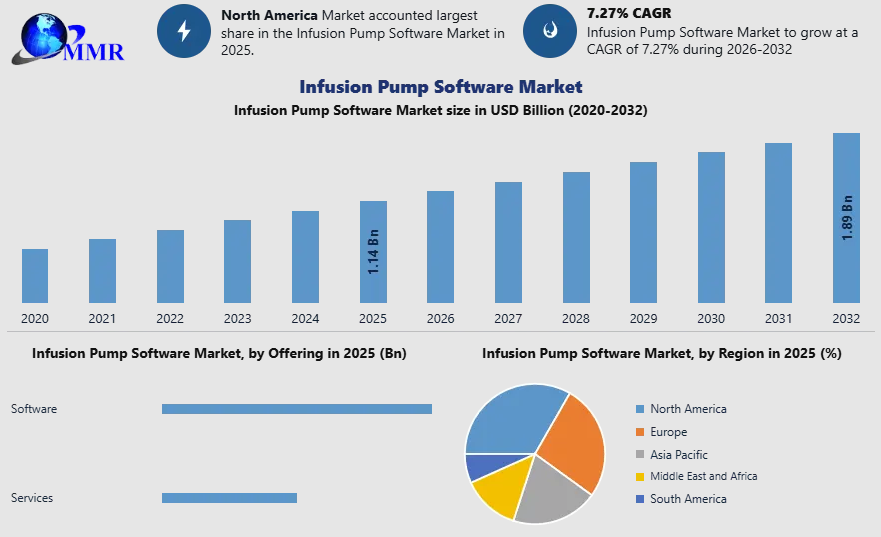
The Infusion Pump Software Market was valued at approximately USD 1.14 billion in 2025 and is expected to reach nearly USD 1.89 billion by 2032, registering a CAGR of 7.27% during the forecast period from 2026 to 2032. The market is experiencing steady expansion as healthcare providers increasingly adopt software-enabled infusion systems designed to improve medication accuracy, patient safety, clinical workflow efficiency, and connectivity across healthcare environments.
Request Sample Link for More Details: https://www.maximizemarketresearch.com/request-sample/164151/
Infusion pump software is an essential component of modern infusion systems used to administer medications, nutrients, fluids, insulin, chemotherapy drugs, analgesics, and other therapies at controlled and programmable rates. Modern software platforms can manage pumping parameters, drug libraries, dose limits, alarm functions, user interfaces, clinical workflows, and data exchange with hospital information systems.
The growing adoption of smart infusion pumps is transforming traditional infusion practices. Healthcare organizations are increasingly moving toward systems that combine infusion hardware with dose error reduction software (DERS), interoperability capabilities, analytics, and electronic medical record connectivity. These developments are supporting more standardized medication administration while reducing reliance on manual programming.
The market is also benefiting from increasing healthcare expenditure, expansion of hospital infrastructure, rising chronic disease prevalence, and growing demand for technology-enabled medication management. In addition, the movement of certain infusion therapies from hospitals toward ambulatory and home-care environments is creating opportunities for software developers to design more flexible and remotely manageable infusion platforms.
Market Drivers and Trends
Growing Demand for Advanced Infusion Pump Software
The increasing adoption of smart infusion pumps is one of the major factors supporting the growth of the infusion pump software market. Healthcare providers are placing greater emphasis on medication safety and accurate intravenous drug administration. Software-enabled pumps can incorporate drug libraries, hard and soft dose limits, clinical alerts, and standardized programming protocols.
Request Sample Link for More Details: https://www.maximizemarketresearch.com/request-sample/164151/
Dose Error Reduction Software has become particularly important because it can help healthcare professionals identify potentially unsafe infusion settings before medication administration. Hospitals are increasingly integrating these capabilities into medication safety programs, particularly in intensive care, oncology, anesthesia, pediatrics, and other high-acuity settings.
Continuous development of software engineering, verification methods, simulation technologies, and model-based development is also supporting innovation. Manufacturers and technology providers are investing in testing and validation processes designed to improve software reliability and usability.
Increasing Prevalence of Chronic Diseases
The rising prevalence of chronic diseases is another important growth factor. Conditions such as cancer, diabetes, neurological disorders, and other long-term diseases often require repeated or continuous medication administration.
Infusion pumps allow healthcare professionals to administer medications and fluids at precisely programmed rates, making them valuable in chemotherapy, insulin therapy, pain management, critical care, and other applications. As the number of patients requiring long-term treatment increases, demand for reliable infusion systems and associated software is expected to rise.
The aging population is also contributing to demand for chronic disease management and long-term care services. This trend is encouraging healthcare organizations to explore infusion technologies that can support treatment outside conventional hospital environments.
Rising Demand for Ambulatory and Home Infusion
The shift toward ambulatory and home-based healthcare is creating additional opportunities for the infusion pump software market. Ambulatory infusion pumps can support chemotherapy, pain management, total parenteral nutrition, and other therapies while allowing patients to receive treatment outside traditional inpatient settings.
Healthcare providers are increasingly exploring site-of-care models that can reduce hospital utilization and provide greater flexibility for patients. This transition is encouraging manufacturers to develop software that supports portable pumps, remote monitoring, simplified interfaces, connectivity, and data management.
Increasing Interoperability and Connected Healthcare
Interoperability is emerging as an important trend in infusion pump software. Integration with EMR and EHR systems can enable infusion information to move between connected clinical systems, helping reduce manual data entry and improving documentation.
Connected infusion platforms can also support centralized drug library management, device fleet monitoring, analytics, maintenance management, and enterprise-wide standardization. As hospitals modernize their digital infrastructure, demand for interoperable infusion software is expected to increase.
Primary Market Constraints
Stringent Regulatory Requirements
Stringent regulatory requirements represent a major challenge for infusion pump software manufacturers. Because infusion systems directly influence medication administration, software development, validation, cybersecurity, usability, and quality assurance must comply with extensive regulatory and safety requirements.
The lengthy development and approval process can increase costs and delay commercialization of new software-enabled infusion technologies. Manufacturers must also continuously update their products to address identified software vulnerabilities, usability concerns, safety issues, and changing regulatory expectations.
Product Recalls and Software-Related Safety Concerns
Software errors, programming issues, alarm-related problems, and manufacturing defects can negatively affect the adoption of infusion technologies. Historical product recalls involving infusion pumps and drug-library systems have highlighted the importance of comprehensive software validation and quality control.
The complexity of modern infusion pump interfaces can also create usability challenges. Incorrect programming or incomplete configuration may increase the risk of medication administration errors. As a result, manufacturers are increasingly focusing on human-centered design, usability testing, verification, and continuous software improvement.
Market Opportunity
Increasing R&D for Home Infusion Systems
The growing cost of hospital-based care and the increasing number of patients requiring long-term therapies are creating opportunities for home infusion software. Manufacturers are investing in technologies that can support portable infusion devices, remote monitoring, connectivity, and simplified patient interfaces.
The expansion of home healthcare, specialty infusion centers, and ambulatory treatment models is expected to create new demand for software capable of managing infusion data across multiple care environments.
The market also presents opportunities through cloud-based deployment, analytics, cybersecurity, artificial intelligence-supported monitoring, and interoperability with healthcare information systems. These technologies can help healthcare organizations manage larger fleets of connected infusion devices while improving visibility into performance and medication administration.
Key Market Segments
By Software Type
Based on software type, the market is segmented into Dose Error Reduction Software, Clinical Workflow Software, Interoperability Software, Tracking and Billing Software, Analytics and Continuous Quality Improvement Software, and Closed-Loop Control Software.
Among these, Dose Error Reduction Software is expected to account for a significant share of market revenue. Its adoption is supported by the growing emphasis on medication safety, drug-library compliance, standardized dosing, and reduction of programming variability. DERS capabilities are particularly relevant in hospitals and high-acuity departments where precise medication administration is essential.
By Delivery Method
The market is divided into Wired and Wireless delivery methods. Wireless technologies are gaining attention as healthcare providers increasingly seek connected medical device ecosystems, centralized management, and flexible device deployment.
By Integration
Based on integration, the market includes Standalone, EMR Integrated, EHR Integrated, Pharmacy Information System Integrated, Alarm Notification Platform Integrated, and Asset Tracking System Integrated solutions.
Integrated solutions are becoming increasingly important as healthcare facilities pursue digital transformation and seek to connect infusion pumps with broader clinical information systems.
By Deployment Mode
The market is segmented into On-Premise, Cloud-Based, and Hybrid deployment models. Cloud-based and hybrid solutions are gaining interest because of their potential to support centralized administration, remote updates, analytics, and multi-site device management.
By Application
Applications include Pain and Anesthesia Management, General Infusion, Insulin Infusion, Chemotherapy, Enteral Infusion, Critical Care Infusion, Neonatal and Pediatric Infusion, Ambulatory Infusion, and Others.
Pain and anesthesia management represented a major application area in 2025, supported by the need for accurate and controlled medication administration in surgical, perioperative, postoperative, and critical-care environments. Chemotherapy and insulin infusion also remain important application areas because of the need for controlled and continuous drug delivery.
By End User
The market is segmented into Hospitals, Clinics, Ambulatory Surgical Centers, Home Care Settings, Specialty Infusion Centers, and Others. Hospitals represent a major end-user category due to their extensive use of infusion pumps across critical care, oncology, surgery, emergency care, and general inpatient departments.
Request Sample Link for More Details: https://www.maximizemarketresearch.com/request-sample/164151/
Regional Analysis
North America dominated the Infusion Pump Software Market in 2025 and is expected to maintain a significant position throughout the forecast period. The region benefits from extensive adoption of smart infusion pumps, advanced hospital infrastructure, strong healthcare IT integration, and increasing emphasis on medication safety.
The United States represents a major contributor to regional demand. Healthcare organizations are increasingly investing in connected infusion platforms, electronic medical record integration, drug-library standardization, and centralized device management. The presence of established medical technology companies and continuous product development further supports regional market activity.
Europe is also expected to experience continued growth, supported by healthcare digitization, medication safety initiatives, and adoption of connected medical devices. Meanwhile, Asia Pacific is anticipated to offer significant opportunities due to expanding healthcare infrastructure, increasing healthcare expenditure, rising patient populations, and growing adoption of advanced medical technologies in countries such as China, Japan, India, and South Korea.
Major Industry Players
The competitive landscape includes established pharmaceutical, medical technology, and healthcare technology companies. Major players identified in the market landscape include Baxter International Inc., Baxter, Fresenius Kabi, ICU Medical, Inc., B. Braun, and other healthcare technology providers involved in infusion systems, software, drug libraries, interoperability, and medication safety solutions.
The broader competitive environment is characterized by product development, regulatory clearances, software upgrades, strategic collaborations, interoperability enhancements, and expansion of connected infusion platforms.
Recent industry developments include Baxter’s FDA 510(k) clearance for its Novum IQ Large Volume Infusion Pump with Dose IQ Safety Software in April 2024. Fresenius Kabi also continued updates to its Agilia Partner software environment, while ICU Medical received FDA 510(k) clearances in May 2025 for Plum Solo, updated Plum Duo, and updated LifeShield infusion safety software as part of its IV Performance Platform.
These developments demonstrate the industry’s continued focus on integrating hardware and software to improve medication safety, workflow efficiency, connectivity, and scalability.
Frequently Asked Questions
What is the size of the Infusion Pump Software Market in 2025?
The Infusion Pump Software Market was valued at approximately USD 1.14 billion in 2025.
What is the expected market size by 2032?
The market is expected to reach nearly USD 1.89 billion by 2032.
What is the expected CAGR of the Infusion Pump Software Market?
The market is projected to expand at a CAGR of 7.27% from 2026 to 2032.
Which software type is expected to hold a significant market position?
Dose Error Reduction Software is expected to remain a major software type because of increasing emphasis on medication safety, drug-library management, and controlled infusion programming.
Conclusion
The Infusion Pump Software Market is entering a period of continued technological development as healthcare providers increasingly prioritize medication safety, interoperability, automation, and efficient clinical workflows. With the market projected to increase from USD 1.14 billion in 2025 to nearly USD 1.89 billion by 2032, software is becoming an increasingly important component of modern infusion systems.
Connect With Us:
MAXIMIZE MARKET RESEARCH PVT. LTD.
2nd Floor, Navale IT park Phase 3,
Pune Banglore Highway, Narhe
Pune, Maharashtra 411041, India.
+91 9607365656
sales@maximizemarketresearch.com
About Maximize Market Research:
Maximize Market Research is one of the fastest-growing market research and business consulting firms serving clients globally. Our revenue impact and focused growth-driven research initiatives make us a proud partner of majority of the Fortune 500 companies. We have a diversified portfolio and serve a variety of industries such as IT & telecom, chemical, food & beverage, aerospace & defense, healthcare and others.