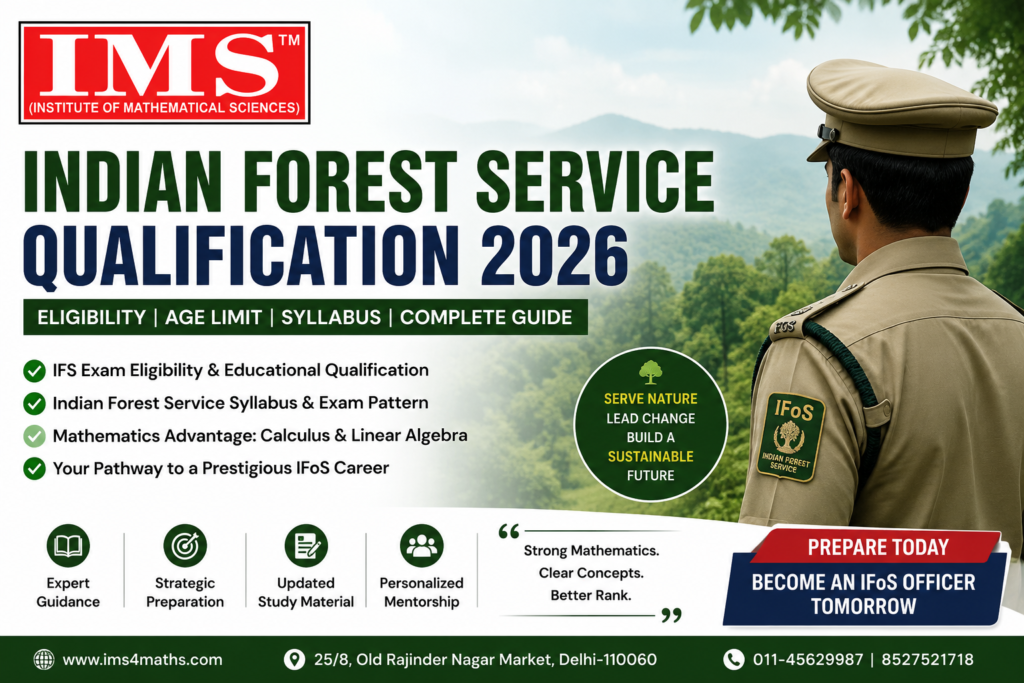
indian forest service syllabus
The Indian Forest Service (IFoS), commonly known as IFS, is one of India’s three All India Services, alongside the IAS and IPS. Officers selected through this exam go on to manage the country’s forests, wildlife, and environmental policy at the field and district level. But before an aspirant even thinks about strategy or study material, there’s one question that decides everything: am I even eligible to sit for this exam?
This guide breaks down the complete IFS exam eligibility criteria for 2026 – nationality, age limit, educational qualification, number of attempts, and physical standards – so you know exactly where you stand before you begin preparation.
1. Nationality Requirements
To appear for the Indian Forest Service Exam, a candidate must be one of the following:
- A citizen of India, or
- A subject of Nepal or Bhutan, or
- A Tibetan refugee who came to India before January 1, 1962, with the intention of settling permanently in India, or
- A person of Indian origin who has migrated from Pakistan, Burma, Sri Lanka, or East African countries such as Kenya, Uganda, or Tanzania, with the intention of settling permanently in India
Candidates who are not Indian citizens by birth must produce a certificate of eligibility issued by the Government of India.
2. Age Limit for IFoS 2026
Candidates must be between 21 and 32 years of age as on August 1, 2026 – meaning you must be born no earlier than August 2, 1994, and no later than August 1, 2005.
Age relaxation by category:
| Category | Upper Age Limit |
| General / EWS | 32 years |
| OBC | 35 years |
| SC / ST | 37 years |
| PwBD (General/EWS/OBC) | 42 years |
| PwBD (SC/ST) | 44 years |
3. Educational Qualification — The Most Important Filter
This is where IFoS eligibility genuinely differs from the regular UPSC Civil Services Examination (CSE). A candidate must hold a Bachelor’s degree that includes at least one of the following subjects:
- Animal Husbandry & Veterinary Science
- Botany
- Chemistry
- Geology
- Mathematics
- Physics
- Statistics
- Zoology
Or, a Bachelor’s degree in Agriculture, Forestry, or Engineering from a recognized university also qualifies.
This is a crucial point many aspirants miss: unlike the general UPSC Civil Services exam, where a graduate of any discipline can apply, IFoS has a science/technical background requirement built into eligibility itself.
Why This Matters for Mathematics Graduates
If you graduated with Mathematics as one of your subjects, you’re not just eligible for IFoS – you’re sitting on a strategic advantage. Mathematics as an Optional subject in UPSC Civil Services is scoring, has a defined syllabus, and rewards preparation over guesswork, unlike subjective humanities-based optionals. Concepts like calculus and linear algebra, which form the backbone of a Mathematics graduate’s coursework, carry direct weightage in the Mathematics Optional paper for Mains – meaning your degree isn’t just a qualification checkbox, it’s a head start on your Mains preparation too.
4. Number of Attempts
Since the IFoS Preliminary exam is common with the UPSC Civil Services (CSE) Prelims, the attempt limits mirror those of the CSE:
| Category | Number of Attempts |
| General / EWS | 6 |
| OBC | 9 |
| SC / ST | Unlimited (within age limit) |
| PwBD (Gen/EWS/OBC) | 9 |
| PwBD (SC/ST) | Unlimited |
5. Physical Standards
Because IFoS officers work extensively in field and forest conditions, candidates must also meet prescribed physical fitness standards, including minimum height, chest measurement (with expansion), and vision standards, as specified in the official notification. These are assessed at a later stage, typically after the interview/personality test, before final appointment.
How the Exam Is Structured
The IFoS selection process follows three stages:
- Preliminary Examination — shared with UPSC CSE Prelims (General Studies + CSAT)
- Main Examination — includes General English, General Knowledge, and two optional subjects chosen from the prescribed Indian Forest Service syllabus, each with two papers
- Interview / Personality Test
Mathematics is among the most consistently high-scoring optional choices at this stage, particularly for candidates who already have a strong undergraduate foundation in the subject.
Frequently Asked Questions
Q1. Can an engineering graduate apply for IFoS?
Yes. A Bachelor’s degree in Engineering from a recognized university is a directly qualifying degree for IFoS, regardless of the specific engineering branch.
Q2. Is Mathematics compulsory for IFoS eligibility?
No, Mathematics is one of several qualifying subjects (along with Botany, Chemistry, Zoology, Statistics, etc.), not a mandatory requirement. However, having Mathematics as a background subject is a strong advantage if you plan to choose it as your Optional in the Mains exam.
Q3. What is the minimum age to apply for IFoS?
21 years, as on August 1 of the examination year.
Q4. How is IFoS different from UPSC Civil Services (IAS) eligibility?
The core difference is educational qualification – UPSC Civil Services (CSE) accepts graduates from any discipline, while IFoS restricts eligibility to specific science, agriculture, forestry, or engineering backgrounds.
Final Word
Understanding your qualification status is step one – the real work begins with building a strong strategy for your optional subject. If you have a Mathematics background and are weighing it as your Optional for the Mains exam, structured guidance on the complete Mathematics Optional syllabus, including core areas like calculus and linear algebra, can make the difference between an average and a top-scoring attempt.
IMS – Institute of Mathematical Sciences has been guiding UPSC IAS and IFoS aspirants through Mathematics Optional preparation with structured classroom and online programs, personal mentoring, and consistent answer-writing practice. Explore our Mathematics Optional courses →