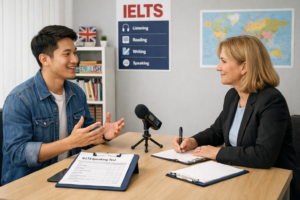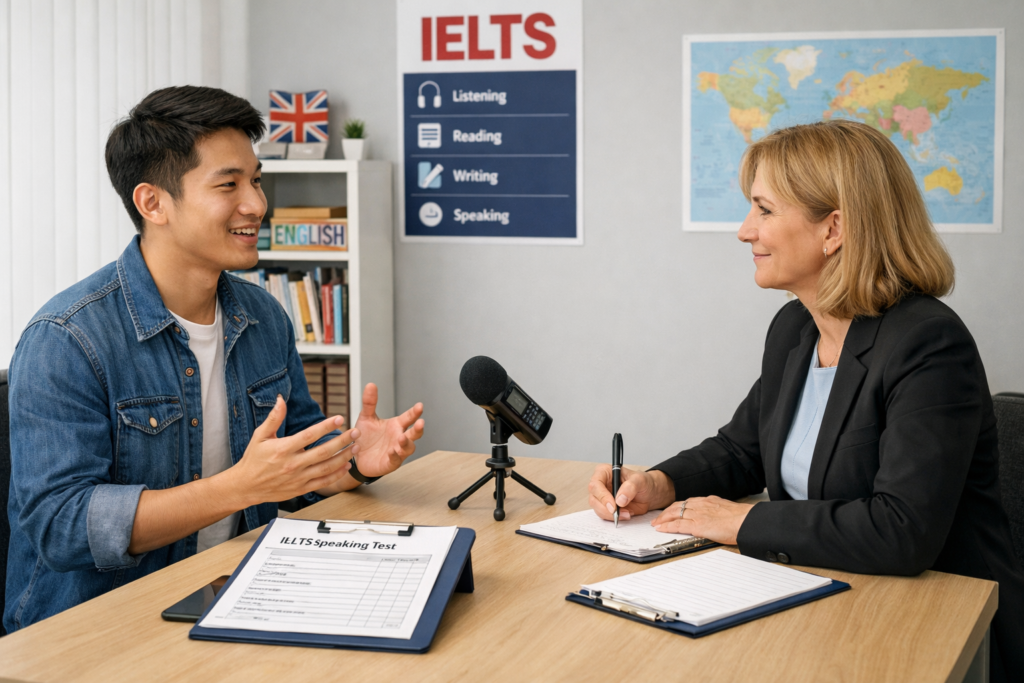
The IELTS Speaking test checks how clearly and naturally a person can communicate in English. Many students focus only on practice questions, but understanding the scoring system is also important. IELTS examiners use official band descriptors speaking criteria to give scores from Band 0 to Band 9.
These descriptors help examiners measure speaking ability fairly. The speaking test is not only about correct grammar. It also checks fluency, vocabulary, pronunciation, and how well ideas are explained.
The IELTS Speaking test is divided into three parts. The total test time is around 11 to 14 minutes. During the test, the examiner listens carefully and gives scores based on official band descriptors speaking standards.
The four main scoring areas are Fluency and Coherence, Lexical Resource, Grammatical Range and Accuracy, and Pronunciation.
Fluency and Coherence
Fluency means speaking smoothly without too many pauses. Coherence means organizing ideas clearly so the listener can understand the conversation easily.
In the IELTS Speaking test, examiners check whether the speaker can continue talking naturally. A candidate with a high band score usually speaks confidently and connects ideas properly.
For example, a Band 6 speaker may pause sometimes to think about vocabulary or grammar. A Band 7 speaker usually speaks more naturally with fewer pauses. Band 8 and Band 9 speakers can discuss topics smoothly with strong idea connection.
According to official band descriptors speaking criteria, candidates should avoid very short answers. They should explain opinions with reasons and examples. Simple linking words such as “because,” “however,” “for example,” and “also” can help improve coherence.
Many students lose marks because they memorize answers. Examiners can often identify memorized responses easily. Natural communication is always better than prepared sentences.
Lexical Resource
Lexical Resource means vocabulary use. IELTS examiners check how well a person can use words to express ideas clearly.
A good vocabulary score does not mean using very difficult words all the time. Instead, candidates should use suitable words naturally and correctly.
In official band descriptors speaking guidelines, higher band scores require a wider range of vocabulary. Candidates should also show the ability to talk about different topics such as education, technology, travel, health, and environment.
Band 5 candidates may repeat the same words many times. Band 6 candidates usually have enough vocabulary for familiar topics. Band 7 and above often use less common vocabulary with better flexibility.
Pronunciation of vocabulary also matters. If a speaker uses advanced words incorrectly, communication may become unclear.
Learning topic-based vocabulary can help improve speaking performance. Reading articles, listening to podcasts, and watching English interviews are useful ways to build vocabulary naturally.
Grammatical Range and Accuracy
Grammar is another important part of the IELTS Speaking score. Examiners check sentence structure, tense use, and accuracy.
The official band descriptors speaking criteria explain that higher band scores require a mix of sentence types. Candidates should use both simple and complex sentences during the conversation.
Band 5 speakers often make frequent grammar mistakes. Band 6 speakers can usually communicate clearly even with some errors. Band 7 and Band 8 speakers use grammar more accurately and flexibly.
Grammar mistakes are acceptable if communication remains clear. IELTS examiners understand that speaking is different from writing. Small mistakes may not reduce the score heavily if ideas are understandable.
Useful grammar areas for IELTS Speaking include:
- Past, present, and future tenses
- Conditional sentences
- Comparative structures
- Passive voice
- Complex sentence connectors
Practicing grammar in real speaking situations is more effective than memorizing rules only.
Pronunciation
Pronunciation measures how clearly a person speaks English. It does not mean copying a British or American accent perfectly.
IELTS accepts many English accents if speech is understandable. Examiners focus on clarity, stress, rhythm, and intonation.
The official band descriptors speaking scoring system explains that high-band candidates are usually easy to understand throughout the test.
Band 5 speakers may sometimes be difficult to understand because of pronunciation problems. Band 6 speakers are generally understandable even with some mistakes. Higher-band speakers use stress and intonation more naturally.
Common pronunciation areas include:
- Word stress
- Sentence stress
- Intonation patterns
- Clear vowel sounds
- Correct ending sounds
Listening to native and fluent English speakers can improve pronunciation over time. Recording practice answers is also useful because students can notice unclear sounds.
How Band Scores Are Calculated
Each of the four categories receives a score from Band 0 to Band 9. The final speaking band score is the average of all four sections.
For example:
- Fluency and Coherence: 7
- Lexical Resource: 6
- Grammar: 6
- Pronunciation: 7
The average becomes 6.5.
Understanding band descriptors speaking standards helps candidates identify weak areas more clearly. Some students have good vocabulary but poor fluency. Others speak fluently but make grammar mistakes often.
Balanced preparation is important for improving the final score.
Common Mistakes in IELTS Speaking
Many students lose marks because they focus on memorization instead of communication.
Very short answers are another common problem. Examiners expect candidates to develop ideas properly.
Speaking too fast can also reduce clarity. Clear communication is more important than speed.
Some candidates avoid complex grammar because they fear mistakes. However, using only simple sentences may limit band scores according to official band descriptors speaking criteria.
Pronunciation problems often happen when students do not practice speaking aloud regularly.
Tips to Improve IELTS Speaking Score
Daily English speaking practice is one of the best improvement methods. Even short conversations can help fluency.
Reading English articles helps build vocabulary naturally. Watching interviews and discussions improves listening and pronunciation.
Candidates should practice answering common IELTS topics such as:
- Hometown
- Education
- Family
- Technology
- Environment
- Travel
- Work
Recording answers can help identify grammar and pronunciation problems.
Mock speaking tests are also useful because they improve confidence and time management.
Understanding official band descriptors speaking criteria can guide preparation more effectively. Students can focus on the exact areas examiners use for scoring instead of practicing randomly.