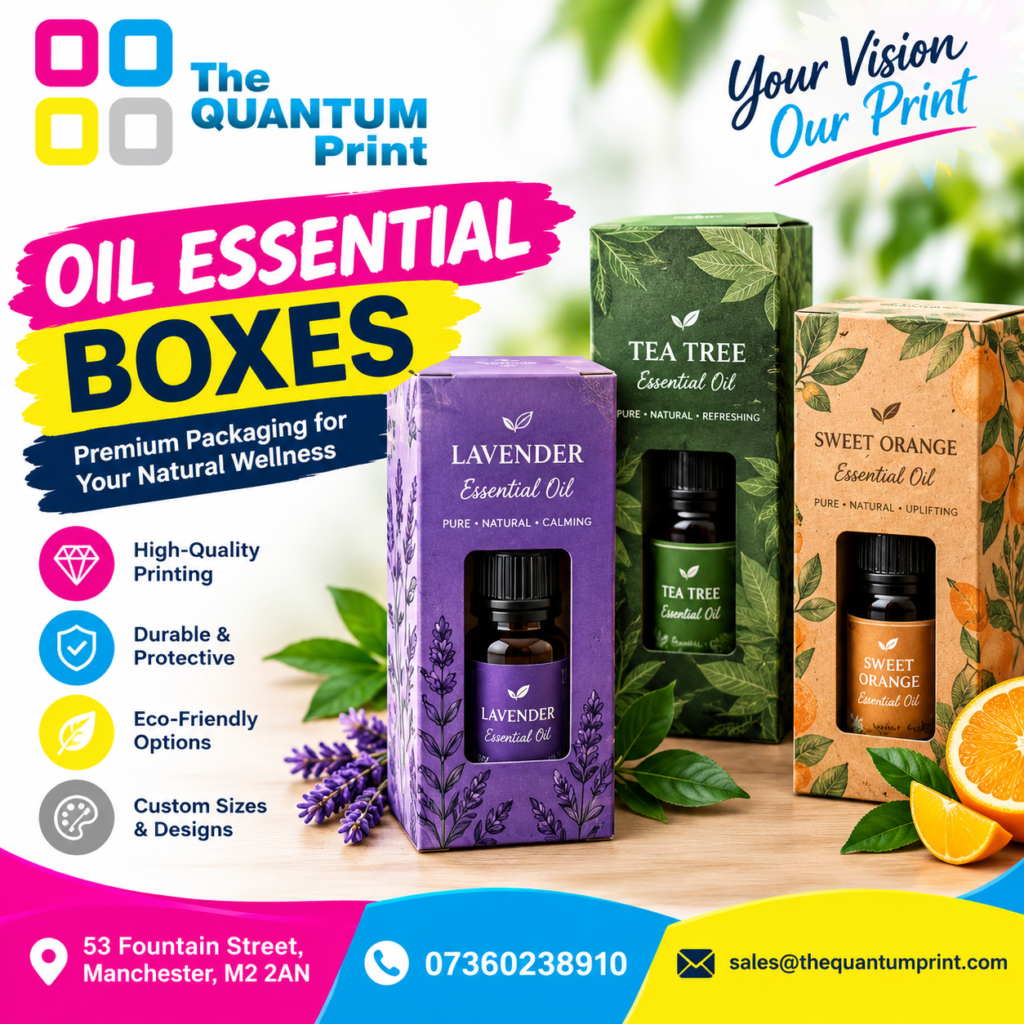
Small essential oil bottles require more than attractive presentation. Because many essential oils are sold in compact glass containers, packaging needs to provide suitable protection while giving customers clear information about the product. For manufacturers, retailers, and online businesses, the box is also an important part of the overall product experience.
Modern packaging has moved beyond simply containing an item. Customers increasingly notice materials, design, sustainability, usability, and the quality of printed information. This makes carefully planned oil essential boxes relevant to businesses operating in wellness, aromatherapy, skincare, personal care, and related retail markets.
What Makes Effective Essential Oil Packaging?
A good packaging solution begins with the product itself. Essential oil bottles can vary considerably in size, shape, closure type, and capacity. Packaging should therefore be developed around the actual dimensions of the bottle rather than relying on a generic box.

Well-planned oil essential boxes packaging can provide several functions at once:
- Protect the bottle during normal handling
- Reduce unnecessary movement inside the carton
- Present product information clearly
- Support consistent branding across a product range
- Make individual varieties easier to identify
- Provide an appropriate surface for printed graphics
- Improve the presentation of products in retail environments
The distribution method should also influence the packaging design. A box intended for a shop shelf may have different requirements from one used for direct-to-consumer delivery.
Material Selection and Product Protection
Material choice has a direct effect on packaging performance. Paperboard is commonly considered for retail cartons because it can be printed and folded into a range of useful structures. Where additional protection is required for transportation, businesses may combine a retail carton with an outer shipping package.
The thickness and construction of the packaging should correspond to the product’s weight and handling conditions. A lightweight bottle may not require the same construction as a heavier glass container, while products shipped individually may need additional protection against movement and impact.
Sustainability is another consideration. Many businesses are examining recyclable and paper-based materials, reducing excessive packaging, and choosing structures that use resources efficiently. However, reducing material should not compromise the fundamental purpose of packaging: protecting the product throughout its journey.
Testing is therefore valuable. A sample package can be filled, closed, stacked, handled, and transported under realistic conditions before a larger production run is approved.

The Importance of Oil Essential Boxes Printing
Packaging communicates information at the point of sale and after purchase. Effective oil essential boxes printing should make important details easy to locate and read, especially when the available surface area is relatively small.
Depending on the product and applicable requirements, printed packaging may include:
- Product name and variety
- Ingredients or relevant product information
- Directions for use
- Safety and cautionary information
- Manufacturer or distributor details
- Batch or traceability information
- Barcode and retail information
- Recycling symbols or disposal guidance
- Brand name and visual identity
Typography deserves particular attention. Very small text can make an otherwise attractive package difficult to use, while excessive decorative elements may compete with important information.
A consistent design system can also help brands manage several products. Different essential oils might use individual colours, illustrations, or identifiers while retaining the same basic layout and packaging structure.
Packaging Trends Across Wellness and Retail Products
The wider wellness and personal-care market has influenced how essential oil products are presented. Minimalist graphics, natural textures, botanical illustrations, restrained colour schemes, and paper-based aesthetics are frequently associated with products positioned around natural or lifestyle themes.
Another development is the growing importance of packaging consistency. Instead of designing every product independently, brands often create a recognisable visual system that can be extended across multiple sizes and varieties.
E-commerce creates another challenge. Customers may first encounter a product through a website or social media image rather than a physical retail shelf. The packaging therefore needs to translate effectively between digital presentation and physical experience.

At the same time, online orders must survive picking, packing, courier handling, and delivery. This means appearance and structural performance need to be considered together.
Common Packaging Problems and Practical Solutions
Businesses can encounter several avoidable problems when developing essential oil packaging boxes.
Poor Bottle Fit
A carton that is significantly larger than the bottle can allow excessive movement. Accurate measurements and suitable internal structures can help create a more secure fit.
Difficult-to-Read Information
Small packaging surfaces can encourage designers to reduce font sizes too aggressively. Prioritising information and establishing a clear hierarchy can improve readability.
Inconsistent Product Ranges
Different box designs can make a product collection appear disconnected. A shared template with controlled variations can provide stronger visual consistency.
Packaging That Is Not Tested
Digital artwork does not reveal every practical issue. Folding, assembly, bottle insertion, storage, and transportation should be considered before final production.
Working With a Packaging Specialist
Businesses developing custom packaging can benefit from discussing the complete product journey with an experienced packaging provider. Questions about dimensions, material, finishing, printing, quantities, storage, and distribution can be addressed before production begins.
The Quantum Print is one example of a UK packaging provider offering information around custom essential oil packaging boxes, which can be useful when researching different approaches to box construction and printed presentation.

The objective should not simply be to create an attractive package. Instead, businesses should seek an appropriate balance between product protection, information, manufacturing requirements, sustainability, and visual identity.
Final Considerations
Effective packaging connects several parts of the retail process. It protects the product, communicates useful information, supports brand recognition, and contributes to the customer’s first physical interaction with the item.
When planning oil essential boxes, businesses should start with bottle dimensions and distribution requirements before moving into artwork and finishing choices. Material performance, print readability, sustainability, and physical testing should then be considered together.
For brands selling essential oils through retail stores or online channels, this structured approach can reduce common packaging problems and create a more dependable product presentation. Good packaging is ultimately not about decoration alone — it is about making the complete journey from production to customer more practical and consistent.