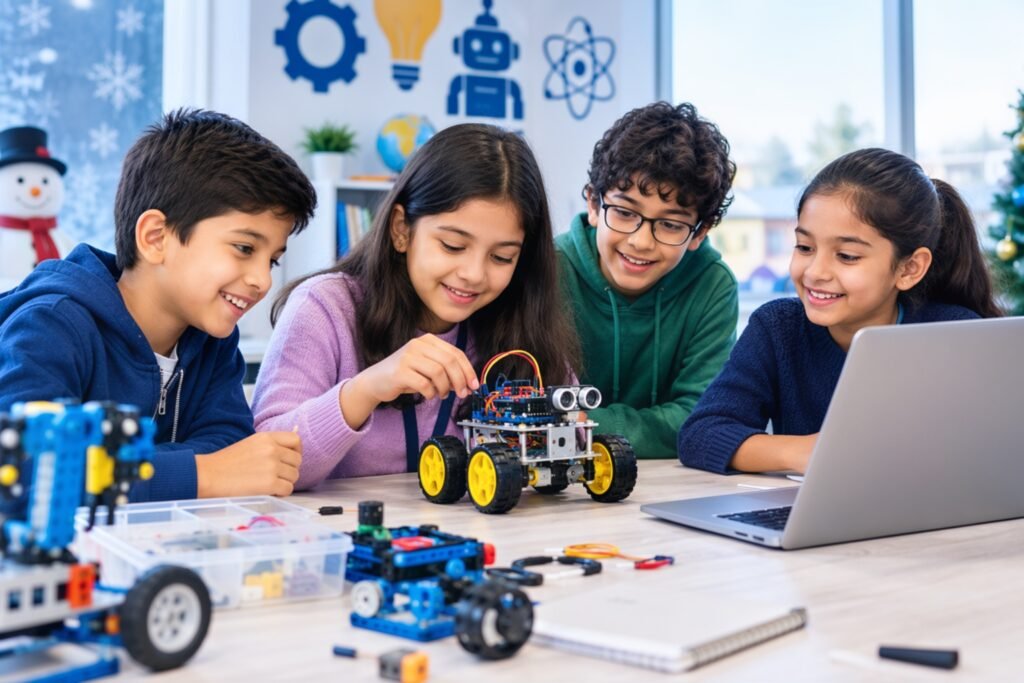
Choosing the right STEM program for your child can feel surprisingly difficult. Search online for STEM programs, and you’ll quickly find coding classes, robotics workshops, science clubs, engineering programs, summer camps, and technology courses all competing for your attention. So, how do you know which one is actually right for your child?
The answer starts with understanding what your child enjoys and how they learn best. STEM education for kids isn’t simply about teaching science, technology, engineering, or mathematics from a textbook. The best programs encourage children to experiment, ask questions, solve problems, build things, and discover how ideas work in the real world.
For parents in New Jersey, there are plenty of opportunities to introduce children to STEM at different ages and skill levels. However, not every program has the same curriculum, teaching style, project experience, or level of instructor support.
In this guide, we’ll walk through the important things you should consider when choosing a STEM program. We’ll also explain what to look for in stem classes for kids in new jersey, how to compare programs, and why Brainy n Bright is an option worth considering for families looking for STEM and robotics learning.
Why STEM Education for Kids Is Important
Children are naturally curious. They want to know why things happen, how machines work, and what happens when they change something. STEM education gives that curiosity a direction.
Instead of asking children to memorize every answer, STEM learning encourages them to investigate problems and find solutions. A child building a robot, designing a simple structure, or programming a game isn’t only learning technology. They’re also practicing patience, logic, creativity, and decision-making.
STEM Builds Problem-Solving Skills
Think about a child trying to make a robot move through an obstacle course. The robot doesn’t turn correctly. What happens next?
The child has to stop, think about the problem, check the code or construction, make a change, and test the robot again. That simple process teaches an important lesson: problems can be solved step by step.
This type of practical thinking can become useful in school, hobbies, and everyday situations.
STEM Encourages Creativity
STEM isn’t always about finding one correct answer. Many projects allow children to approach the same challenge in different ways.
A child may design a bridge differently from another student or create a completely different solution to a programming challenge. That freedom can help children understand that creativity and technology can work together.
What Should a Good STEM Program Offer?
Before enrolling your child, look beyond the program’s name. A course called “STEM for Kids” could involve very different activities depending on the provider.
Look for a program that combines instruction with experimentation and practical work. Children should have opportunities to use what they learn instead of simply listening to an instructor.
Hands-On Learning
Hands-on activities can make abstract concepts easier for children to understand. Building, programming, measuring, testing, and modifying projects can turn theoretical information into something tangible.
If you’re evaluating a stem class for kids, ask what students actually do during a typical session. The answer can tell you more than a promotional headline.
Project-Based Activities
Projects provide children with a reason to apply multiple skills at once. A robotics project, for example, may require programming, engineering, mathematics, design, and troubleshooting.
Project-based learning can also give children a sense of accomplishment. Instead of simply completing a worksheet, they can finish something they built themselves.
How to Identify Your Child’s STEM Interests
Not every child will be excited by the same STEM subject. That’s perfectly normal.
One child might spend hours building machines, while another prefers creating games or experimenting with computers. Before choosing a program, pay attention to what naturally captures your child’s attention.
Does Your Child Like Building Things?
If your child enjoys LEGO-style construction, mechanical toys, puzzles, or taking objects apart and putting them back together, robotics and engineering could be interesting starting points.
A robotics program can combine physical construction with coding, giving children both a creative and technical challenge.
Does Your Child Enjoy Computers and Games?
Children who love games may enjoy coding or game development. Instead of only playing games, they can begin understanding how characters move, how rules are created, and how interactive experiences are designed.
That transition from technology consumer to technology creator can be a powerful part of STEM learning.
How to Find STEM Classes for Kids Near Me
Parents often begin their search with the phrase stem classes for kids near me. That’s a practical starting point because location can affect attendance, especially for younger children.
However, proximity shouldn’t be the only deciding factor. A program that is five minutes away isn’t necessarily the right fit if the curriculum doesn’t match your child’s interests.
Compare Location and Learning Quality
When comparing nearby programs, consider travel time alongside curriculum quality, instructor support, class format, projects, and age suitability.
If your child is excited about the subject and receives meaningful instruction, they’re more likely to stay engaged and benefit from the experience.
Check the Class Schedule
A great program won’t be useful if the schedule constantly conflicts with school, sports, family activities, or other commitments.
Look for a schedule your family can realistically maintain. Consistency matters because children often develop stronger skills when they participate regularly.
Understanding STEM Classes for Kids in New Jersey
The phrase stem classes for kids in new jersey covers a wide range of educational experiences. Some programs focus on robotics, while others specialize in coding, science experiments, engineering, mathematics, or emerging technologies.
The right option depends on your child’s age, experience, interests, and learning goals.
Programs for Beginners
Beginners need a supportive introduction rather than an overwhelming curriculum. The early goal should be helping children understand basic concepts while developing confidence.
An effective beginner program can make children think, “I want to try that again,” rather than, “This is too difficult.”
Programs for Experienced Students
Children who already have coding or robotics experience may need more challenging projects. Advanced programs can introduce increasingly complex problems that require planning, debugging, testing, and independent thinking.
Ask whether the provider has a clear progression from beginner to advanced learning.
How to Evaluate an Affordable STEM Program
Cost is naturally an important consideration for families. Parents searching for affordable stem classes for kids in new jersey should compare what is included in the program rather than simply looking at the lowest price.
A cheaper course isn’t necessarily more affordable if it provides limited instruction or requires additional materials and fees.
Understand What the Fee Includes
Before enrolling, ask whether the cost includes learning materials, equipment, projects, instructor support, assessments, or other resources.
Understanding the complete cost helps you compare programs fairly and avoid unexpected expenses.
Consider the Overall Value
Value isn’t only about price. Think about what your child will learn, how much instructor interaction they receive, the quality of the curriculum, and whether they can complete meaningful projects.
A program that provides a strong learning experience can offer value beyond the initial enrollment fee.
What to Look for in STEM Summer Camps
Stem summer camps can be a fun way for children to explore technology and science during school breaks. Unlike regular weekly classes, camps often provide concentrated learning experiences with multiple activities.
A good STEM camp can combine education with teamwork, creativity, challenges, and hands-on projects.
Why Summer Camps Can Be Different
Summer camps can create more space for longer projects. Children may have time to design something, test it, discover problems, and improve it over several sessions.
That extended project experience can make STEM concepts feel more connected and meaningful.
Look Beyond the Word “STEM”
Not every camp using the STEM label will provide the same experience. Look at the actual daily activities.
Does the camp involve robotics? Coding? Engineering challenges? Science experiments? AI? Design? Ask for a sample schedule if one is available.
What Makes STEM Camps for Kids Engaging?
The best stem camps for kids should give children opportunities to participate rather than simply watch demonstrations.
Kids generally learn more actively when they can touch, build, test, collaborate, and make decisions. That’s why interactive activities can be such an important part of a STEM camp.
Teamwork and Collaboration
Many STEM challenges work particularly well when children collaborate. One student might focus on construction while another works on programming or testing.
Through this process, children can learn how to communicate ideas, listen to others, divide responsibilities, and work toward a shared goal.
Learning Through Challenges
Challenges can turn learning into a mission. Instead of simply saying, “Today we’re learning about programming,” an instructor might give students a practical problem to solve.
That small change in presentation can make a lesson much more exciting for children.
How to Choose a STEM Camp in NJ
If you’re specifically looking for a stem camp in nj, begin by deciding what you want your child to experience.
Some parents want general STEM exposure, while others are looking for a specific subject such as robotics, coding, AI, or engineering.
Check the Camp’s Age Range
Make sure the activities are appropriate for your child’s age. Younger children generally need simpler instructions and more guided activities, while older students may enjoy independent challenges.
Age-specific groups can also help instructors adjust the difficulty level.
Review the Daily Activities
Ask what children will actually do throughout the day. A strong schedule should have a reasonable balance between instruction, hands-on work, breaks, collaboration, and creative activities.
If most of the day involves passive screen time or lectures, it may not deliver the interactive STEM experience you’re expecting.
Planning for STEM Camp for Kids 2026
If you’re researching a stem camp for kids 2026, planning early can make the process easier. Popular programs can have limited spaces, and families often need to coordinate camp schedules with vacations and other summer activities.
Start by making a short list of programs that match your child’s interests. Then compare curriculum, dates, age groups, location, format, costs, and activities.
Create a Simple Comparison Checklist
You don’t need a complicated spreadsheet. Simply compare:
- Age suitability
- STEM subjects covered
- Hands-on projects
- Instructor support
- Class or group size
- Schedule
- Location or online format
- Materials included
- Total cost
- Learning outcomes
This makes it much easier to see which programs match your family’s needs.
Why Robotics Is an Important Part of STEM
Robotics can bring several STEM concepts together in one project. Children can build a physical object and then use programming to control it.
This creates a direct connection between an idea and its result. If the robot doesn’t behave as expected, students can investigate the reason and make adjustments.
Robotics Combines Multiple Skills
A robotics activity may involve mechanical design, programming logic, measurements, mathematics, electronics, creativity, and problem-solving.
That’s one reason robotics can be such an engaging introduction to STEM for children who enjoy making things work.
How Brainy n Bright Helps Kids Explore STEM
Brainy n Bright focuses on technology and STEM learning for children, with programs that can introduce learners to areas such as robotics, coding, artificial intelligence, and other technology-related subjects.
For families searching for a STEM training center in NJ, Brainy n Bright can be considered when comparing programs that aim to combine structured instruction with practical learning.
A Focus on STEM and Robotics
Brainy n Bright positions its learning experience around technology skills that children can apply through projects and activities.
Rather than treating technology as something children only consume, the goal is to encourage them to understand how it works and explore how they can create with it.
Learning Through Practical Projects
Projects can give children a chance to put concepts into action. Whether they’re working with robotics, programming, or another STEM topic, practical challenges can encourage students to think independently.
That can make the learning process more memorable because children aren’t simply hearing about an idea—they’re using it.
Why Parents Should Consider Instructor Support
Even the most interesting curriculum can become difficult if children don’t receive enough guidance.
A good instructor should be able to explain concepts clearly, answer questions, identify where a child is struggling, and encourage them to keep experimenting.
Ask How Teachers Handle Mistakes
Mistakes are inevitable in STEM. A program should treat them as part of the learning process rather than something embarrassing.
When children understand that debugging and experimentation are normal, they can become more comfortable tackling difficult problems.
Online vs. In-Person STEM Programs
Parents have more learning-format choices than ever. Depending on the program, children may be able to learn in a classroom, online, or through a combination of formats.
Each option has potential advantages.
Benefits of In-Person Learning
In-person classes can provide direct interaction with instructors and classmates. For hands-on robotics and engineering activities, physical access to equipment can also be useful.
Children can collaborate face-to-face and learn by observing how others approach a challenge.
Benefits of Online Learning
Online STEM programs can offer flexibility, especially for families managing busy schedules or transportation challenges.
The important thing is to make sure an online program still provides meaningful interaction, live guidance when appropriate, and project-based activities.
How to Know If Your Child Is Enjoying STEM
Grades aren’t the only indicator of a successful STEM experience. Pay attention to what your child says and does after class.
Do they talk about their project? Do they ask questions at home? Do they try to recreate something they learned? Do they want to show you what they built?
Those reactions can tell you whether the program is sparking genuine curiosity.
Look for Growing Confidence
A child doesn’t need to become an expert immediately. Progress can be as simple as becoming more willing to attempt a difficult challenge.
Over time, that confidence can encourage children to take on increasingly complex STEM projects.
Common Mistakes Parents Should Avoid
One common mistake is choosing a program only because it sounds advanced. Words like AI, robotics, coding, and engineering can sound impressive, but the program still needs to match your child’s abilities.
Another mistake is choosing entirely based on price or distance. Both factors matter, but they should be considered alongside curriculum quality and learning support.
Don’t Force a Subject Your Child Dislikes
STEM is a broad field. If your child doesn’t enjoy one subject, that doesn’t mean they dislike STEM altogether.
Try another area. A child who dislikes traditional coding might love robotics. Another child who isn’t interested in robotics may become fascinated by game development or AI.
How to Make STEM a Long-Term Learning Journey
STEM education works best when children have opportunities to keep building on previous knowledge.
A child might start with basic coding, explore robotics later, and eventually move toward AI or advanced programming. Each experience can become another building block.
Encourage Curiosity Outside Class
Parents can support STEM learning without turning home into another classroom. Ask your child to explain their project, encourage them to investigate questions, and celebrate their experiments.
Even a simple question such as “What do you think will happen if you change that?” can encourage scientific thinking.
Why Brainy n Bright Can Be a STEM Learning Option for NJ Families
Parents searching for a STEM training center in NJ often want a program where children can explore technology while developing practical skills.
Brainy n Bright offers STEM and robotics-focused learning opportunities for kids in New Jersey, covering areas such as coding, robotics, AI, and technology-based projects. Its focus on interactive learning can help children develop skills while exploring subjects that may shape their future interests.
For families comparing stem classes for kids in new jersey, the right choice ultimately depends on the child’s age, interests, schedule, and learning goals. Brainy n Bright can be included in that comparison for parents looking for a technology-focused STEM learning environment.
Final Checklist Before Enrolling Your Child
Before signing up, take a few minutes to ask yourself whether the program checks the important boxes.
Does it match your child’s age? Does your child actually like the subject? Are there hands-on projects? Are instructors available to help? Is the schedule practical? Is the total cost clear?
Most importantly, ask whether your child will leave the class with more curiosity than they had when they entered.
Conclusion
Choosing STEM programs for kids in New Jersey is about finding the right combination of curiosity, challenge, guidance, and practical learning. You don’t need to find the most complicated program. You need to find one that makes sense for your child’s age, interests, abilities, and learning goals.
Whether you’re researching stem classes for kids near me, affordable stem classes for kids in new jersey, stem summer camps, or a stem camp for kids 2026, take time to compare the curriculum, instructors, activities, projects, schedule, and overall learning experience.
For parents looking for technology-focused learning, Brainy n Bright is a STEM and robotics training center for kids in New Jersey, USA, offering opportunities to explore robotics, coding, AI, and other STEM-related skills. With the right program and the right encouragement, a child’s natural curiosity can become a powerful foundation for future learning.
FAQs About STEM Programs for Kids in New Jersey
1. What age is best to start STEM education for kids?
There isn’t one perfect age. Children can begin exploring age-appropriate STEM activities when they are young, with the complexity of the curriculum increasing as their skills and interests develop.
2. How do I find stem classes for kids near me?
Start by searching for local STEM programs and compare their curriculum, age groups, schedules, instructor support, project activities, and costs. Location is important, but the quality and suitability of the program should also be considered.
3. What should I look for in affordable STEM classes for kids in New Jersey?
Look beyond the advertised price. Check what is included in the fee, such as equipment, materials, projects, instruction, and mentorship. Then compare the overall learning experience between programs.
4. Are STEM summer camps suitable for beginners?
Yes. Many STEM summer camps offer beginner-friendly activities. Before enrolling, check the age range and curriculum to make sure the activities are appropriate for your child’s current experience.
5. Why consider Brainy n Bright for STEM learning in New Jersey?
Brainy n Bright focuses on STEM and robotics education for children, with learning opportunities involving coding, robotics, AI, and practical projects. Parents can consider it when comparing technology-focused STEM programs in New Jersey.