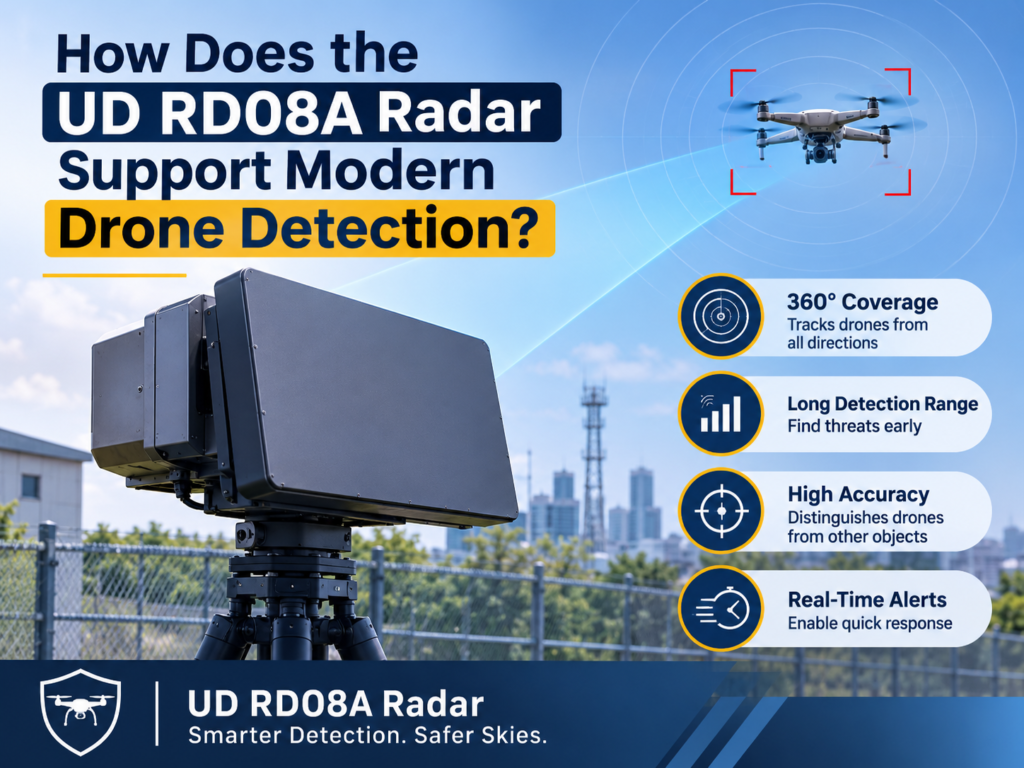
The UD RD08A radar supports modern drone detection by monitoring low-altitude airspace and helping security teams identify and track potential unmanned aerial vehicles (UAVs). Designed around X-band radar technology, it provides radar-based surveillance that can contribute to early warning and improved awareness of unauthorized drone activity.
As drones become more accessible, they can create security concerns around airports, industrial facilities, military installations, government buildings, and other sensitive locations. Organizations need detection systems that can identify potential aerial activity and provide useful information for security assessments. The UD RD08A is designed to support this requirement through radar surveillance and target monitoring.
What Is the UD RD08A Radar?
The UD RD08A is an anti-drone radar designed to detect and monitor potential UAV activity in protected airspace. It uses X-band radar technology and a phased-array architecture to support the detection of small, low-altitude aerial targets.
Unlike systems that depend entirely on radio communication signals, radar detects objects by transmitting electromagnetic signals and analysing the energy reflected from them. This means radar-based detection can provide useful information even when a drone is not actively communicating with its operator.
The UD RD08A is presented as a stationary radar solution. Businesses and security teams should check the manufacturer’s current specifications to confirm its installation requirements, coverage, and available configurations before selecting it for a particular site.
How Does X-Band Technology Support Drone Detection?
X-band is a microwave frequency range commonly used in radar applications. Its characteristics make it suitable for surveillance tasks that require the detection and tracking of relatively small objects.
An X-band drone radar works through a basic process:
- Signal transmission: The radar sends electromagnetic signals into the monitored airspace.
- Signal reflection: When the signals encounter an object, some energy reflects toward the radar.
- Signal reception: The radar receives and processes the returning signals.
- Target analysis: Processing software evaluates the returns to identify potential aerial targets.
- Tracking: The system monitors changes in target position and movement over time.
Radar performance depends on several factors, including the target’s size, radar cross-section, distance, altitude, and surrounding environment. Buildings, terrain, weather, and other sources of interference can also affect detection.
X-band technology therefore provides useful capabilities, but actual performance must be assessed using the specifications and test conditions for the particular radar model.
How Does the UD RD08A Support UAV Detection?
Modern UAV detection requires more than identifying an object in the sky. Security teams also need information that helps them understand its movement and assess whether further investigation is necessary.
The UD RD08A’s radar-based monitoring can support this process by providing information about detected aerial targets. Its phased-array design and target-processing capabilities are intended to support the detection and tracking of low-altitude objects.
Some important functions of a modern UAV detection radar include:
- Aerial target detection: Identifying potential UAV activity within the radar’s effective coverage area.
- Movement monitoring: Observing changes in a target’s position over time.
- Target classification: Using available radar-processing features to help distinguish potential drones from other objects.
- Early warning: Providing information that allows security personnel to assess potential aerial activity.
- Surveillance support: Contributing radar information to a broader security monitoring system.
Detection and classification should not be confused with identifying a drone’s owner, operator, or purpose. Additional sensors and verification may be needed to establish those details.
Why Is a Phased-Array Radar Useful for Modern Airspace Monitoring?
Phased-array technology allows a radar to control the direction of its transmitted and received signals electronically. Depending on the system design, this can support faster scanning and more flexible target monitoring than some conventional mechanical scanning arrangements.
For drone detection, these capabilities can be valuable because UAVs may be small, move at relatively low speeds, and operate at different altitudes.
A phased-array radar can support:
Target monitoring: Electronic scanning can help the system observe selected areas of airspace and maintain information about detected targets.
Flexible surveillance: Radar configurations may support different scanning modes depending on the installation and monitoring requirements.
Low-altitude observation: Purpose-designed radar processing can help identify aerial objects that may be difficult for conventional surveillance systems to monitor.
Security integration: Radar information can be shared with compatible monitoring platforms, depending on the system’s interfaces and configuration.
The actual benefits depend on the radar’s design, software, and operating environment.
How Does a Portable Anti-Drone Radar Differ From the UD RD08A?
A portable anti drone radar is generally selected when security teams need to move detection equipment between locations or deploy it temporarily. Such systems may be useful for temporary events, mobile security operations, and locations without permanent surveillance infrastructure.
A stationary radar, by comparison, is intended for a more fixed installation and ongoing monitoring of a designated area.
The distinction matters when selecting equipment:
ConsiderationPortable anti-drone radarStationary radar
Deployment Designed for movement and temporary use Installed at a designated location
Mobility Generally easier to relocate Usually requires a planned installation
Power May support battery operation Often uses a fixed power arrangement
Typical application Temporary or mobile monitoring Ongoing site surveillance
Site coverage Depends on deployment position Depends on installation and radar configuration
Although the portable anti drone radar keyword is relevant to the wider detection market, the UD RD08A should not be assumed to have portable capabilities without confirmation from its current product documentation.
Businesses should compare mobility, coverage, power requirements, and installation needs before choosing between these radar categories.
Where Can the UD RD08A Support Drone Detection?
Radar-based surveillance can be useful in locations where unauthorized aerial activity may affect safety, operations, or security.
Potential applications include:
- Industrial facilities: Monitoring airspace around manufacturing plants, energy infrastructure, and other sensitive sites.
- Airports: Supporting security monitoring around aviation facilities, subject to applicable aviation and operational requirements.
- Military installations: Contributing to surveillance around restricted or sensitive locations.
- Government facilities: Helping security teams monitor potential aerial activity near protected buildings.
- Ports and logistics centres: Supporting awareness around large operational areas where unauthorized drones may create security concerns.
- Public venues: Contributing to drone monitoring during large gatherings and organized events.
The suitability of the UD RD08A for any particular application depends on the required detection range, coverage, installation conditions, and local regulatory requirements.
How Can the UD RD08A Work With Other Drone Detection Technologies?
Radar can provide important information about aerial targets, but a single detection technology may not answer every security question. Integrating multiple sensors can provide additional information for target assessment.
For example, an integrated counter-UAS monitoring system may combine:
- Radar: Detects and tracks physical objects in the monitored airspace.
- Radio frequency sensors: Identify relevant communication signals between drones and controllers.
- Electro-optical cameras: Provide visual information that can help operators assess detected objects.
- Infrared cameras: Support observation in low-light conditions.
- Centralized monitoring software: Combines available sensor information and presents alerts to security personnel.
This approach is often called sensor fusion. It helps operators compare information from different sources rather than relying on one sensor alone.
Radar detection does not automatically establish whether a drone is authorized or identify its operator. Additional information and human assessment remain important parts of the security process.
What Should Businesses Consider Before Selecting a UAV Detection Radar?
Choosing a UAV detection radar requires an assessment of the location, security objectives, and expected operating conditions. Businesses should review the technical specifications rather than relying only on general product descriptions.
Important factors include:
- Detection range: Confirm the stated range and the target conditions used during testing.
- Coverage: Review horizontal and vertical coverage to understand potential blind spots.
- Target performance: Check the system’s ability to detect small and low-altitude aerial objects.
- Tracking capabilities: Understand how the radar monitors detected targets and updates their positions.
- Environmental suitability: Consider weather, terrain, nearby buildings, and potential interference.
- Integration: Confirm compatibility with existing cameras, sensors, and monitoring software.
- Installation requirements: Review power, mounting, network connectivity, and maintenance needs.
- Regulatory compliance: Ensure that radar operation and any associated security measures comply with local laws.
A professional site assessment can help determine whether the UD RD08A meets the organization’s requirements or whether additional detection equipment is necessary.
Frequently Asked Questions
What is the UD RD08A radar used for?
The UD RD08A is designed for radar-based drone detection and low-altitude airspace monitoring. It can help security teams identify and track potential UAV activity around protected locations.
Does the UD RD08A use X-band technology?
Yes. The product is described as an X-band phased-array radar designed to support the detection of small, low-altitude aerial targets.
Is the UD RD08A a portable anti-drone radar?
It is presented by UAV Defence as a stationary radar. Businesses should consult the manufacturer’s current documentation to confirm whether any portable configuration is available.
Can UAV detection radar identify every drone?
No. Detection depends on factors such as drone size, radar cross-section, distance, altitude, environmental conditions, and radar configuration. No radar system should be assumed to detect every aerial object in every situation.
Can radar work without drone communication signals?
Yes. Radar detects physical objects through reflected electromagnetic signals. Unlike radio frequency detection, it does not depend on receiving communication signals from a drone or its controller.
Conclusion
The UD RD08A radar supports modern drone detection through X-band radar technology, phased-array surveillance, and target monitoring capabilities. These features can help security teams improve awareness of low-altitude aerial activity and assess potential unauthorized drone presence.
For organizations evaluating a UAV detection radar, the most important considerations include detection performance, coverage, installation requirements, environmental suitability, and integration with other security technologies. Selecting a system based on these requirements can help build a more reliable and coordinated approach to airspace monitoring.