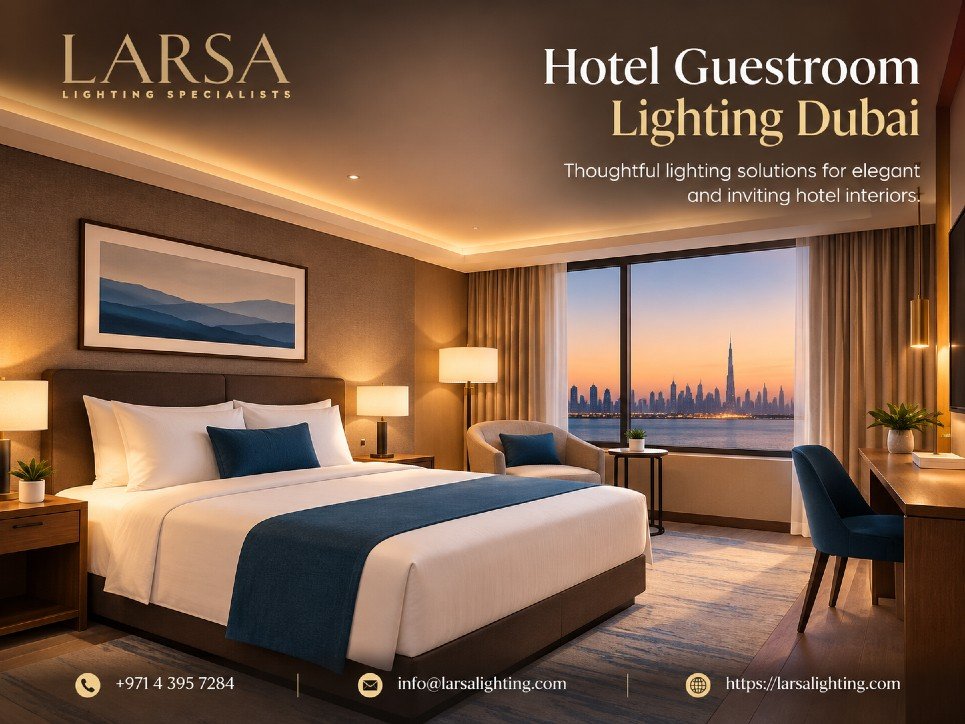
Hotel interiors are designed to create a memorable experience, and lighting plays a major role in shaping how guests perceive a room. From the moment guests enter to the time they prepare for sleep, the right illumination improves comfort, highlights architectural details, and makes everyday activities easier. In Dubai, where hotels range from contemporary business properties to luxurious resorts, guestroom lighting must balance visual appeal with functionality and energy efficiency.
Hotel Guestroom Lighting Dubai projects require a thoughtful combination of ambient, task, and accent lighting. Rather than relying on decorative fixtures alone, designers should consider room layouts, furniture placement, material finishes, lighting controls, and maintenance requirements. With careful planning, lighting can enhance a premium interior while meeting the practical needs of hotel guests and operators.
1. Create a Welcoming Atmosphere with Ambient Lighting
Ambient lighting establishes the overall brightness and mood of a guestroom. It should provide sufficient illumination for entering the room, unpacking luggage, and moving between different areas without creating harsh contrasts or uncomfortable glare.
Recessed downlights, concealed LED strips, and architectural ceiling lighting are common options for achieving balanced illumination. Decorative ceiling fixtures can add character, but they should complement the general lighting rather than serve as the only source.
Warm white lighting, typically between 2700K and 3000K, often works well in luxury guestrooms. These colour temperatures can create a relaxing atmosphere and complement finishes such as timber, marble, textured fabrics, and warm metallic accents. The final choice should reflect the hotel’s design concept and the appearance of materials under artificial light.
For Hotel Guestroom Lighting Dubai, designers should also consider daylight entering through large windows. Dimmable fixtures allow guests to adjust brightness throughout the day, supporting different activities without compromising comfort.
2. Combine Bedside Lighting with Comfortable Reading Options
The bed is usually the visual centre of a hotel guestroom, making bedside lighting an important part of the overall design. Wall-mounted reading lights, decorative pendants, and integrated headboard lighting can provide both practical illumination and an elegant finishing detail.
Individual reading lights on either side of the bed allow guests to read without disturbing someone sleeping nearby. Adjustable fixtures are particularly useful because they direct light towards a book or electronic device rather than into the eyes.
Concealed LED lighting behind the headboard can add depth and create a soft glow around the bed. When combined with independently controlled reading lights, it provides flexibility for relaxation and nighttime use.
Switch placement is equally important. Guests should be able to control bedside lighting without getting out of bed. Clearly labelled switches or intuitive control panels make the experience more convenient.
3. Use Accent Lighting to Highlight Luxury Interior Details
Accent lighting draws attention to selected architectural and decorative features. In luxury hotel guestrooms, it can highlight artwork, textured walls, decorative niches, feature panels, or carefully selected furnishings.
Adjustable spotlights are useful for illuminating artwork, while concealed linear lighting can emphasise ceiling details and wall recesses. Integrated shelving lights may also add visual interest to display areas.
The key is to create a clear visual hierarchy. Too many accent lights can make a room appear cluttered, while excessive brightness may reduce the contrast that gives an interior its character. Carefully positioned light sources help designers emphasise selected features while maintaining a calm atmosphere.
A coordinated lighting scheme should also consider beam angles, glare control, and the distance between fixtures and illuminated surfaces. These details help achieve consistent results across different guestrooms.
4. Improve Functionality with Task Lighting
Luxury should not come at the expense of everyday convenience. Hotel guests may need to work on a laptop, read documents, organise their belongings, or prepare for an evening event.
A desk lamp or integrated task light provides focused illumination for work surfaces. Designers should position the light to minimise shadows and reflections on computer screens. Where guestrooms accommodate business travellers, adjustable task lighting can improve usability without requiring higher brightness throughout the room.
Wardrobe lighting is another valuable feature. Integrated LED strips activated by door sensors help guests locate clothing and accessories. These systems should be coordinated with cabinetry dimensions, door mechanisms, and accessible driver locations to simplify future maintenance.
Vanity lighting also deserves attention. Light positioned on both sides of a bathroom mirror can illuminate the face more evenly than a single overhead fitting. Suitable colour rendering helps guests assess clothing, makeup, and skin tones more accurately.
5. Introduce Smart Controls and Flexible Lighting Scenes
Modern guestrooms benefit from lighting controls that make different activities easy to manage. Instead of operating numerous individual switches, guests can use simple controls or preset scenes to adjust several fixtures at once.
Common lighting scenes include:
- Arrival: Provides comfortable illumination near the entrance and throughout the room.
- Relax: Reduces general brightness while retaining selected decorative and indirect lighting.
- Work: Increases illumination around the desk and other task areas.
- Night: Switches off most fixtures while maintaining a low-level route for nighttime movement.
For larger hospitality projects, lighting controls can be coordinated with occupancy sensors, curtain systems, and guestroom management platforms. Compatibility between LED drivers, dimmers, and control devices should be verified before installation to prevent flickering or inconsistent dimming.
Intuitive controls are particularly important for international hotels, where guests may be unfamiliar with the room’s layout. Simplicity improves the overall experience and reduces confusion.
6. Prioritise Energy Efficiency, Safety, and Maintenance
A successful lighting design must perform reliably beyond the initial installation. LED technology can reduce energy consumption and replacement frequency when appropriately specified, while dimming and occupancy-based controls can help limit unnecessary use.
However, product selection should consider more than energy efficiency. Colour consistency, glare control, durability, driver accessibility, and compatibility with the building’s electrical systems are also important.
Bathroom fixtures must have suitable protection for their installation locations and comply with applicable electrical safety requirements. Emergency lighting and other life-safety provisions should be coordinated with the project’s relevant codes and standards.
Standardising fixture families across multiple guestrooms can simplify spare-parts management and maintenance. For large hotels, accessible components and practical replacement procedures help reduce disruption to room operations.
7. Coordinate Lighting with the Interior Design Concept
Lighting decisions should be made alongside the architectural and interior design process. Ceiling layouts, furniture positions, joinery details, power requirements, and control locations all influence the final result.
A room mock-up can help designers and hotel operators evaluate brightness, glare, material appearance, and control usability before approving the specification for wider installation. This process also helps identify problems that may not be obvious in drawings.
Larsa Lighting recognises lighting as both a technical discipline and a design element. For hospitality projects, coordinating architectural fixtures, decorative luminaires, concealed LED systems, and lighting controls helps create a consistent and functional environment. The objective is to ensure that each component contributes to the overall guest experience.
Conclusion
Well-planned guestroom lighting combines atmosphere, functionality, and reliable performance. From warm ambient illumination and focused bedside reading lights to smart controls and carefully positioned accent lighting, each layer contributes to a more comfortable hotel interior.
By considering guest needs, energy efficiency, maintenance, and architectural details from the beginning, Hotel Guestroom Lighting Dubai projects can achieve elegant interiors that remain practical over time. Thoughtful coordination with experienced lighting specialists, such as Larsa Lighting, can help hotel owners, designers, and consultants develop lighting schemes that support both design objectives and operational requirements.