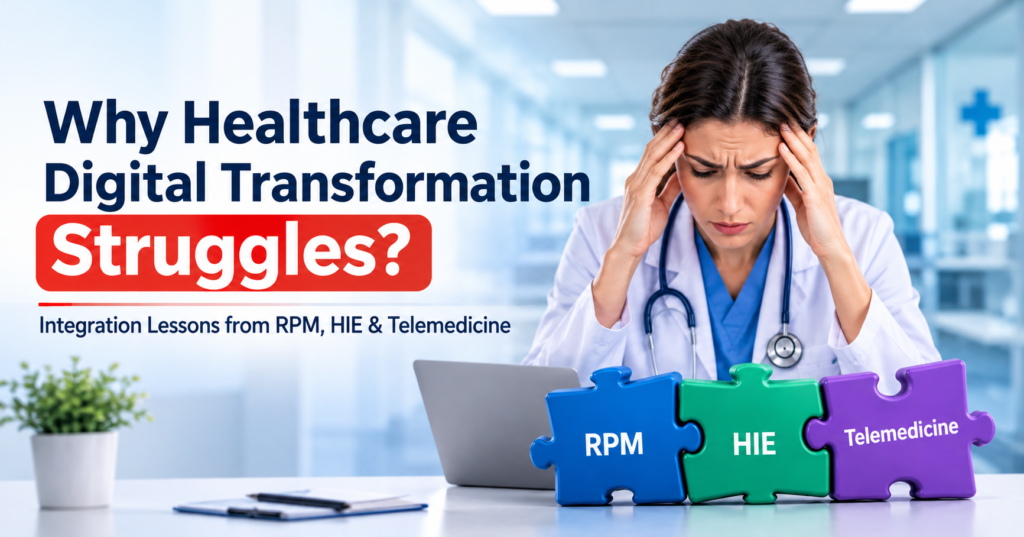
Most healthcare digital transformation projects don’t fail because the technology is bad. They fail because the new tools don’t connect properly to the systems, data, and workflows already in place. A remote monitoring platform that can’t write readings into the EHR creates more work for nurses, not less. A health information exchange that can’t match patient identities produces duplicate records. Integration is where digital transformation succeeds or stalls.
This article explains the most common integration problems, what remote patient monitoring (RPM), health information exchange (HIE), and telemedicine projects teach about them, and how healthcare leaders can plan around these risks.
Why do healthcare digital transformation projects fail?
They usually fail for one of three reasons: the new system was bought without a clear integration plan, the existing infrastructure was underestimated, or the workflows were never redesigned around the new tool.
Adding technology doesn’t automatically improve operations. If clinicians have to log into one more portal, retype data from one screen into another, or check two systems to confirm a medication list, the tool adds friction. Staff stop using it, and the expected gains never arrive.
The fix starts before purchase. Leaders need to know which systems must share data, in what format, and who owns each connection. Projects that answer those questions early tend to hit their timelines. Projects that skip them tend to spend the back half of the budget on rework.
What are the biggest healthcare IT integration challenges?
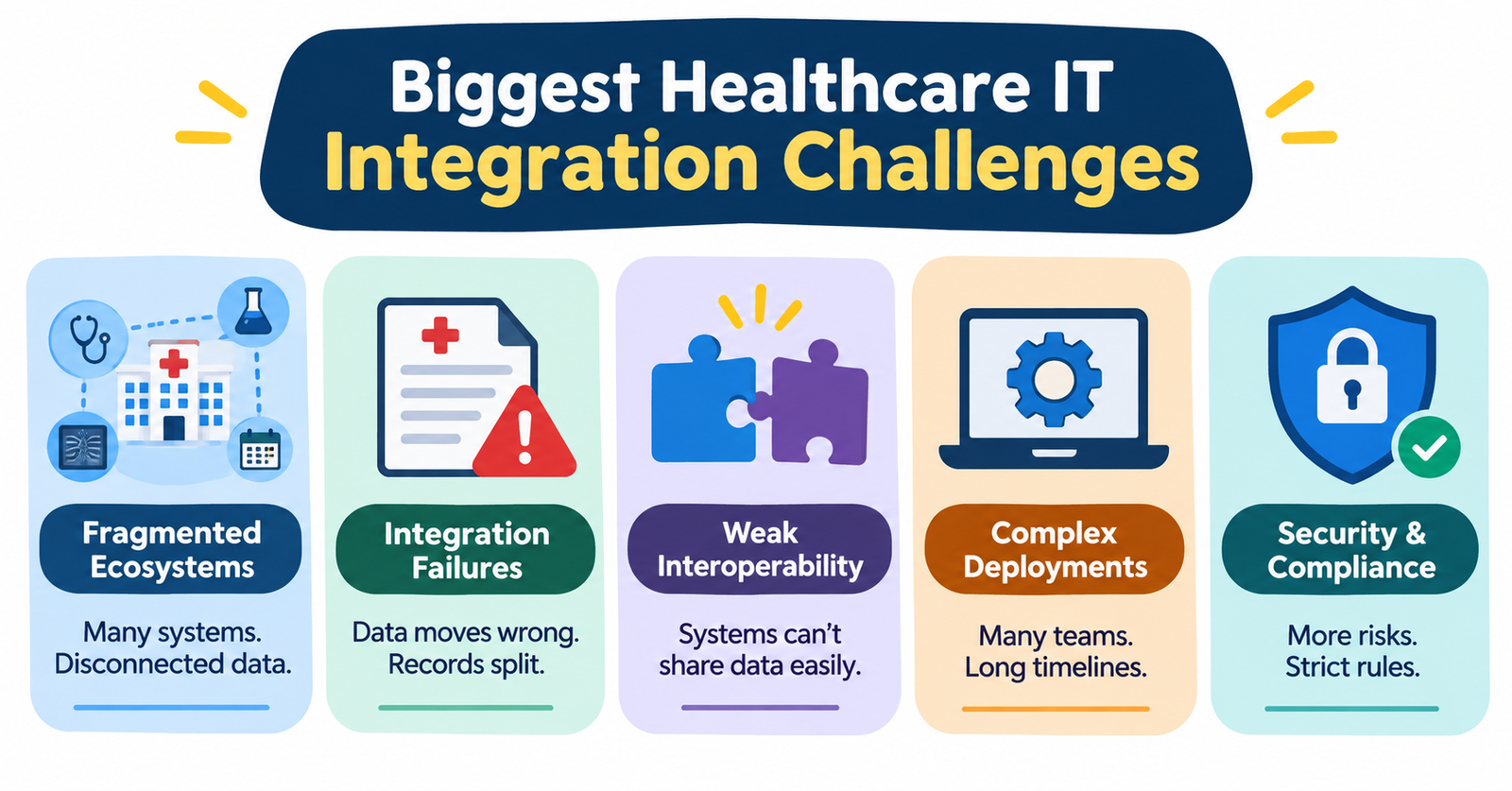
Five challenges appear again and again across hospitals, clinic networks, and digital health vendors.
Fragmented ecosystems. Most healthcare organizations run an EHR alongside separate billing, laboratory, imaging, scheduling, and patient engagement systems. Each one stores part of the patient story. When those systems don’t talk to each other, clinicians make decisions with partial information. A lab result may exist in one system while the physician reviews a different one.
Integration failures and inconsistent records. Legacy systems often use older message formats, custom field names, or batch file transfers. Modern apps expect real-time APIs. When data moves between them, fields get mapped incorrectly, timestamps drift, and the same patient ends up with two slightly different records. Once that happens, staff lose trust in the data, and trust is hard to rebuild.
Weak interoperability. Interoperability means systems can exchange data and use it correctly on the other side. HL7 v2 messages still carry much of the day-to-day traffic in hospitals. FHIR (Fast Healthcare Interoperability Resources) has become the standard most new projects target, because it exposes data through web-style APIs with defined resources like Patient, Observation, and Medication. A project that doesn’t plan for these standards tends to end up with custom point-to-point interfaces that are expensive to maintain.
Complex deployments. A single digital health project can involve an EHR vendor, a device manufacturer, a cloud provider, a security team, and several clinical departments. Each group has its own timeline. Requirements that sound clear in a kickoff meeting turn vague in testing, and migration work that was scoped as a few weeks grows into months.
Security and compliance. Every new connection is a new place where patient data can leak. Teams have to manage authentication, role-based access, encryption in transit and at rest, and audit logging across every system. In the United States, HIPAA sets the baseline for protecting health information, and organizations in other regions face their own rules. Security reviews are often the step that delays go-live, which is why they belong at the start of the project rather than the end.
What do RPM, HIE, and telemedicine projects teach about integration?
Remote patient monitoring, health information exchange, and telemedicine look like different categories, but they face the same underlying problem. Each one has to move data between systems that were never designed to work together.
Remote patient monitoring: device-to-platform-to-EHR integration
An RPM program collects readings from blood pressure cuffs, glucose meters, pulse oximeters, and wearable sensors. Those devices come from different manufacturers and use different protocols and data formats. Some send readings over Bluetooth to a phone app. Others upload through a cellular gateway. Timestamps and units vary, and some devices drop connections when the battery runs low.
The data then needs to reach the RPM platform, pass clinical rules (for example, an alert when systolic blood pressure stays above a set threshold for several readings), and land in the EHR where clinicians actually work. Each handoff is a place where data can be lost or misread.
The lesson is that an RPM program is only as good as its weakest connection. Teams should test the full path, from device to dashboard to chart, using realistic data volumes and failure scenarios. A remote patient monitoring app that works in a demo but drops readings during a network outage will erode clinician trust quickly.
Organizations building their own RPM platforms should look for remote patient monitoring software development services that design for interoperability from the start. The goal is a platform that supports multiple device vendors, uses standard data models, and writes clean records back to the EHR without manual rework.
Health information exchange: identity and standards across organizations
An HIE connects hospitals, labs, clinics, and other providers so they can share patient records across organizational boundaries. The value is obvious: a physician in one hospital can see recent visits and test results from another. The difficulty is that every organization has its own EHR, its own data conventions, and its own idea of who the patient is.
Patient identity matching is often the hardest problem. Two records for “Maria Gonzalez” with different birth dates, addresses, or phone numbers may belong to the same person, or they may not. A match that’s too loose merges records that shouldn’t be merged. A match that’s too strict leaves the same patient split across several charts. Either error is a patient safety risk.
HIE projects also depend on agreement about data standards, consent rules, and who can access what. A technically working exchange can still fail if participating organizations disagree on how to code diagnoses or handle sensitive data.
The lesson is that HIE success depends on standardized exchange and a framework that can grow. Teams should use established profiles and terminologies, invest in identity management early, and build governance structures that outlast the first set of participants. Organizations looking for hie software development should evaluate whether a vendor has delivered cross-organizational exchange in production, not just in a pilot.
Telemedicine: fitting virtual care into existing workflows
Telemedicine platforms often start as standalone products. A clinician logs into a video tool, sees the patient, and then manually copies notes into the EHR. Prescriptions go through a separate e-prescribing system. Billing codes get entered by hand later. Each step adds time and creates a chance for error.
The integration work involves connecting scheduling so appointments appear in the EHR calendar, pushing visit notes and orders back into the chart, linking e-prescriptions to the medication list, and sending charges to billing. Patient records need to stay in sync whether the visit happened by video or in person.
Usability matters as much as connectivity. If a telemedicine workflow requires clinicians to switch between four screens to finish one visit, adoption will drop no matter how good the video quality is. Teams should watch real clinicians complete real visits during testing and adjust until the flow feels natural.
The lesson is that telemedicine has to work inside clinical operations, not beside them. Organizations evaluating a telemedicine app development company should ask how the team handles EHR integration, scheduling sync, and e-prescribing, not just video quality.
Why isn’t point-to-point integration enough anymore?
Many healthcare organizations built their integrations one connection at a time. System A talks directly to System B, which talks to System C, and so on. That works for a few systems. It becomes fragile once there are ten or twenty.
Each direct connection has its own format, its own failure modes, and its own maintenance schedule. When one system upgrades, every connected system may need changes. Troubleshooting becomes difficult because no one has a full picture of how data flows. Costs rise each time a new application is added.
Legacy infrastructure makes this worse. Older hospital information systems may have limited API support, rely on batch file exchanges, or require vendor-specific tools to extract data. Modernizing them without disrupting daily operations is a delicate job. Health systems often need to run old and new systems in parallel for months, which means the integration layer has to handle both.
Vendor dependency adds another constraint. Proprietary platforms sometimes restrict data access or charge for API usage. Organizations that want flexibility need to check, before signing, what data they can export, in what format, and under what terms.
ALSO READ – Why Remote Patient Monitoring Systems Struggle with Data Accuracy, Alert Fatigue, and EHR Integration
How do you build an integration approach that holds up?
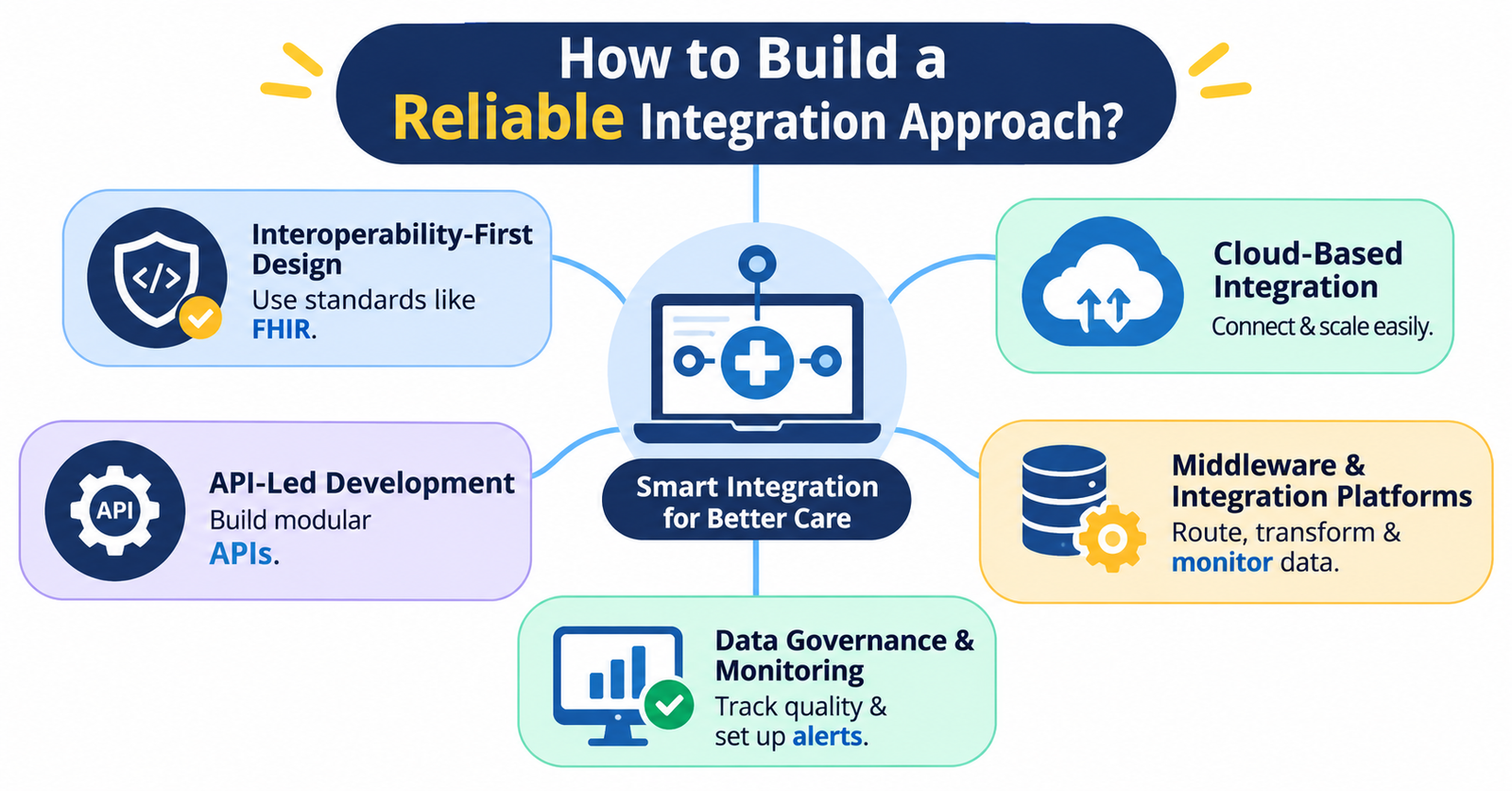
Several architectural approaches reduce long-term complexity. They work best in combination.
Interoperability-first design. Build around standard data models and protocols like FHIR, rather than custom mappings for each system. This makes new connections faster and reduces the number of one-off interfaces to maintain.
Cloud-based integration. Cloud infrastructure makes it easier to connect distributed sites, scale during peak usage, and give authorized staff access to data from anywhere they work. It also requires careful attention to data residency, access control, and vendor security commitments.
API-led development. Well-designed APIs let applications share data in controlled, documented ways. They support modular development, so a telemedicine module, an RPM feed, and an EHR connector can be built and tested separately.
Middleware and integration platforms. A central integration layer handles message routing, data transformation, and monitoring. Applications connect to the hub rather than to each other, which cuts the number of direct dependencies. Middleware also gives operations teams one place to see what’s flowing and what’s failing.
Data governance and monitoring. Integration needs ongoing oversight. Teams should define data quality rules, track failed messages, keep audit trails of who accessed what, and set up alerts for stalled or malformed data. Without monitoring, integration problems tend to surface first as clinician complaints.
How should you sequence a digital transformation project?
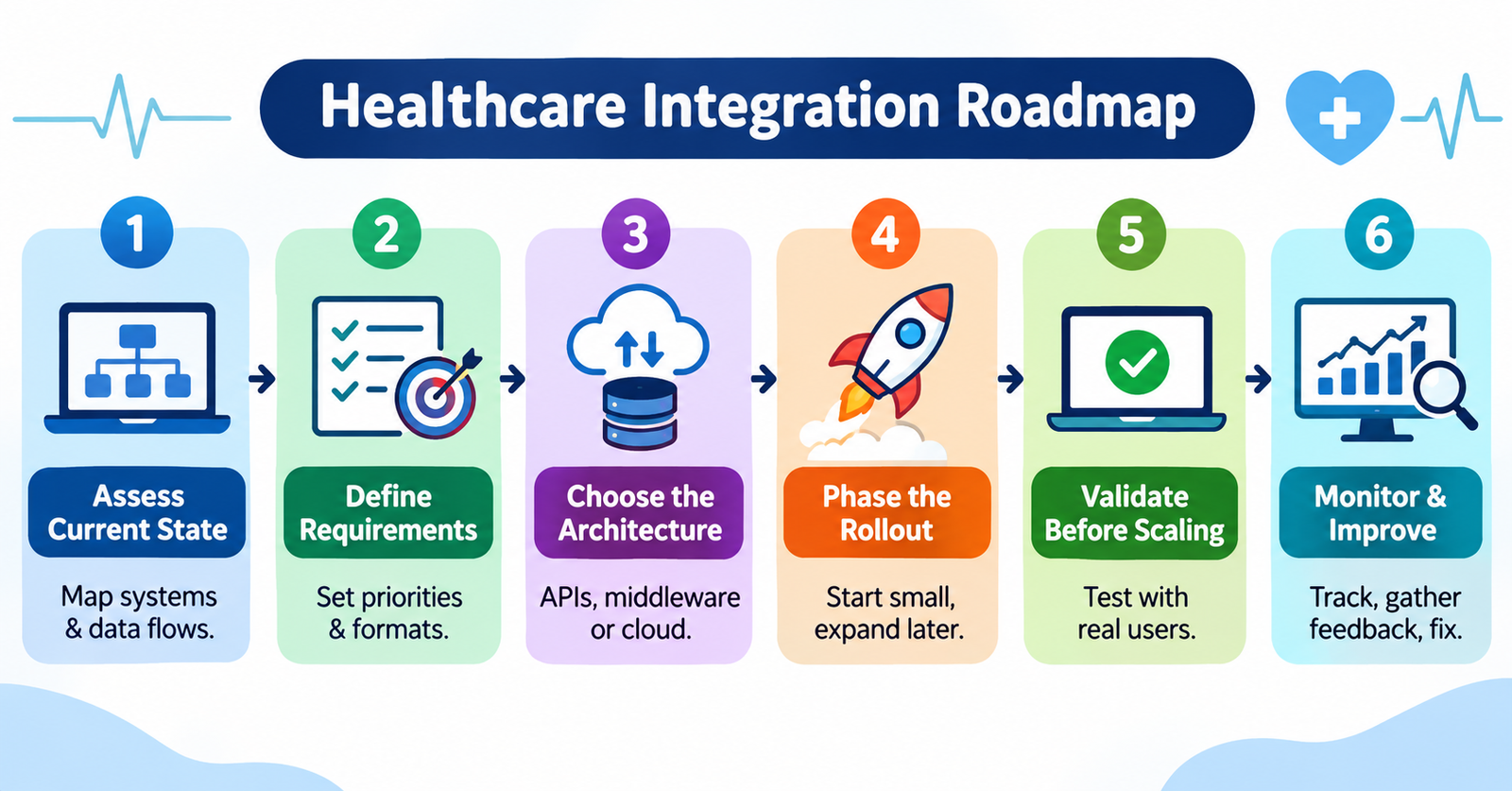
A practical sequence looks like this:
- Assess the current state. Map existing systems, applications, data flows, and integration dependencies. Identify where data is re-entered by hand or where clinicians check multiple systems.
- Define requirements. Specify which systems must exchange data, in which formats, and with what latency. Rank integrations by clinical and business priority.
- Choose the architecture. Decide how much will run through APIs, how much through middleware, and where cloud services fit. Weigh scalability, security, and flexibility against the organization’s existing capabilities.
- Phase the rollout. Start with the workflows that matter most, such as admissions or discharge summaries for an HIE or device onboarding for RPM. Pilot with a small group, then expand as testing confirms performance.
- Validate before scaling. Test integration end to end, check data accuracy and synchronization, and run clinical workflow tests with actual users. Don’t count a feature as finished until clinicians can complete their work with it.
- Monitor and improve. Track uptime, failed exchanges, and processing delays. Collect feedback from the people using the system daily and fix what they report.
Which metrics show that integration is working?
Measuring integration health requires more than tracking whether a system is up. Useful metrics include:
- Integration success and failure rates across each connection
- Data synchronization accuracy between systems
- EHR/EMR data exchange performance, including message latency
- Reduction in manual data entry
- Clinical workflow time for common tasks
- Telemedicine adoption and visit completion rates
- RPM data transmission reliability, measured as the share of expected readings that arrive intact
- Overall system uptime and interoperability performance
The most revealing metric is often the simplest: how many staff members still keep a parallel record in a spreadsheet or on paper. If that number isn’t falling, the integration isn’t doing its job.
How can a healthcare IT partner reduce implementation risk?
Many organizations bring in outside help, and the right partner can shorten timelines and prevent expensive mistakes. A capable partner typically does the following:
- Assesses the existing technology environment before recommending changes
- Builds an integration strategy around interoperability standards
- Connects RPM, HIE, telemedicine, and EHR platforms into a coherent architecture
- Develops secure, scalable, API-driven applications
- Supports migration, rollout, and ongoing optimization after go-live
When evaluating a telehealth app development company or any integration partner, look for specific evidence. Ask for examples of production EHR integrations, not just demos. Ask how they handle patient identity matching, what their testing process covers, and how they support systems after launch. Ask who on the team has clinical workflow experience, because integration decisions made without that context often create problems later.
Integration expertise matters more than the feature list. A vendor with an impressive product catalog but weak integration experience will leave you with disconnected tools.
Conclusion
Digital transformation in healthcare isn’t a matter of buying the newest tools. It depends on how well those tools connect to the systems and workflows that clinicians already use.
RPM, HIE, and telemedicine each show the same lesson in different ways. Data has to move cleanly from device to platform to chart. Patient identity has to be accurate across organizations. Virtual care has to fit into the visit, not sit beside it.
Healthcare leaders should start by reviewing their current infrastructure and integration strategy. Identify the connections that create the most manual work, the data that people don’t trust, and the systems that can’t yet share information. Then prioritize interoperability-first, scalable, and secure solutions. That work is less visible than a new app launch, but it’s what determines whether the launch succeeds.

Frequently Asked Questions
Why do healthcare digital transformation projects fail?
Most fail because integration was an afterthought. Teams buy tools without mapping data flows, underestimate legacy systems, or leave workflow redesign until after launch. Clinicians then work around the new system, and the expected benefits never materialize.
What are the biggest healthcare IT integration challenges?
The most common are fragmented systems, inconsistent patient data, weak interoperability between legacy and modern platforms, complex multi-vendor deployments, and security requirements that span every connection.
Why is interoperability important in healthcare digital transformation?
Interoperability lets systems exchange data that is accurate and usable on arrival. Without it, clinicians rely on partial information, staff re-enter data by hand, and each new system adds another custom interface to maintain.
How can healthcare organizations integrate RPM platforms with EHR systems?
Test the full path from device to platform to EHR, using standard data formats such as FHIR where possible. Confirm that readings arrive intact, timestamps are correct, and alerts reach the right clinicians. Plan for failures like dropped connections and low batteries.
What are the common challenges in HIE implementation?
Patient identity matching, inconsistent data coding across organizations, differing EHR systems, consent and access rules, and governance that must scale as new participants join.
How can telemedicine platforms integrate with existing hospital systems?
Connect scheduling, visit documentation, e-prescribing, and billing to the EHR so that information isn’t re-entered. Test the workflow with real clinicians to confirm it fits how they work.
What role do APIs play in healthcare system integration?
APIs let applications exchange data through defined, controlled interfaces. They reduce reliance on custom point-to-point connections, support modular development, and make it easier to add new applications without rebuilding existing ones.
How can cloud-based architecture improve healthcare interoperability?
Cloud platforms can connect distributed sites, scale to meet demand, and centralize integration management. They must be configured carefully for data residency, access control, and compliance requirements.
What healthcare standards support seamless data exchange?
HL7 v2 remains common for hospital messaging. FHIR is the standard most new projects use for API-based exchange. Terminology standards such as SNOMED CT, LOINC, and ICD-10 support consistent meaning across systems.
How can healthcare IT consulting services reduce digital transformation risks?
Consultants can assess current infrastructure, define integration requirements, select suitable architecture, plan phased rollouts, and support testing and monitoring. Their main value is catching integration problems before they reach clinicians.