HDPE Pipes Market to Reach USD 33.49 Billion by 2032, Driven by Water Infrastructure Investments
HDPE Pipes Market Overview and Growth Forecast
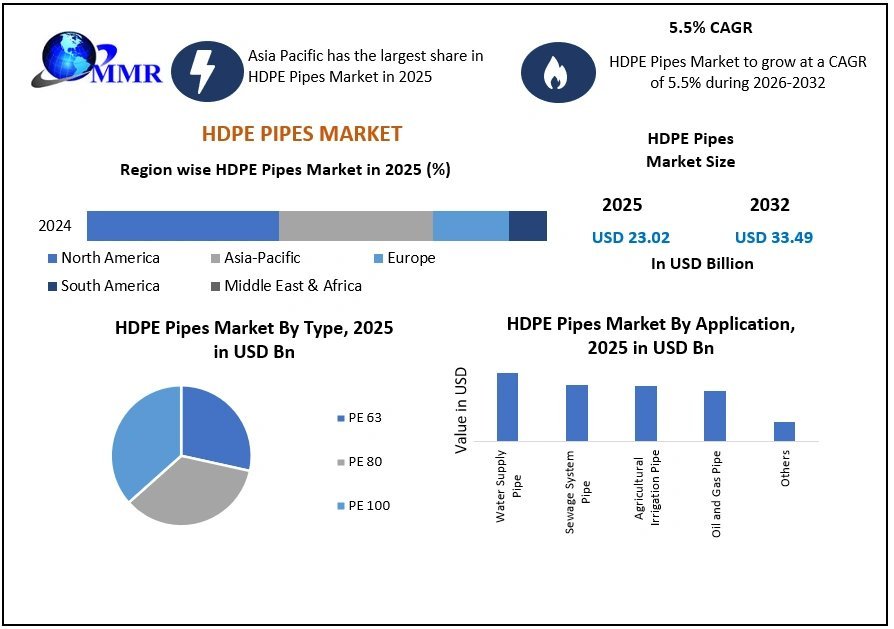
The HDPE Pipes Market was valued at USD 23.02 billion in 2025 and is projected to reach USD 33.49 billion by 2032, registering a compound annual growth rate (CAGR) of 5.5% during the forecast period. High-density polyethylene (HDPE) pipes are increasingly used across water supply, wastewater management, irrigation, industrial applications, gas distribution, and mining because of their durability, corrosion resistance, flexibility, and relatively low maintenance requirements.
Growing investments in water infrastructure modernization, urban development, and agricultural irrigation are creating favorable conditions for market expansion. Governments and utility operators are prioritizing reliable water distribution systems to reduce leakage, improve operational efficiency, and address water scarcity. HDPE pipes offer a practical alternative to traditional piping materials because they can withstand demanding operating conditions and provide long service life when properly designed and installed.
The expansion of industrial facilities, residential construction, and municipal infrastructure is also supporting demand. Furthermore, the increasing adoption of trenchless installation technologies is improving the feasibility of pipeline replacement projects in densely populated urban areas. These technologies can reduce surface disruption, installation time, and associated costs.
Get a Sample Insight Report Now : https://www.maximizemarketresearch.com/request-sample/15696/
Growth Drivers, Market Opportunities, and Emerging Demand
Water conservation initiatives and infrastructure rehabilitation represent major growth drivers for the HDPE Pipes Market. Aging pipeline networks in developed economies require replacement, while developing economies continue to invest in new water supply and sanitation infrastructure. HDPE pipes are suitable for these applications because their flexibility and fusion-joined connections can help minimize leakage risks.
Agricultural modernization offers another significant opportunity. Efficient irrigation systems, including drip and sprinkler irrigation, require dependable piping networks that can operate across different soil and climatic conditions. HDPE pipes are increasingly relevant to irrigation projects focused on improving water utilization and agricultural productivity.
Additional opportunities are emerging from renewable energy infrastructure, industrial fluid transportation, and expanding gas distribution networks. Manufacturers can strengthen their market positions by developing advanced polyethylene grades, improving pressure resistance, incorporating recycled materials where technically appropriate, and adopting digital quality-control systems.
However, fluctuations in polyethylene resin prices, competition from alternative materials, transportation costs, and varying infrastructure investment levels may affect profitability. Compliance with national standards and the availability of skilled installation professionals will remain important considerations for market participants.
United States Market: Latest Trends and Investment Developments
In 2025, the United States continued to present opportunities for HDPE pipe manufacturers through infrastructure renewal, water system improvements, and investments in resilient utility networks. Federal infrastructure funding, including programs established under the Infrastructure Investment and Jobs Act, supports drinking water and wastewater improvements through mechanisms such as the Environmental Protection Agency’s Drinking Water State Revolving Fund and Clean Water State Revolving Fund. These initiatives create opportunities for pipeline replacement, leakage reduction, and municipal system upgrades. Utilities are also considering trenchless rehabilitation, advanced leak detection, and durable piping solutions to improve long-term asset performance. Investment opportunities extend to agricultural water management, industrial facilities, and energy infrastructure. Although individual project allocations and procurement decisions vary, the continued emphasis on infrastructure resilience and reliable water delivery supports the long-term outlook for HDPE pipes in the US market.
Market Segmentation: Leading Segments
The HDPE Pipes Market is segmented by type, diameter, application, and region. Based on type, PE 100 pipes held the dominant market position in 2024, supported by their high strength, pressure-handling capabilities, resistance to slow crack growth, and suitability for demanding water supply and gas distribution applications.
By diameter, small-diameter pipes represented the leading segment, driven by extensive use in residential water connections, municipal distribution networks, agricultural irrigation, and sewage connections. Their lightweight construction and ease of installation make them suitable for projects requiring extensive pipeline networks.
By application, water supply, oil and gas transportation, agricultural irrigation, and sewage systems represent important demand areas. Water infrastructure investment and the need for dependable distribution networks continue to support the adoption of HDPE piping solutions.
Competitive Analysis: Top Industry Participants
The competitive landscape includes resin producers, pipe manufacturers, and integrated infrastructure solution providers. Companies are emphasizing manufacturing efficiency, advanced materials, product quality, and strategic expansion to strengthen their positions.
- The Dow Chemical Company: Dow supplies polyethylene materials used in pipe manufacturing. Its focus on polymer science, material performance, and more sustainable plastics solutions supports the development of durable piping products.
- PetroChina Company Limited: PetroChina benefits from its integrated petrochemical operations and substantial polyethylene production capabilities. Investment in petrochemical infrastructure and polymer technologies can strengthen the availability of materials for China’s expanding water and industrial networks.
- Abu Dhabi Polymers Company Ltd. (Borouge): Borouge develops advanced polyolefin materials for infrastructure applications. Its focus on high-performance polyethylene grades supports durable piping systems designed for demanding operating conditions.
- LyondellBasell Industries N.V.: LyondellBasell invests in polymer innovation, process efficiency, and circular economy initiatives. Advances in polyethylene production and material development can help pipe manufacturers improve product performance and explore resource-efficient manufacturing.
- Formosa Plastics Corporation: Formosa Plastics participates in the petrochemical value chain, supplying polymer materials for industrial applications. Its manufacturing capabilities and product development efforts support the broader supply of polyethylene used in piping systems.
Across the industry, opportunities for innovation include improved PE 100 formulations, enhanced resistance to cracking, automated extrusion, precision quality monitoring, and advanced joining technologies. These developments can improve reliability, reduce installation risks, and support long-term infrastructure performance. The companies listed are major industry participants; their individual global pipe-market shares and exact rankings are not publicly established here.
Regional Analysis: Key Country Markets
United States: Aging municipal water networks, infrastructure rehabilitation, and federal support for drinking water and wastewater improvements underpin demand. Infrastructure funding programs encourage utilities to modernize distribution systems and improve water efficiency.
United Kingdom: Water utility investment, leakage reduction, wastewater upgrades, and regulatory pressure to improve environmental performance create opportunities for HDPE pipe suppliers. Long-term infrastructure programs support pipeline renewal and more resilient water management.
Germany: Industrial modernization, municipal water infrastructure, and environmental objectives support demand for durable piping materials. European product standards and sustainability requirements also influence manufacturers’ material selection and production practices.
France: Water network maintenance, wastewater infrastructure upgrades, and agricultural irrigation requirements contribute to market opportunities. Public investment in essential services and water resource management supports the adoption of modern pipeline systems.
Japan: Infrastructure renewal, earthquake resilience, and the modernization of aging water distribution networks encourage demand for flexible, durable piping. Government initiatives focused on disaster preparedness and reliable public utilities support long-term investment.
China: Urbanization, industrial development, agricultural modernization, and extensive municipal water projects support demand for HDPE pipes. Government priorities involving water conservation, environmental protection, and infrastructure development create opportunities for domestic manufacturers. Asia-Pacific is expected to experience strong market growth, supported by infrastructure investment and expanding polyethylene production.
Country-level HDPE pipe market shares are not specified because reliable comparable percentages are unavailable in the cited market overview.
Key Players in the HDPE Pipes Market
- The Dow Chemical Company
- PetroChina Company Limited
- Abu Dhabi Polymers Company Ltd. (Borouge)
- LyondellBasell Industries N.V.
- Formosa Plastics Corporation
- ExxonMobil Corporation
- Chevron Phillips Chemical Company
- Braskem S.A.
- Dura-Line Corporation
- IPEX Inc.
- Reliance Industries Limited
- WL Plastics Inc.
- China Lesso Group Holdings Ltd.
- Advanced Drainage Systems, Inc.
- JM Eagle, Inc.
Why This Market Matters Now
The HDPE Pipes Market is becoming increasingly important as countries address water scarcity, aging infrastructure, population growth, and the need for reliable utility services. Compared with conventional piping materials, HDPE offers corrosion resistance, flexibility, and fusion-jointed connections that can help reduce leakage and maintenance requirements.
For investors, manufacturers, and infrastructure developers, the projected increase from USD 23.02 billion in 2025 to USD 33.49 billion by 2032 represents opportunities across polymer production, pipe manufacturing, irrigation, and water infrastructure. Companies that combine material innovation, efficient production, and reliable distribution are positioned to benefit from evolving infrastructure needs.
Explore More Related Reports
Foam Mattress Market https://www.maximizemarketresearch.com/market-report/global-foam-mattress-market/10799/
Bamboos Market https://www.maximizemarketresearch.com/market-report/bamboos-market/126098/
About Maximize Market Research
Maximize Market Research Pvt. Ltd. (MMR) is a global market research and consulting company that provides reliable, data-focused, and practical business insights. The firm serves a wide range of industries, including healthcare, pharmaceuticals, technology, automotive, electronics, chemicals, personal care, and consumer goods. Through market forecasts, competitive analysis, and strategic consulting, MMR helps organizations understand changing market conditions, identify growth opportunities, and make informed business decisions for long-term success.
Contact Us
Maximize Market Research Pvt. Ltd.
2nd Floor, Navale IT Park Phase 3
Pune Bangalore Highway, Narhe
Pune, Maharashtra 411041, India
Phone: +91 9607365656