Key Highlights
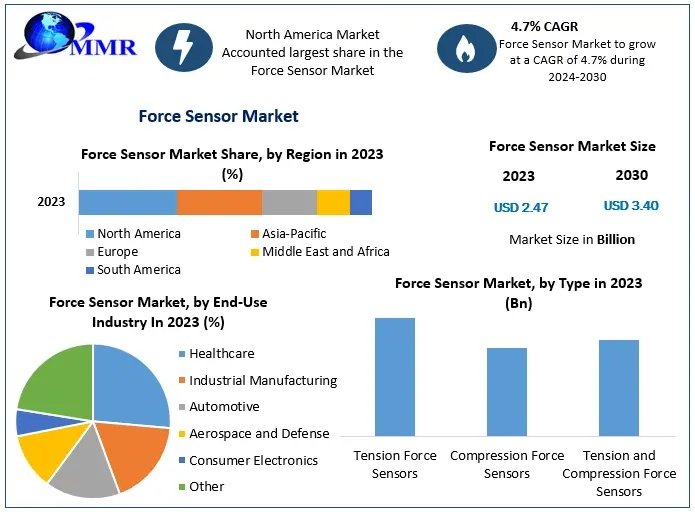
- The Force Sensor Market was valued at US$ 2.47 billion in 2023, creating a substantial base for future demand.
- Revenue is projected to grow at a 4.7% CAGR from 2024 to 2030, reaching nearly US$ 3.40 billion and indicating steady expansion.
- Versatile applications remain a major growth driver, widening opportunities for sensor manufacturers.
- Industrial automation and robotics are creating new use cases in assembly, inspection, packaging, polishing, and machine operations.
- North America is expected to retain a significant share, with the United States identified as an important demand center.
Market Overview
The Force Sensor Market covers devices that convert tension and compression into digital signals for monitoring, processing, and machinery control. It includes tension, compression, and combined sensors, plus analog and digital operation and strain gauge, load cell, force-sensitive resistor, and other technologies.
This breadth gives suppliers multiple routes to address application-specific requirements across industrial and technology-driven environments.
Why This Market Matters Now
Manufacturing organizations use sensors to monitor force during production, while vehicles can use them to estimate axle loads and evaluate coupling behavior.
Meanwhile, Industry 4.0 is accelerating robotics adoption. Force and torque sensing can support robotic deburring, sanding, polishing, inspection, packing, and assembly. For buyers, this expands sensors from measurement components into tools for process control and productivity.
Access a Free Sample Report Copy : https://www.maximizemarketresearch.com/request-sample/14584/
Key Trends Driving Growth
Industrial automation is a central trend. Connected machines, robotics, and control systems increasingly use force feedback for precision tasks, creating opportunities for reliable sensing suppliers.
Application expansion is another trend. Healthcare, automotive, aerospace and defense, consumer electronics, and industrial manufacturing are all covered in the market structure. However, miniaturization remains a challenge because smaller sensors require extensive research and development and can increase costs.
Force Sensor Market Growth Outlook
The Force Sensor Market is expected to reach nearly US$ 3.40 billion by 2030 from US$ 2.47 billion in 2023. The 4.7% CAGR points to sustained expansion rather than a short-term surge.
The Force Sensor Market outlook highlights automation and diversified applications, while reinforcing the need to evaluate suppliers on technology and application fit.
Market Segmentation
The Force Sensor Market is segmented by type, end-use industry, operation, technology, and region. Types include tension, compression, and tension-and-compression sensors. End-use categories cover healthcare, industrial manufacturing, automotive, aerospace and defense, consumer electronics, and other applications.
Operation is divided into analog and digital, while technology includes strain gauges, load cells, force-sensitive resistors, and others. This structure reflects varied purchasing priorities across applications.
Regional Growth Story
North America is anticipated to hold a significant portion of the Force Sensor Market by the end of the forecast period, with the United States playing a stronger demand role than Canada. Digitization across healthcare and defense, together with defense spending, supports regional demand.
The report also covers Europe, Asia Pacific, the Middle East and Africa, and South America. Asia Pacific includes China, South Korea, Japan, and India, creating a broad supplier landscape.
Force Sensor Market Competitive Landscape
The Force Sensor Market includes established companies and emerging participants. The report names Alps Electric, Synaptics, Interlink Electronics, Pressure Profile Systems, Uneo, Futek Advanced Sensor Technology, Tekscan, HBM, Kavlico, Flintec Group, Tecsis, Shenzhen New Degree Technology, Sensel, Tangio Printed Electronics, and NextInput.
Competition is shaped by product portfolios, pricing, growth strategies, and regional presence, making technology and application coverage important differentiators.
Recent Developments
- The latest report update, dated March 30, 2026, provides an updated market view through the 2030 forecast period.
- Industrial automation and robotics are highlighted as a key opportunity area for assembly, inspection, packaging, and surface-finishing applications.
- Automotive demand remains strategically relevant as safety requirements and advanced driver assistance adoption support sensor use.
Force Sensor Market Strategic Implications
The Force Sensor Market presents a steady opportunity built on automation, diversified applications, and demand for precise force measurement. Manufacturers can benefit by aligning product development with robotics and application-specific requirements, while investors can focus on companies with broad industry exposure.
Procurement leaders should weigh miniaturization, functionality, development requirements, and cost. Suppliers combining sensing performance with practical integration capabilities can capture opportunities created by connected manufacturing.
Explore More Related Reports:
For additional insights and reports on related industries and markets, visit our website to stay updated with the latest market research and industry developments.
About Maximize Market Research:
Maximize Market Research is one of the fastest-growing market research and business consulting firms serving clients globally. Our revenue impact and focused growth-driven research initiatives make us a proud partner of majority of the Fortune 500 companies. We have a diversified portfolio and serve a variety of industries such as IT & telecom, chemical, food & beverage, aerospace & defense, healthcare and others.
Contact Maximize Market Research:
MAXIMIZE MARKET RESEARCH PVT. LTD.
⮝ 3rd Floor, Navale IT park Phase 2,
Pune Banglore Highway, Narhe
Pune, Maharashtra 411041, India.
✆ +91 9607365656