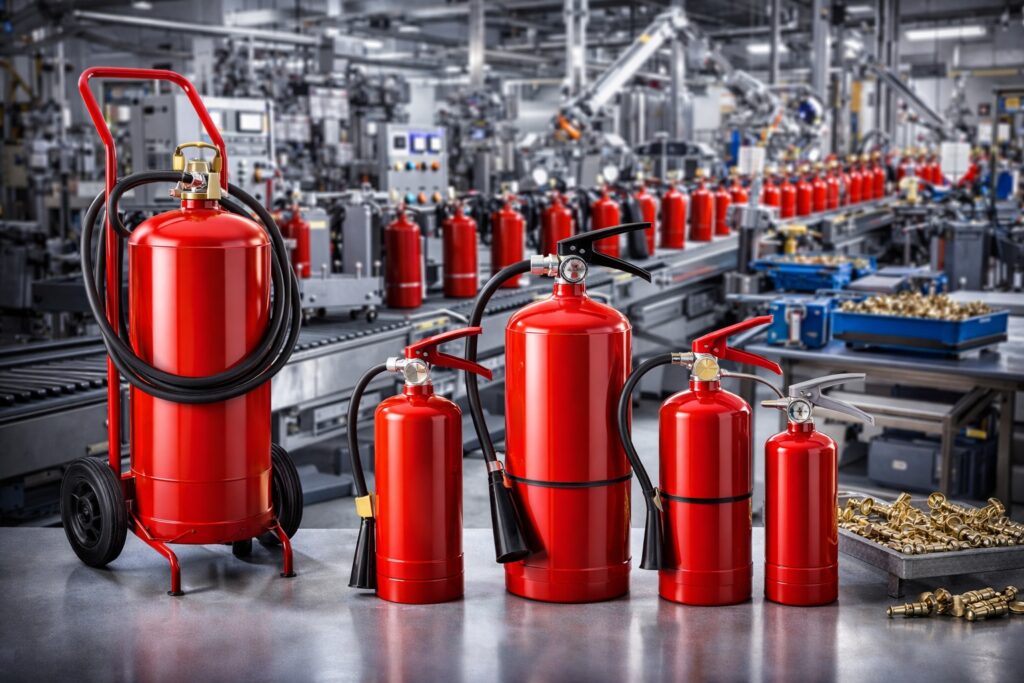
IMARC Group’s report, “Fire Extinguisher Manufacturing Plant Project Report 2026: Industry Trends, Plant Setup, Machinery, Raw Materials, Investment Opportunities, Cost and Revenue,” offers a comprehensive guide for establishing a manufacturing plant. The fire extinguisher manufacturing plant feasibility report offers insights into the manufacturing process, financials, capital investment, expenses, ROI, and more for informed business decisions.
Fire Extinguisher Manufacturing Plant Project Report Summary: –
- Comprehensive guide for setting up a fire extinguisher manufacturing plant.
- Covers market trends and industry outlook for 2026.
- Detailed project setup, including unit operations and processes.
- Raw material and utility requirements.
- Infrastructure and machinery specifications.
- Workforce and staffing requirements.
- Packaging and transportation details.
- Financial aspects: investment opportunities, cost analysis, and revenue projections.
In addition to covering operational aspects, the report offers detailed insights into the fire extinguisher manufacturing plant process and project economics.
- Detailed insights into the fire extinguisher manufacturing plant.
- In-depth project economics and financial metrics.
- Covers capital investments and project funding.
- Analysis of operating expenses and income projections.
- Breakdown of fixed and variable costs, direct and indirect expenses.
- Evaluation of ROI (Return on Investment) and NPV (Net Present Value).
- Profit and Loss account analysis.
- Comprehensive financial analysis for decision-making.
- Provides a roadmap for successfully establishing a fire extinguisher manufacturing.
What is Fire Extinguisher?
A fire extinguisher is a portable firefighting device designed to control or extinguish small fires before they escalate. It typically consists of a pressurized cylindrical container filled with agents such as water, foam, carbon dioxide, or dry chemical powder. These agents work by cooling the fire, displacing oxygen, or interrupting the combustion process. Fire extinguishers are essential safety tools used in residential, commercial, and industrial environments. They are classified based on the type of fire they can combat, ensuring effective fire suppression. Their compact design and ease of use make them critical for emergency response and fire safety management systems.
Request for a Sample Report: https://www.imarcgroup.com/fire-extinguisher-manufacturing-plant-project-report/requestsample
Is Fire Extinguisher Manufacturing Profitable?
Fire extinguisher manufacturing is a profitable business driven by steady demand from construction, industrial, and safety sectors. The global market is expanding, supported by strict fire safety regulations and increasing awareness. Profitability is strong, with gross margins ranging between 25-35% and net profits around 12-18%, indicating solid returns for manufacturers. The scalability of production and recurring replacement demand further enhance revenue opportunities. Overall, it offers a stable and long-term investment opportunity in the safety equipment industry.
How to Start Fire Extinguisher Manufacturing Plant?
Starting a fire extinguisher manufacturing plant involves selecting product types such as CO₂, foam, or dry powder extinguishers and conducting detailed market research. The setup requires procurement of raw materials like steel cylinders, valves, and extinguishing agents, along with installation of fabrication, filling, and testing equipment. Compliance with safety standards and certifications is essential. Efficient plant layout, skilled manpower, and quality control systems ensure operational success. A structured financial plan covering capital investment and operational costs is critical for long-term sustainability.
Market Trends and Drivers:
The fire extinguisher market is witnessing consistent growth due to increasing safety regulations across industries and rising awareness regarding fire hazards. The global market was valued at USD 5.98 Billion in 2025 and is projected to reach USD 9.20 Billion by 2034, growing at a CAGR of 4.9%. Key drivers include rapid urbanization, expanding construction activities, and stringent government mandates for fire safety equipment in residential and commercial buildings. Industrial growth and infrastructure development further boost demand. Additionally, technological advancements such as smart fire extinguishers with IoT-enabled monitoring systems are gaining traction. Increasing investments in safety infrastructure and heightened focus on workplace safety continue to strengthen market expansion, making it a stable and essential segment in the global safety equipment industry.
Key Insights Covered in the Fire Extinguisher Manufacturing Plant Report
Market Coverage:
- Market Trends: Analysis of current and emerging trends in the fire extinguisher market.
- Market Segmentation: Breakdown of the market by different segments.
- Regional Analysis: Distribution and performance of the market across various regions.
- Price Analysis: Evaluation of pricing trends for fire extinguisher.
- Impact of COVID-19: Examination of the effects of the COVID-19 pandemic on the fire extinguisher market.
- Market Forecast: Outlook and projections for the fire extinguisher industry.
Key Aspects Required for Setting Up a Fire Extinguisher Plant
Detailed Process Flow:
- Product Overview: Comprehensive description of the fire extinguisher product and its characteristics.
- Unit Operations Involved: Step-by-step breakdown of the various operations in the production process.
- Mass Balance and Raw Material Requirements: Calculations for material inputs and outputs, along with required quantities of raw materials.
- Quality Assurance Criteria: Standards and procedures to ensure the quality of the final product.
- Technical Tests: Essential tests and evaluations to maintain product consistency and compliance.
Project Details, Requirements, and Costs Involved
- Land, Location, and Site Development: Assessment of land requirements, optimal location selection, and site development costs.
- Plant Layout: Design and layout planning for efficient plant operations.
- Machinery Requirements and Costs: Identification of machinery needed, along with the associated costs.
- Raw Material Requirements and Costs: Determination of the types and quantities of raw materials required and their costs.
- Packaging Requirements and Costs: Specifications for packaging materials and equipment, including associated expenses.
- Transportation Requirements and Costs: Logistics planning and cost estimation for the transportation of raw materials and finished products.
- Utility Requirements and Costs: Analysis of utility needs (such as water, electricity, and fuel) and their associated costs.
- Human Resource Requirements and Costs: Workforce planning, including staffing needs, roles, and costs for labor and management.
Project Economics
- Capital Investments: Initial costs required for setting up the fire extinguisher manufacturing plant, including land, equipment, and infrastructure.
- Operating Costs: Ongoing expenses for running the plant, such as raw materials, labor, utilities, and maintenance.
- Expenditure Projections: Detailed forecasts of all costs over the short and long term.
- Revenue Projections: Expected income generated from the sale of fire extinguisher and by-products.
- Taxation and Depreciation: Analysis of tax obligations, incentives, and asset depreciation over time.
- Profit Projections: Estimated profitability based on costs, revenues, and market conditions.
- Financial Analysis: Comprehensive evaluation of the plant’s financial viability, including cash flow analysis, return on investment (ROI), and break-even point.
Ask Analyst for Customization: https://www.imarcgroup.com/request?type=report&id=9066&flag=C
Customization Options Available:
- Plant Location: Selection of optimal location for the plant.
- Plant Capacity: Customization based on desired production capacity.
- Machinery: Choice between automatic, semi-automatic, or manual machinery.
- List of Machinery Providers: Identification of suitable machinery suppliers.
Key Questions Addressed in This Report:
- How has the fire extinguisher market performed so far and how will it perform in the coming years?
- What is the market segmentation of the global fire extinguisher market?
- What is the regional breakup of the global fire extinguisher market?
- What are the price trends of various feedstocks in the fire extinguisher industry?
- What is the structure of the fire extinguisher industry and who are the key players?
- What are the various unit operations involved in a fire extinguisher manufacturing plant?
- What is the total size of land required for setting up a fire extinguisher manufacturing plant?
- What is the layout of a fire extinguisher manufacturing plant?
- What are the machinery requirements for setting up a fire extinguisher manufacturing plant?
- What are the raw material requirements for setting up a fire extinguisher manufacturing plant?
- And more…
How IMARC Can Help?
IMARC Group is a global management consulting firm that helps the world’s most ambitious changemakers to create a lasting impact. The company provide a comprehensive suite of market entry and expansion services. IMARC offerings include thorough market assessment, feasibility studies, company incorporation assistance, factory setup support, regulatory approvals and licensing navigation, branding, marketing and sales strategies, competitive landscape and benchmarking analyses, pricing and cost research, and procurement research.
Services:
- Plant Setup
- Factory Audit Services
- Regulatory Approvals, and Licensing
- Company Incorporation
- Incubation Services
- Recruitment Services
- Marketing and Sales
Contact Us:
IMARC Group
134 N 4th St. Brooklyn, NY 11249, USA
Email: sales@imarcgroup.com
Tel No:(D) +91 120 433 0800
United States: (+1-201971-6302)