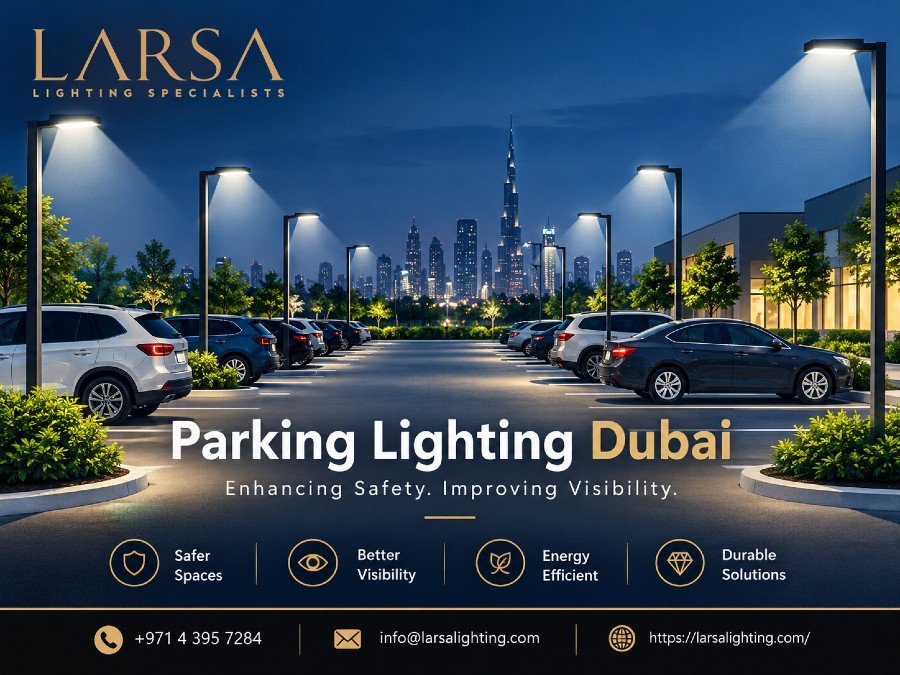
A well-lit parking area creates a positive first impression while helping drivers and pedestrians move safely through a property. Poor illumination, harsh glare, uneven brightness, and dark corners can make parking facilities uncomfortable and difficult to navigate. In Dubai, where commercial developments, residential communities, hotels, and retail destinations operate in varied conditions, effective parking illumination requires careful planning.
Parking Lighting Dubai projects should balance safety, visual comfort, energy efficiency, and architectural appeal. Rather than simply increasing brightness, a successful design places the right amount of light in the right locations and uses reliable luminaires and intelligent controls to support long-term performance.
Understand the Purpose of the Parking Area
Every parking facility has different lighting requirements. An open parking lot, an enclosed basement garage, a hotel drop-off zone, and a residential podium cannot necessarily use the same lighting approach.
Begin by identifying vehicle lanes, parking bays, ramps, pedestrian crossings, entrances, payment stations, staircases, and elevator lobbies. These areas experience different types of movement and require appropriate illumination.
Vehicle routes need sufficient horizontal light to reveal road markings, curbs, obstacles, and other vehicles. Pedestrian areas benefit from vertical illumination that makes people, signs, and entrances easier to recognize.
For hotels and premium developments, lighting should also complement the surrounding architecture and landscaping. Residential projects may require additional attention to limiting light spill into nearby homes. Understanding these priorities helps establish a practical lighting plan before selecting fixtures.
Prioritise Safety, Uniformity, and Glare Control
Brightness alone does not determine whether a parking area feels safe. Uneven illumination can create deep shadows between fixtures, behind columns, and around corners, making it harder for drivers and pedestrians to identify potential hazards.
Uniform light distribution helps users adapt comfortably as they move through the space. It can also support security camera performance by reducing extreme contrasts that obscure faces, vehicles, and other important details.
Glare control is equally important. Poorly positioned floodlights or exposed high-output LED sources may temporarily reduce a driver’s visibility, particularly near ramps, intersections, and garage exits.
Effective Parking Lighting Dubai designs use suitable optical distributions, shielding, and mounting angles to direct light towards the intended surfaces. Perimeter lighting should also be coordinated with landscaping, walkways, neighbouring properties, and CCTV locations to improve visibility without creating unnecessary light pollution.
Choose the Right Luminaires for Each Zone
Different parking zones benefit from different lighting products. Selecting fixtures according to their application can improve performance and simplify maintenance.
- Open parking lots: Pole-mounted LED area lights provide broad coverage across parking bays and vehicle routes. Their beam distribution should match the site’s layout and mounting heights.
- Covered parking and canopies: Recessed, surface-mounted, or linear LED luminaires can deliver comfortable illumination while maintaining a clean ceiling appearance.
- Enclosed garages: Linear LED systems and suitably rated, sealed fixtures provide practical illumination for concrete ceilings and demanding operating environments.
- Pedestrian pathways: Carefully positioned luminaires help highlight crossings, entrances, staircases, and routes connecting parking areas to buildings.
- Landscaped boundaries: Bollards and low-level lights can support wayfinding and highlight pedestrian routes, although they should not replace adequate general lighting.
Durability is essential, particularly in Dubai’s outdoor environment. Consider ingress protection, corrosion resistance, thermal performance, impact resistance, and driver reliability when specifying products. These characteristics influence maintenance requirements and the expected service life of the installation.
Balance Light Quality and Energy Efficiency
An effective design must provide suitable illumination without wasting energy. Lighting calculations should consider average and minimum illuminance, uniformity, vertical visibility, and the specific activities taking place in each zone.
The appropriate light levels depend on the facility’s use, applicable regulations, operating hours, and safety requirements. A residential parking area may need a different approach from an airport, hospital, or busy shopping destination.
Colour temperature also affects the atmosphere. Neutral white lighting is often suitable for parking environments because it supports visual clarity and presents surfaces naturally. Colour-rendering performance should be considered where users need to distinguish vehicle colours, clothing, signage, and surrounding finishes.
LED technology can reduce electricity consumption and maintenance demands compared with less efficient alternatives. However, efficiency depends on more than the light source itself. Appropriate optics, correct fixture placement, and well-planned operating schedules are equally important.
Introduce Smart Lighting Controls
Parking facilities do not experience consistent activity throughout the day. Lighting controls can adjust output according to occupancy, daylight, and operating schedules, helping reduce unnecessary energy consumption.
Photocells can switch exterior lighting in response to daylight conditions, while occupancy sensors can increase illumination when vehicles or pedestrians enter quieter areas. In enclosed garages, bi-level control maintains a background light level and raises output when movement is detected.
Controls must remain responsive and predictable. Delayed sensor activation can leave pedestrians uncomfortable, while excessive dimming may compromise visibility and surveillance. Suitable detection overlap, gradual transitions, and minimum illumination levels help maintain usability.
For larger developments, central monitoring may also help facility teams identify faults, track energy consumption, and manage operating schedules. The right system depends on the site’s complexity, maintenance resources, and operational requirements.
Coordinate Lighting With the Overall Development
Parking illumination should be integrated into the wider architectural and engineering plan. Pole positions must accommodate trees, signage, drainage, vehicle access, and future electric vehicle charging points. In enclosed garages, luminaire placement must account for beams, sprinklers, ducts, cable trays, and maintenance access.
Emergency lighting and backup power requirements should be addressed during the design stage. Escape routes, staircases, and exit pathways may require dedicated arrangements to provide dependable illumination during a power failure, according to applicable local regulations.
For architecturally sensitive developments, an on-site lighting mock-up can help assess glare, colour consistency, beam distribution, and the appearance of paving and facades after dark.
Plan for Long-Term Maintenance
A successful lighting installation should remain reliable well beyond the project’s completion. Select products with documented performance, accessible components where appropriate, and clear maintenance requirements.
Routine inspections should cover fixture cleanliness, damaged fittings, driver performance, sensor operation, and light output. Outdoor installations may require additional checks for corrosion, heat-related deterioration, and accidental impact.
For developers, contractors, and facility managers, Parking Lighting Dubai solutions work best when design quality, operational efficiency, and maintenance planning are considered together.
Larsa Lighting provides a relevant reference point for exploring lighting products and coordinated lighting approaches for different environments. By considering site requirements, visual comfort, reliable equipment, and energy management from the beginning, project teams can create parking facilities that are safer, more efficient, and better integrated with the surrounding property.