Boost Cooling Efficiency with Correct Refrigerant Charging – Modern air conditioning and heat pump systems are designed to deliver reliable comfort while minimizing energy consumption. However, even the most advanced HVAC equipment cannot perform efficiently if the refrigerant charge is incorrect. Proper refrigerant charging is one of the most critical maintenance procedures because it directly affects cooling capacity, energy efficiency, compressor reliability, and overall system lifespan.
Whether installing ac 1/2 pk a new unit or servicing an existing system, understanding the fundamentals of refrigerant charging helps technicians optimize system performance while preventing costly repairs. Accurate charging ensures that every component within the refrigeration cycle operates as intended.
Why Refrigerant Charging Matters
Refrigerant serves as the working fluid that absorbs heat from indoor spaces and releases it outdoors. Unlike fuel, refrigerant is not consumed during normal operation. Instead, it continuously circulates through the compressor, condenser, expansion device, and evaporator.
The amount of refrigerant inside the system must match the manufacturer’s specifications. Even a small deviation can significantly reduce efficiency and create operational problems.
Proper refrigerant charging provides several benefits:
- Maximum cooling and heating performance
- Lower electricity consumption
- Stable indoor comfort
- Reduced compressor stress
- Longer equipment lifespan
- Improved humidity control
- Fewer service callbacks
Incorrect charging, on the other hand, often causes poor temperature control, higher utility bills, and premature equipment failure.
Understanding Refrigerant Charge Levels
HVAC systems generally experience two charging conditions when the refrigerant quantity is incorrect.
Undercharged Systems
An undercharged air conditioner lacks sufficient refrigerant to absorb and transfer heat efficiently.
Common symptoms include:
- Longer cooling cycles
- Warm supply air
- Low suction pressure
- Frozen evaporator coils
- Compressor overheating
- Reduced energy efficiency
Most undercharged systems develop because of refrigerant leaks. Simply adding refrigerant without repairing the leak only provides a temporary solution.
Overcharged Systems
Adding excessive refrigerant is equally harmful.
An overcharged system may experience:
- High discharge pressure
- Increased compressor workload
- Poor cooling efficiency
- Flooded condenser
- Higher power consumption
- Possible compressor damage
Many people mistakenly believe “more refrigerant means better cooling,” but HVAC systems require a precise refrigerant charge rather than the maximum possible amount.
Factors That Affect Refrigerant Charging
Several variables influence the correct refrigerant charge.
System Design
Different HVAC systems use different charging procedures depending on the expansion device.
Common configurations include:
- Fixed orifice systems
- Capillary tube systems
- Thermostatic Expansion Valve (TXV)
- Electronic Expansion Valve (EEV)
Each design requires specific charging techniques recommended by the manufacturer.
Outdoor Temperature
Ambient temperature affects refrigerant pressures throughout the system. Technicians should consider environmental conditions during charging to obtain accurate measurements.
Indoor Heat Load
Occupancy, lighting, appliances, and solar gain influence evaporator performance. Stable indoor conditions produce more reliable charging results.
Refrigerant Type
Modern HVAC systems use different refrigerants, including:
- R-410A
- R-32
- R-454B
- Other low Global Warming Potential (GWP) refrigerants
Each refrigerant has unique pressure-temperature characteristics that require compatible gauges and charging procedures.
Common Refrigerant Charging Methods
Professional HVAC technicians rely on several charging techniques depending on system design.
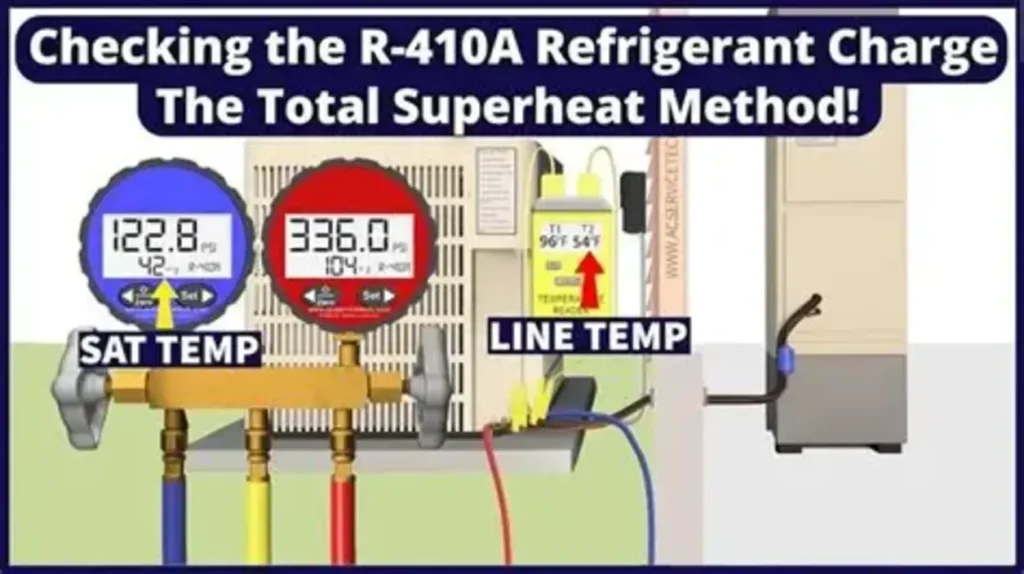
Superheat Method
The superheat method is commonly used for systems equipped with fixed metering devices.
Technicians compare the refrigerant temperature leaving the evaporator with its saturation temperature to determine whether the refrigerant charge is correct.
This method ensures the evaporator is fully utilized without allowing liquid refrigerant to reach the compressor.
Subcooling Method
Systems using TXV valves are generally charged using the subcooling method.
Subcooling measures how much the liquid refrigerant is cooled below its condensing temperature after leaving the condenser.
Maintaining proper subcooling ensures a steady supply of liquid refrigerant reaches the expansion valve.
Weigh-In Method
New installations often begin with the weigh-in method.
Technicians use an electronic refrigerant scale to add the precise factory-specified refrigerant charge before fine-tuning operating conditions.
This method is particularly useful after major repairs or complete refrigerant recovery.
Tools Required for Accurate Charging
Proper refrigerant charging depends on accurate measurements rather than guesswork.
Essential HVAC service tools include:
- Digital manifold gauges
- Refrigerant scale
- Temperature clamps
- Electronic leak detector
- Vacuum pump
- Micron gauge
- Recovery machine
- Pressure-temperature chart
- Personal protective equipment (PPE)
Digital diagnostic tools have greatly improved charging accuracy compared to older analog instruments.
Avoid Common Charging Mistakes
Several common mistakes can reduce HVAC efficiency or damage expensive components.
Charging Without Repairing Leaks
Adding refrigerant repeatedly without locating the leak wastes refrigerant and increases operating costs.
Always repair leaks before recharging.
Ignoring Airflow Problems
Restricted airflow caused by dirty filters, blocked evaporator coils, or failing blower motors can produce misleading pressure readings.
Verify proper airflow before diagnosing refrigerant charge.
Charging by Pressure Alone
Pressure readings do not provide enough information to determine the correct refrigerant charge.
Professional technicians combine pressure, temperature, superheat, and subcooling measurements for accurate diagnosis.
Mixing Refrigerants
Different refrigerants must never be mixed inside the same HVAC system.
Using incompatible refrigerants can damage compressors, reduce efficiency, and violate environmental regulations.
Benefits of Correct Refrigerant Charging
When refrigerant is charged accurately, HVAC systems operate at peak performance.
Homeowners and facility managers can expect:
- Faster cooling
- Consistent indoor temperatures
- Lower monthly energy costs
- Better humidity removal
- Quieter operation
- Reduced equipment wear
- Fewer emergency repairs
- Longer compressor life
For commercial buildings, these improvements can translate into substantial annual energy savings and lower maintenance expenses.
The Importance of Professional Service
Although refrigerant charging may appear straightforward, it requires specialized training, precision instruments, and knowledge of refrigeration principles.
Professional HVAC technicians understand how pressure, temperature, airflow, and system design interact during the charging process. They also follow safety procedures and environmental regulations governing refrigerant handling.
Routine maintenance inspections allow technicians to verify refrigerant charge before small performance issues become expensive repairs.
Conclusion
Correct refrigerant charging is one of the most effective ways to boost cooling efficiency and maintain reliable HVAC performance. Whether servicing residential air conditioners or commercial heat pump systems, maintaining the proper refrigerant charge ensures optimal heat transfer, improved energy efficiency, and longer equipment life.
Rather than relying on pressure readings alone or adding refrigerant as a quick fix, technicians should follow manufacturer-approved charging methods, verify airflow, inspect for leaks, and use calibrated diagnostic equipment. These best practices not only improve comfort but also protect valuable HVAC investments while reducing operating costs for years to come.
Frequently Asked Questions (FAQs)
1. How do I know if my air conditioner is low on refrigerant?
Common signs include reduced cooling performance, longer run times, frozen evaporator coils, unusually high electricity bills, and low suction pressure. A certified HVAC technician can confirm the refrigerant charge using professional diagnostic tools.
2. Can too much refrigerant damage an HVAC system?
Yes. Overcharging can increase system pressure, reduce efficiency, force liquid refrigerant into the compressor, and lead to premature compressor failure.
3. Should refrigerant be added during routine maintenance?
Not necessarily. Refrigerant is not consumed during normal operation. If a system is low on refrigerant, it usually indicates a leak that should be located and repaired before recharging.
4. Which charging method is the most accurate?
The appropriate method depends on the system design. Fixed-orifice systems typically use the superheat method, while TXV-equipped systems are generally charged using the subcooling method. New installations often begin with the weigh-in method according to manufacturer specifications.