Two car seats, a folded pushchair, a week’s groceries and a car park sitting at 45°C. That’s the real test for any family car in Abu Dhabi, and plenty of rentals fail it by the second weekend. If you’ve just relocated, or you’re here for a few months on a contract, monthly car rental in Abu Dhabi gets you a proper family SUV without a car loan, a big upfront purchase or the hassle of selling it when you leave. The hard part is choosing the right size. Go too small, and the boot fights you every Saturday. Go too big, and you’ll spend twenty minutes circling Hamdan Street for a bay.
What Actually Matters in a Family SUV Here
AC That Reaches the Back Seats
Every rental in the UAE has air conditioning. Not every one has rear vents, and that’s the bit families notice. A toddler in a rear-facing seat gets very little of the airflow from the dashboard, so on a July afternoon the front can feel fine while the back is still an oven.
Check for second-row vents before you commit, and third-row vents if you’re taking a seven-seater. When the car arrives, start it, put the fan on full and hold your hand to the rear vents. It takes two minutes and saves a month of complaints from the back.
Fuel Economy: Size Costs You Every Week
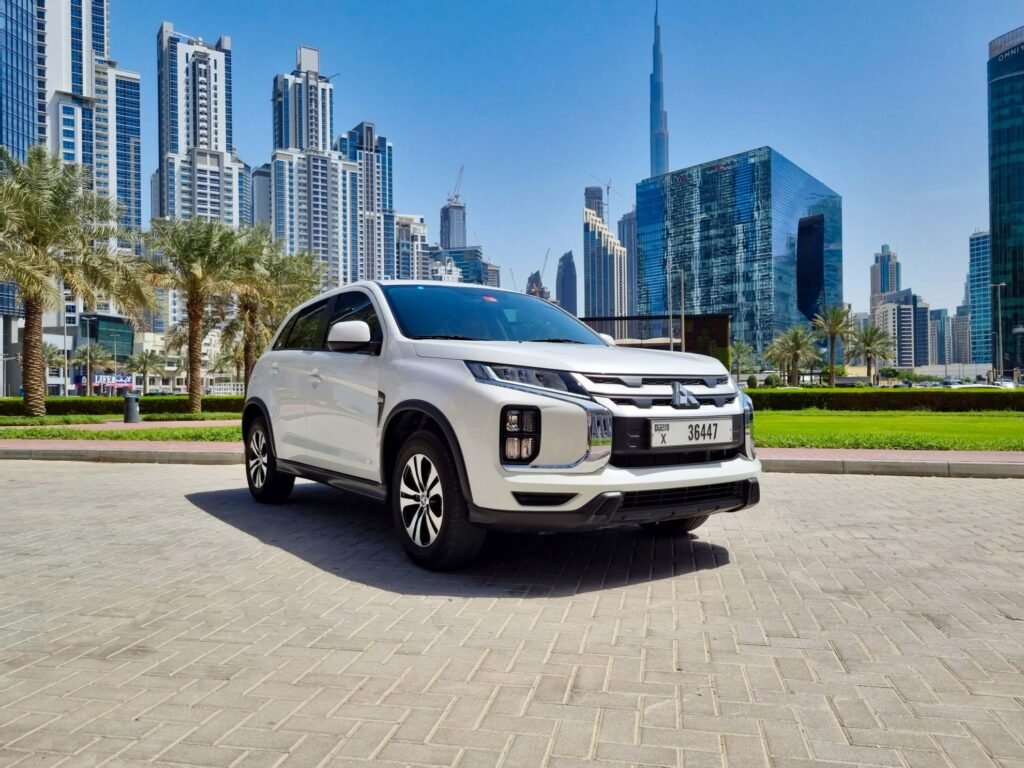
A compact SUV such as the Mitsubishi ASX or MG ZS runs on a small petrol engine and is cheap to run on the school run. A full-size seven-seater like the Nissan Patrol is a different animal: superb on the drive to Al Ain, thirsty in stop-start traffic on Muroor Road. UAE petrol prices are revised every month, so the gap moves around, but it never closes. If you won’t use the third row at least once a week, you’re paying to carry empty seats.
Boot Space: Test It With Your Own Kit
Spec sheets quote litres. Parents want to know whether the pushchair goes in without a fight. As a rough guide:
- Compact SUVs (ASX, MG ZS) take a folded pushchair plus a big supermarket shop.
- Mid-size SUVs such as the Hyundai Tucson add enough room for four people’s airport luggage.
- Seven-seaters (Mitsubishi Pajero, Hyundai Santa Fe, Nissan Patrol) are cavernous with the third row folded and surprisingly tight with it up.
That last point catches people out. With all seven seats in use, you may have room for school bags and not much else.
Safety Features That Earn Their Keep
UAE law requires children under four to ride in a proper child seat, and children under ten or shorter than 145 cm must sit in the back. So look for ISOFIX anchor points on the rear seats, which make fitting a child seat quicker and more secure. Add a reversing camera and parking sensors, and you’ll be grateful the first time you squeeze into a busy mall car park on a Saturday.
SUV, Sedan or Hatchback? Matching the Car to Abu Dhabi’s Roads
If you commute from Khalifa City onto the island, or head up the E11 to Dubai a few times a week, you’ll spend a lot of time at highway speed. A sedan is quiet and economical out there. A mid-size SUV gives you the same composure with a higher driving position, which helps when you’re reading traffic three lanes across.
Hamdan Street and Electra Street are another story. Parallel bays are tight, premium parking is capped at four hours, and you’re manoeuvring around delivery bikes and double-parked taxis. A hatchback slots in with room to spare. A seven-seater, honestly, is hard work here.
So which one? Two adults doing mostly city driving will be happiest in a hatchback or small sedan, and it’s the most affordable way in if you’re after cheap car rental in Abu Dhabi. A family of four with a mix of highway and city driving suits a compact or mid-size SUV. Five or more people, or regular weekends in Al Ain and Liwa, and the seven-seater earns its place.
Local Driving Realities: DARB, Mawaqif and the Speed Limit
DARB Toll Gates
Abu Dhabi’s DARB system charges AED 4 per crossing at the bridge gates during peak hours: 7 am to 9 am and 3 pm to 7 pm, Monday to Saturday. Sundays and public holidays are free at those gates. Two newer gates, at Ghantoot and Al Qurm, charge AED 4 on every crossing, around the clock.
Here’s what catches newcomers out. The daily and monthly caps were scrapped in September 2025. Cross a bridge gate twice a day in peak hours, six days a week, and you’re looking at roughly AED 200 a month. On a rental, those charges come to you through the rental company, so ask how they’re billed before you drive away.
Mawaqif Parking
Look at the kerb before you look for the meter. White-and-turquoise kerbs mean premium parking: AED 3 an hour, four hours maximum. Black-and-turquoise is standard: AED 2 an hour or AED 15 for the whole day. Paid hours run from 8 am to midnight, Monday to Saturday, and Sundays and public holidays are free. Friday is not free, which still surprises people who drove here before 2022. Resident-permit bays are the real trap: park in one after 9 pm without a permit and expect a fine.
No Speed Buffer. None.
In Dubai, radars on many roads are set to trigger some way above the posted limit. Abu Dhabi scrapped that buffer in August 2018. If the sign says 120, then 121 can get you flashed, and speeding fines start at AED 300. Limits change, too: part of the E311 dropped to 100 km/h in September 2026. Read the signs, not your memory of the road.
Why Choose Quick Drive for Monthly Car Rental in Abu Dhabi
Quick Drive keeps long-term car rental in Abu Dhabi straightforward. Monthly rates start from AED 1,170, and the car comes to you. Free doorstep delivery anywhere in Abu Dhabi means no taxi to a rental desk with two children and a suitcase.
Maintenance is included for the length of your contract, which matters when an SUV is working hard through an Abu Dhabi summer. If something does go wrong, Quick Drive’s roadside team works 24/7 and will either fix the car on the spot or bring you a replacement. Every rental includes collision damage waiver and third-party liability cover, and the cars are cleared to drive anywhere in the UAE.
The fleet runs from compact SUVs like the MG ZS and Mitsubishi ASX up to the Hyundai Tucson. If you’d rather arrive at a wedding or a client dinner in something special, Quick Drive also covers luxury car rental in Abu Dhabi, with options such as the Range Rover Sport, Nissan Patrol and Cadillac Escalade.
Frequently Asked Questions
Is monthly car rental in Abu Dhabi cheaper than renting by the day?
Almost always. A monthly contract works out far cheaper per day than a string of daily bookings, and it usually bundles insurance, maintenance and roadside support. If you need a car for more than two or three weeks, monthly is the sensible default.
Can I drive my rented SUV from Abu Dhabi to Dubai?
Yes. Quick Drive cars are cleared for travel across the UAE. Just remember that Dubai uses Salik tolls rather than DARB, and the Ghantoot gate on the Dubai road charges AED 4 at any hour. Both are charged back to you.
What documents do I need to rent a car in Abu Dhabi?
UAE residents need a valid UAE driving licence and Emirates ID. Visitors need a passport, visit visa and home licence, plus an International Driving Permit if their country isn’t on the UAE’s approved list. Quick Drive confirms the exact requirements when you book.
Who pays for DARB tolls and traffic fines on a rental?
You do. Tolls and fines are linked to the car’s plate, so the rental company receives them and charges them back to you, sometimes with an admin fee. Stick to posted limits and cross the bridges off-peak, and you’ll keep both low.
What size SUV do I need for a family of five?
A five-seat SUV like the Hyundai Tucson works if your children are older and you travel light. With car seats, a pushchair or regular guests, a seven-seater gives you breathing room, and folding the third row keeps the boot usable day to day.
Book Your Family SUV With Quick Drive
Tell Quick Drive where you are in Abu Dhabi, how many seats you need and when you want the car. They’ll bring it to your door, ready for Monday’s school run. Book your monthly rental with Quick Drive today and spend your first weekend exploring, not queuing at a rental desk.