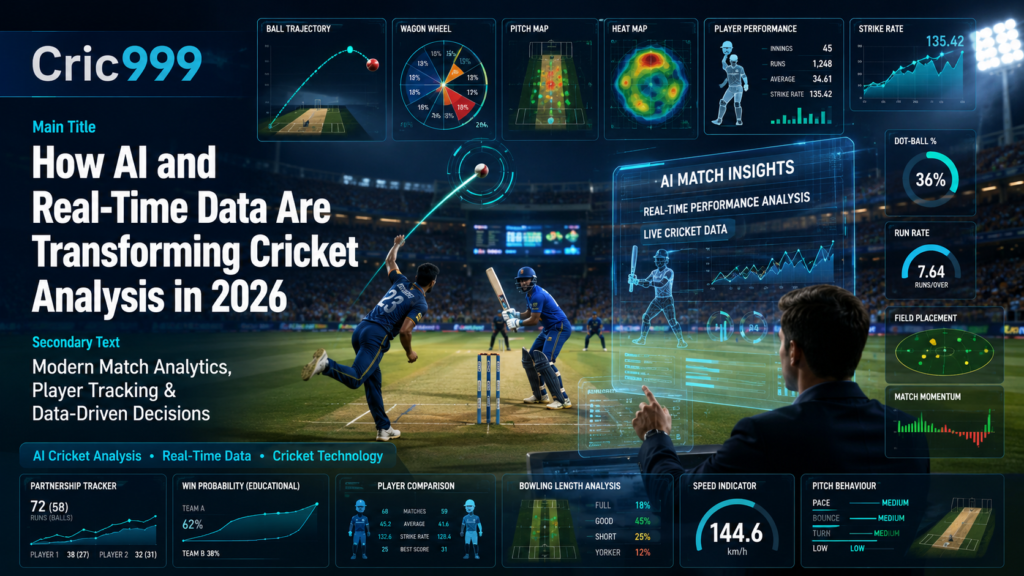
A scorecard can show that a team lost three wickets in five overs, but it cannot fully explain why the collapse happened. To understand the situation, analysts may examine the bowlers’ lengths, batter scoring areas, dot-ball pressure, field placements, changing pitch behaviour and individual matchups.
This wider approach has made real-time cricket data an important part of modern analysis. Official cricket coverage now uses technologies such as ball tracking, edge detection, advanced broadcast graphics and detailed performance information to help viewers interpret the game more clearly.
Educational resources such as Cric999 can help beginners understand how these different pieces of information connect without treating data as a guaranteed prediction.
What Does AI Mean in Cricket Analysis?
Artificial intelligence, or AI, refers to computer systems that can examine large amounts of information, recognise patterns and generate useful observations.
In cricket, an analytical system may compare thousands of deliveries to identify where a batter scores most frequently, which length creates the most difficulty or how a bowler performs against left-handed and right-handed players.
This does not mean that a computer knows what will happen next. AI in cricket analysis works with available data and historical patterns. Its conclusions may indicate possibilities, but they cannot account perfectly for human decisions, pressure, weather or unexpected moments.
The International Cricket Council has also explored innovation involving technologies such as artificial intelligence, machine learning, augmented reality and virtual reality through cricket-focused technology initiatives.
How Real-Time Data Improves Match Understanding
Real-time information gives viewers more context than the total score alone.
Suppose a chasing team needs 70 runs from the final seven overs. The required run rate looks manageable, but a deeper live score analysis may reveal that:
- The set batter has been dismissed.
- The new batter struggles against wrist spin.
- The boundary on one side is longer.
- The bowling team has two strong death-over specialists available.
- The required run rate has increased after several dot balls.
Analysts may also examine batter scoring areas, bowler line and length, boundary frequency, partnership development, pitch pace, bounce and changes in field placement.
These details help explain the direction of a match. A rising dot-ball percentage, for example, may show that pressure is building even before a wicket falls. Similarly, repeated boundaries in one area may lead the captain to reposition a fielder or change the bowling plan.
Player-Performance Tracking and Workload Management
Player-performance tracking is not limited to runs and wickets. Teams may study bowling workload, running intensity, batting consistency, strike rotation, boundary percentage and performance against particular bowling styles.
Training and match information may also help support workload planning. Relevant factors can include:
- Number of overs bowled
- Recent travel and match schedule
- Previous injury history
- Training intensity
- Recovery time
- Running and movement patterns
- Changes in performance over several matches
In March 2026, the BCCI publicly invited proposals for national-team performance-analysis services involving real-time match analysis, video analysis, data collection and statistical modelling. This provides a clear example of how formal cricket organisations use structured analytical services to support decision-making.
However, technology cannot perfectly predict an injury. It may help professionals notice unusual patterns or manage workload more carefully, but medical evaluation and human judgement remain essential.
Data-Driven Team Selection and Matchups
Modern team selection involves more than choosing the eleven players with the highest recent scores.
Analysts may compare:
- Left-hand and right-hand matchups
- Performance against pace and spin
- Powerplay effectiveness
- Middle-over strike rotation
- Death-over batting or bowling
- Venue history
- Recent form
- Role suitability
- Fielding contribution
A batter with a lower overall average may still be valuable if the team needs someone who can attack spin in the middle overs. Similarly, a bowler may be selected because their slower deliveries suit a particular pitch or because they have a favourable matchup against key opposition batters.
A useful Cric999 cricket analysis guide encourages readers to examine format, conditions, player roles and match situations together rather than judging a player from one innings or a single performance metric.
Data provides evidence, but selectors must still consider team balance, fitness, leadership and tactical requirements.
How AI Helps with Pitch and Venue Analysis
Pitch and venue analysis can combine current observations with historical information.
Analysts may study:
- Average first-innings totals
- New-ball movement
- Spin assistance
- Boundary dimensions
- Dew conditions
- Weather forecasts
- Toss influence
- Previous chasing records
For example, historical records may suggest that a venue favours chasing under lights because of dew. However, that pattern does not guarantee the same result in every match. A fresh pitch, unusual weather, stronger bowling attack or early wickets can change the situation.
AI tools can organise and compare this information quickly, but the final interpretation should include current match conditions. Historical data is most useful as context, not certainty.
Can AI Predict the Winner of a Cricket Match?
Predictive cricket models may calculate the probability of different outcomes by examining the score, wickets remaining, required run rate, player records and previous matches.
A model might suggest that one team is in a stronger position, but cricket remains affected by events that are difficult to predict, including:
- A sudden injury
- An unexpected toss decision
- Rain or changing weather
- A dropped catch
- Player pressure
- A tactical bowling change
- An exceptional individual performance
Probability should therefore be understood as an estimate based on available information.
No AI system, analyst or cricket website can guarantee the result of a match. A responsible interpretation explains why an outcome appears more or less likely without presenting it as certain.
Responsible Use of Online Cricket Information
Cricket information can spread rapidly through social media, messaging groups and unofficial websites. Before accepting a claim, readers should compare it with announcements from official cricket boards, recognised broadcasters, tournament organisers and established sports publications.
This is especially important when researching topics connected with an Online Betting ID. Users should approach such information carefully and should:
- Check applicable laws in their location.
- Confirm age restrictions.
- Investigate whether a platform is legitimate.
- Read its privacy and account-security policies.
- Never share passwords, PINs or OTPs.
- Avoid guaranteed-profit or guaranteed-winning claims.
- Protect personal and financial information.
- Avoid acting on unverified predictions.
Cric999 presents this subject from an awareness and responsible digital-behaviour perspective. Educational cricket analysis should help readers understand the game, not encourage risky financial decisions.
How Beginners Can Analyse Cricket Data More Effectively
Beginners do not need complicated software to improve their analysis. A structured process is often enough.
- Start with the format: Test, ODI and T20 cricket require different strategies.
- Study the conditions: Check pitch behaviour, weather and boundary size.
- Confirm the playing XIs: Avoid analysis based only on expected teams.
- Compare player roles: A finisher should not be assessed in the same way as an opener.
- Observe partnerships: Strong partnerships can reduce pressure and control the required rate.
- Track the match situation: Look at wickets, overs remaining and available bowlers.
- Use historical data carefully: Past records provide context but not certainty.
- Verify important claims: Use official cricket boards and trusted publications.
- Treat predictions as probabilities: Never assume an outcome is guaranteed.
The ICC’s official website can be used as an authoritative reference for playing conditions, international schedules, rankings and regulations. Its DRS guidance also explains how technology assists match officials rather than replacing the decision-making process entirely.
The Future of Cricket Analysis
Cricket analytics technology is likely to become more accessible to teams, broadcasters and ordinary viewers.
Future developments may include improved player tracking, automated video analysis, better workload monitoring, faster tactical insights and more personalised statistics. Broadcast graphics may also make advanced information easier for beginners to understand.
The 2026 ICC Men’s T20 World Cup broadcast plans included off-bat tracking, DRS services, ball tracking, edge detection and data-led graphics, showing how multiple technologies can be combined to enrich match coverage.
Even with these developments, interpretation will remain important. A number cannot fully explain confidence, leadership, pressure or tactical creativity. Technology works best when it supports experienced human observation.
Frequently Asked Questions
1. What is AI in cricket analysis?
AI in cricket analysis refers to computer-based systems that examine large amounts of match and player data to identify useful patterns. These systems may analyse batting areas, bowling lengths, player matchups, scoring rates and historical performances. AI supports analysis, but it cannot guarantee future results.
2. How is real-time data used during a cricket match?
Real-time data helps analysts and viewers understand changing match situations. It may include the current run rate, required run rate, dot-ball percentage, batter scoring zones, bowler line and length, field placements, partnerships and weather conditions. This information provides more context than the score alone.
3. Can AI accurately predict the winner of a cricket match?
AI-based models can estimate the probability of different outcomes using available data. However, they cannot predict every event accurately. Injuries, dropped catches, weather changes, pressure, tactical decisions and individual performances can completely change a match.
4. How does data help with team selection?
Data can help selectors compare players according to recent form, role suitability, performance against pace or spin, powerplay records, death-over ability, venue history and fielding contribution. Final selection decisions should also consider fitness, team balance, experience and current match conditions.
5. Can cricket technology help prevent player injuries?
Player-tracking systems and workload data may help teams identify signs of fatigue, excessive bowling workload or changes in movement patterns. However, technology cannot perfectly predict or prevent injuries. Medical assessment, recovery planning and professional judgement remain necessary.
Conclusion
AI and real-time data are making cricket analysis more detailed, accessible and evidence-based. Ball-by-ball information, player matchups, workload indicators, pitch records and performance metrics can help readers understand why a match is changing rather than simply following the score.
However, data should support human judgement, not replace it. Every statistic needs context, and every predictive model has limitations.
Cric999 offers an educational approach to match analysis, cricket statistics and responsible digital behaviour. Readers who combine reliable data with format, conditions, player roles and verified sources can develop a more balanced understanding of the game. The most valuable analysis does not promise certainty; it asks better questions and explains the evidence clearly.