Artificial intelligence is moving beyond experimentation and becoming a strategic capability for governments and enterprises. Across the Gulf Cooperation Council (GCC), investments in computing infrastructure, data centers, cloud platforms, connectivity, and AI ecosystems are accelerating to support this transition.
As AI workloads become more demanding, infrastructure is no longer simply an IT foundation. It has become an important business and national asset that influences data control, cybersecurity, operational resilience, innovation, and economic competitiveness.
This shift is driving demand for sovereign AI infrastructure that can provide greater control over where sensitive data and AI workloads are processed. For GCC organizations, the objective is not only to build more computing capacity but also to establish secure, scalable, and strategically controlled environments capable of supporting long-term AI adoption.
What Is Sovereign Compute and Why Does It Matter?
Sovereign compute refers to computing infrastructure designed to provide greater control over the location, management, security, and processing of critical workloads. It is particularly relevant when organizations handle sensitive government information, financial data, healthcare records, intellectual property, or other regulated information.
AI makes this requirement more significant because modern AI systems can process enormous volumes of data and require substantial computing resources.
A sovereign computing strategy can help organizations strengthen:
- Data residency and processing controls
- Infrastructure security and governance
- Compliance with regional regulations
- Protection of sensitive AI workloads
- Business continuity and operational resilience
- Control over critical computing resources
For enterprises operating in regulated sectors, sovereignty can therefore become an important part of AI infrastructure planning rather than an optional consideration.
Why the GCC Is Investing in AI Infrastructure
The GCC is undergoing a significant digital transformation. Governments across the region are investing in AI, cloud computing, digital services, and advanced infrastructure as part of broader economic and technology strategies.
Several factors are contributing to this growth.
Growing Demand for AI Compute
AI applications require significantly more computing power than many conventional enterprise workloads. Training foundation models, running inference workloads, processing large datasets, and deploying AI agents can require specialized infrastructure.
Increasing Importance of Data Sovereignty
Organizations in finance, healthcare, government, telecommunications, and energy often need greater control over sensitive information. Local infrastructure can help address data residency and regulatory requirements.
Building Regional Technology Capabilities
Developing local computing capacity can reduce infrastructure dependency, support innovation, attract technology investment, and create opportunities for regional AI ecosystems.
These developments are helping accelerate the growth of GCC AI infrastructure and creating new opportunities for enterprises that want to deploy AI at scale.
The Role of Data Centers in Sovereign AI
Data centers are the physical foundation of sovereign AI infrastructure. However, AI workloads create requirements that differ considerably from traditional enterprise applications.
High-density GPU environments generate significant power and thermal demands. They also require high-speed networking and storage to prevent infrastructure bottlenecks.
AI-ready data centers need to address:
- High-density computing
- Advanced cooling and thermal management
- Reliable power infrastructure
- High-bandwidth networking
- High-performance storage
- Physical security
- Cybersecurity controls
- Infrastructure scalability
For GCC organizations, developing these capabilities locally can create a stronger foundation for AI adoption while improving control over sensitive workloads.
Another important consideration is future readiness. AI hardware and software are evolving quickly, so infrastructure should be flexible enough to accommodate new accelerator technologies, changing workload requirements, and increasing demand for inference.
GPUs Are Only One Part of the AI Infrastructure Strategy
GPUs are essential for many AI workloads, but simply purchasing additional computing hardware does not guarantee an efficient AI environment.
Organizations also need to optimize how computing resources are scheduled, monitored, and consumed.
Key considerations include:
- GPU utilization
- Workload scheduling
- Network performance
- Storage throughput
- Capacity planning
- Infrastructure monitoring
- Power efficiency
- Cost optimization
Poorly managed GPU infrastructure can result in significant unused capacity. Effective orchestration and monitoring are therefore critical to achieving a strong return on AI infrastructure investments.
How GCC Countries Are Building Sovereign AI Ecosystems
The GCC is not following a single infrastructure model. Each country is developing its capabilities according to its economic priorities, technology strategies, and national requirements.
UAE
The UAE has established itself as a major regional technology and AI hub. Investments in data centers, cloud infrastructure, AI initiatives, and digital platforms are contributing to a mature technology ecosystem.
Its infrastructure development is also strengthening the wider AI infrastructure GCC landscape by creating opportunities for global technology companies, investors, and AI-focused organizations.
Saudi Arabia
Saudi Arabia is making substantial investments in digital transformation and emerging technologies. AI infrastructure is becoming increasingly important across government, energy, finance, healthcare, and other strategic industries.
The combination of technology investment, digital initiatives, and large-scale infrastructure development is creating the computing foundation needed for advanced AI applications.
Qatar and Other GCC Markets
Qatar continues to develop its digital capabilities, including AI research and high-performance computing. Bahrain, Kuwait, and Oman are also expanding their digital infrastructure and cloud capabilities.
Together, these developments are contributing to a more connected regional AI ecosystem.
Sovereign Cloud vs. Sovereign Compute
Sovereign cloud and sovereign compute are closely related but serve different infrastructure objectives.
A sovereign cloud generally focuses on ensuring that cloud services, data, and operations meet specific jurisdictional requirements. Sovereign compute places greater emphasis on control over the computing resources used to process workloads.
Organizations evaluating a sovereign cloud GCC strategy should consider:
- What types of data will be processed?
- Which workloads require local processing?
- What regulatory requirements apply?
- How much infrastructure control is necessary?
- Can sensitive and non-sensitive workloads be separated?
- Would a hybrid architecture provide greater flexibility?
For some organizations, a sovereign cloud environment may provide sufficient control. Others may require dedicated computing environments for highly sensitive workloads.
Hybrid architectures can also combine controlled infrastructure for critical applications with public or regional cloud resources for less sensitive workloads.
Building the Infrastructure Stack for Sovereign AI
Sovereign AI requires an integrated technology stack rather than isolated hardware investments.
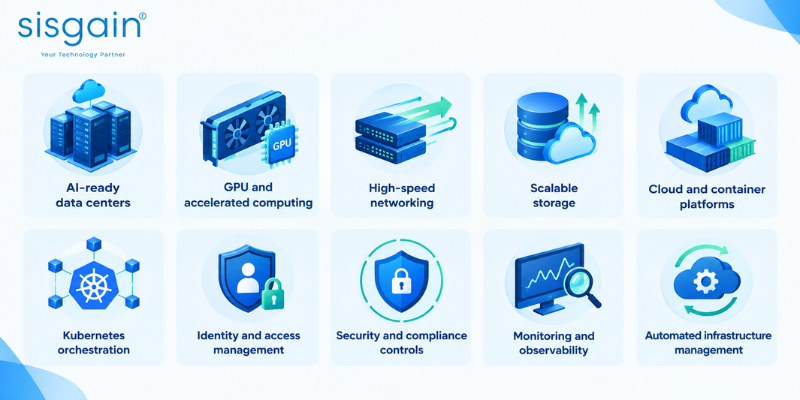
A modern infrastructure environment may include:
- AI-ready data centers
- GPU and accelerated computing
- High-speed networking
- Scalable storage
- Cloud and container platforms
- Kubernetes orchestration
- Identity and access management
- Security and compliance controls
- Monitoring and observability
- Automated infrastructure management
Managing all these components can become increasingly complex as organizations scale their AI operations.
This is where IT Infrastructure Management Services can provide business value. A structured infrastructure management strategy can help organizations monitor performance, maintain availability, optimize resources, identify infrastructure issues, and support long-term scalability.
For enterprises planning large-scale AI adoption, infrastructure management should be considered alongside AI development rather than treated as a separate operational function.
Kubernetes Is Becoming Important for AI Workloads
Cloud-native infrastructure is becoming an important component of modern AI platforms. Kubernetes provides organizations with a flexible framework for deploying and managing containerized workloads across complex infrastructure environments.
For AI applications, Kubernetes can support:
- Containerized AI workloads
- GPU resource scheduling
- Application deployment
- Automated scaling
- Workload isolation
- Hybrid and multi-cloud environments
- Infrastructure portability
Organizations with specialized AI requirements may use Kubernetes Development Services to build customized platforms for AI applications, data pipelines, APIs, GPU workloads, and other cloud-native components.
A well-designed Kubernetes environment can also improve operational consistency by giving development and infrastructure teams standardized tools for deploying and managing applications.
Security and Compliance Must Be Built Into AI Infrastructure
As AI becomes part of critical business processes, security cannot be treated as an afterthought.
Sovereign AI environments should address infrastructure, application, data, and access security together.
Important controls include:
- Encryption at rest and in transit
- Identity and access management
- Network segmentation
- Zero Trust security
- Workload isolation
- Continuous monitoring
- Secure software supply chains
- Compliance management
- Infrastructure access governance
Organizations should also establish clear policies governing where AI workloads can run, who can access them, and how sensitive data can be used.
This approach helps create an AI environment that is not only powerful but also manageable and defensible from a security and compliance perspective.
Managing the Cost of Sovereign Compute
Sovereign infrastructure can require substantial investment in hardware, facilities, energy, networking, software, and specialized talent.
Cost management therefore needs to be part of the infrastructure strategy from the beginning.
Organizations can improve efficiency by:
- Monitoring GPU utilization
- Identifying idle resources
- Optimizing workload scheduling
- Forecasting infrastructure demand
- Automating resource allocation
- Measuring infrastructure performance
- Connecting infrastructure spending with business outcomes
FinOps principles can also help organizations understand the financial impact of AI workloads and make better decisions about infrastructure capacity.
The goal should not simply be to reduce infrastructure spending. Instead, enterprises should maximize the value generated by every unit of computing capacity.
What Sovereign Compute Means for GCC Industries
The growth of sovereign compute can have a significant impact across industries that depend on sensitive data and high-performance computing.
Financial Services
Banks and financial institutions can use controlled AI environments for fraud detection, risk analysis, customer intelligence, and regulatory applications.
Energy
Oil and gas organizations can apply AI to predictive maintenance, exploration, operational optimization, and industrial analytics.
Healthcare
Healthcare providers can benefit from AI-powered diagnostics, research, and data analysis while maintaining strict controls over sensitive information.
Government
Government agencies can use sovereign AI infrastructure for citizen services, intelligent automation, national analytics, and digital platforms.
Telecommunications
Telecommunications providers can apply AI to network optimization, customer service, security, and infrastructure management.
These use cases demonstrate why AI infrastructure is increasingly being viewed as strategic infrastructure rather than simply another technology investment.
Key Takeaways for Enterprises
The GCC’s investment in sovereign compute offers several important lessons for organizations planning their AI strategies:
- AI infrastructure should be treated as a strategic business capability, not only as an IT expense.
- Sovereignty should be considered early when workloads involve sensitive or regulated information.
- GPU capacity needs effective management to prevent underutilization and unnecessary costs.
- Cloud-native platforms can improve scalability and infrastructure flexibility.
- Security and compliance should be embedded into infrastructure architecture from the beginning.
- Infrastructure management requires continuous optimization as AI workloads evolve.
- Hybrid architectures can provide a balance between sovereignty, scalability, and cloud flexibility.
Enterprises that address these areas early can build stronger foundations for long-term AI adoption.
The Future of Sovereign Compute in the GCC
The GCC’s AI infrastructure landscape is likely to expand as organizations move from AI experimentation toward production-scale deployments.
Future developments may include more AI-focused data centers, regional computing platforms, advanced inference infrastructure, sovereign cloud environments, and specialized AI models.
The region may also see deeper integration between data centers, telecommunications networks, cloud platforms, and AI services.
As this ecosystem matures, sovereign compute could become more than a mechanism for meeting regulatory requirements. It could become a competitive advantage that enables organizations to process sensitive workloads closer to their customers, data, and operational environments.
Conclusion
AI infrastructure is becoming strategic infrastructure as governments and enterprises increasingly depend on AI for critical operations, innovation, and economic growth. The GCC’s investments in data centers, accelerated computing, cloud platforms, and digital ecosystems reflect this changing role.
The development of sovereign AI infrastructure can provide organizations with greater control over sensitive workloads while supporting security, compliance, resilience, and innovation. At the same time, technologies such as Kubernetes, cloud-native platforms, and professional infrastructure management can help enterprises operate these environments efficiently.
As the GCC continues strengthening its position in the global AI landscape, sovereign compute will increasingly influence how organizations build, secure, scale, and manage the infrastructure behind their AI strategies.
Frequently Asked Questions
1. What is sovereign AI infrastructure?
Sovereign AI infrastructure is computing infrastructure designed to provide greater control over AI workloads, data processing, security, and infrastructure operations within a specific jurisdiction.
2. Why is sovereign compute important for the GCC?
Sovereign compute can help GCC organizations strengthen data control, regulatory compliance, cybersecurity, digital resilience, and access to locally managed AI computing resources.
3. How is the GCC developing AI infrastructure?
GCC countries are investing in AI-ready data centers, GPUs, high-speed networks, cloud platforms, storage, cybersecurity, and advanced computing capabilities to support large-scale AI adoption.
4. What is the difference between sovereign cloud and sovereign compute?
Sovereign cloud focuses on controlling cloud services, data, and operations according to local requirements, while sovereign compute places greater emphasis on controlling the underlying computing resources.
5. Why are GPUs important for sovereign AI infrastructure?
GPUs provide the accelerated computing capacity required for demanding AI workloads, including model training, inference, large-scale data processing, and AI application deployment.
6. How does Kubernetes support AI infrastructure?
Kubernetes helps organizations orchestrate containerized AI workloads, manage GPU resources, automate scaling, and operate applications across private, hybrid, and multi-cloud environments.