Key Takeaways
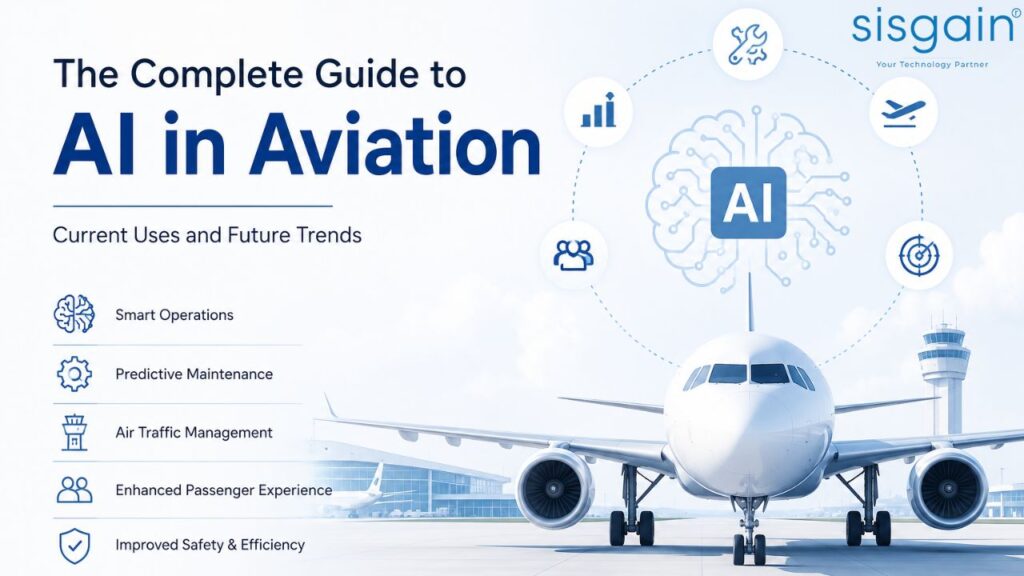
- AI is transforming the aviation industry by improving safety, efficiency, and decision-making across all operations.
- Airlines, airports, and aircraft manufacturers are rapidly adopting AI to solve complex operational challenges.
- Predictive maintenance, smart airports, and AI-driven flight optimization are already widely used in the aviation sector.
- Generative AI and digital twins are shaping the next phase of innovation in aviation technology.
- The future of aviation will focus on automation, sustainability, and real-time intelligent systems powered by AI.
- Companies investing in AI today will gain a strong competitive advantage in the global aviation market.
The aviation industry is undergoing one of the most significant technological shifts in its history, driven largely by the rapid adoption of digital systems and intelligent automation. Among these advancements, AI in Aviation has emerged as a transformative force reshaping how airlines, airports, and aircraft operations function on a global scale. From improving safety standards to optimizing operational efficiency, artificial intelligence is no longer a futuristic concept—it is an active and essential part of modern aviation systems.
In today’s AI in Aviation Industry, data plays a central role. Every flight generates vast amounts of information, including engine performance metrics, weather conditions, air traffic patterns, and passenger behavior. Traditionally, much of this data remained underutilized due to its complexity and scale. However, with the integration of AI and Aviation technologies, organizations can now process and analyze this data in real time to make faster, smarter, and more accurate decisions.
One of the key reasons AI is gaining momentum in aviation is its ability to enhance both safety and efficiency simultaneously. Airlines are using AI-driven predictive maintenance systems to detect potential aircraft failures before they occur, reducing downtime and preventing costly disruptions. Airports are leveraging AI-powered systems for crowd management, baggage handling, and security screening, ensuring smoother passenger experiences. Meanwhile, air traffic management is becoming more precise and adaptive with AI-based forecasting and optimization tools.
Another major factor driving adoption is the competitive advantage AI provides. Airlines and aviation companies that implement AI technologies are able to reduce operational costs, improve fuel efficiency, and deliver more personalized passenger services. In an industry where margins are tight and customer expectations are high, these advantages are critical.
In this guide, readers will explore how AI is currently being used across different segments of aviation and gain insights into the future innovations that are set to redefine the industry. From automation in cockpit systems to generative AI in customer service, this article will provide a comprehensive understanding of where aviation is today—and where it is heading next.
What Is AI in Aviation?
AI in aviation refers to the application of advanced computational systems that can simulate human intelligence to improve decision-making, automate complex processes, and enhance operational efficiency within the aviation ecosystem. It encompasses a wide range of technologies and use cases across airlines, airports, air traffic management, and aircraft manufacturing.
Understanding Artificial Intelligence in Aviation
At its core, AI in Aviation Industry involves using intelligent algorithms to analyze data, identify patterns, and make predictions that support aviation operations. These systems are designed to assist—not replace—human expertise, ensuring safer, faster, and more efficient decision-making. From autopilot enhancements to predictive maintenance, AI is embedded in multiple layers of aviation infrastructure.
Core Technologies Powering AI in Aviation
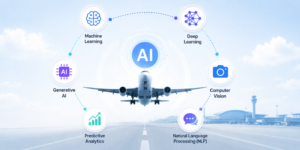
Several advanced technologies work together to enable AI capabilities in aviation:
Machine Learning: Enables systems to learn from historical data and improve accuracy over time without explicit programming. It is widely used in demand forecasting, fuel optimization, and maintenance scheduling.
Deep Learning: A subset of machine learning that uses neural networks to process large volumes of complex data such as images, speech, and sensor inputs. It plays a key role in computer vision systems used for runway safety and aircraft inspection.
Computer Vision: Allows machines to interpret visual data from cameras and sensors. In aviation, it is used for identifying runway obstructions, inspecting aircraft surfaces, and enhancing airport security.
Natural Language Processing (NLP): Helps systems understand and respond to human language. It is widely used in AI-powered chatbots, customer service automation, and pilot communication systems.
Predictive Analytics: Uses historical and real-time data to forecast future events such as maintenance needs, flight delays, or passenger demand.
Generative AI: A newer advancement that can create text, images, and simulations. In aviation, it is being explored for training simulations, automated reporting, and customer engagement tools.
Why Aviation Is an Ideal Industry for AI Adoption
The aviation sector generates massive volumes of structured and unstructured data every second—from flight sensors and radar systems to passenger booking platforms. This makes it an ideal environment for AI systems to operate effectively. Additionally, aviation requires high levels of precision, safety, and efficiency, all of which align perfectly with AI capabilities.
Evolution of AI in the Aviation Industry
The use of AI in aviation has evolved from basic automation systems to advanced intelligent platforms. Initially, aviation relied heavily on rule-based software for navigation and scheduling. Over time, these systems evolved into data-driven platforms capable of real-time decision-making. Today, AI is integrated into nearly every aspect of aviation, including flight operations, maintenance, customer service, and logistics.
AI vs Traditional Aviation Software
Traditional aviation software is typically rule-based, meaning it follows predefined instructions without adapting to new data. In contrast, AI-powered systems continuously learn and improve from incoming data. This adaptability allows AI systems to handle complex and dynamic aviation environments more effectively, making them significantly more efficient than traditional solutions.
Why AI Is Becoming Essential in Modern Aviation
The aviation industry is becoming increasingly complex due to rising demand, stricter regulations, and operational pressures. In this environment, AI for Aviation is no longer just an advanced technology—it has become a core requirement for efficient and safe operations. Across the global AI in Aviation Industry, artificial intelligence is helping airlines and airports solve challenges that traditional systems can no longer manage effectively.
One of the biggest reasons AI is becoming essential is the continuous rise in operational costs. Airlines spend a major portion of their budget on fuel, maintenance, and staffing. AI helps reduce these costs by improving fuel efficiency, predicting maintenance issues before they occur, and optimizing the use of resources across operations.
At the same time, passenger expectations have changed dramatically. Travelers today expect fast, smooth, and personalized experiences at every stage of their journey. AI enables airlines to meet these expectations by automating services such as check-ins, flight updates, and customer support through chatbots and virtual assistants. This not only improves customer satisfaction but also reduces workload on airline staff.
Another major factor is the rapid growth in global air traffic. With more flights operating than ever before, airports and airspace systems face congestion and delays. AI helps manage this complexity by analyzing real-time data and improving scheduling, routing, and traffic flow to ensure smoother operations.
Safety and compliance requirements are also becoming more demanding. Aviation authorities require strict adherence to safety standards, and even minor errors can have serious consequences. AI strengthens safety systems by continuously monitoring aircraft performance, detecting anomalies, and predicting potential risks before they turn into failures.
Environmental sustainability is another growing challenge. The aviation sector is under pressure to reduce carbon emissions and adopt greener practices. AI contributes by optimizing flight paths, reducing unnecessary fuel consumption, and supporting more sustainable operational strategies.
Finally, aviation depends heavily on real-time decision-making. Weather changes, technical issues, and traffic conditions can shift within minutes. AI processes large volumes of real-time data instantly, enabling faster and more accurate decisions that keep operations safe and efficient.
In this evolving landscape, Aviation Software Development in Dubai is playing a crucial role in enabling companies to build advanced AI-driven aviation systems that support these complex operational needs.
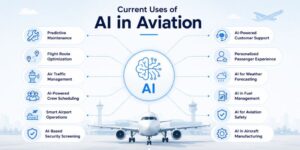
Current Uses of AI in Aviation
Artificial intelligence is already deeply integrated into modern aviation systems and is actively reshaping how airlines, airports, and aviation authorities function. From improving safety to enhancing passenger experience, AI is being used across nearly every part of the aviation ecosystem.
1. Predictive Aircraft Maintenance
One of the most important applications of AI in aviation is predictive maintenance, which focuses on identifying technical issues before they cause failures.
In traditional systems, aircraft are maintained on fixed schedules, regardless of their actual condition. However, with AI, maintenance becomes data-driven. Sensors installed in aircraft continuously collect information such as engine temperature, vibration levels, fuel performance, and system pressure. AI systems analyze this data in real time to identify patterns that may indicate early signs of wear or malfunction.
This means airlines no longer have to wait for a component to fail or rely solely on scheduled inspections. Instead, AI predicts when a part is likely to fail and alerts maintenance teams in advance. This allows engineers to fix issues early, often before passengers are even affected.
The benefits are significant. Airlines experience fewer unexpected breakdowns, which reduces flight delays and cancellations. Maintenance costs also decrease because repairs are done only when necessary, not on a fixed cycle. Most importantly, aircraft safety improves because potential failures are addressed before they become serious risks.
2. Flight Route Optimization
AI is also transforming how flight routes are planned and managed. Instead of relying on static routes, airlines now use intelligent systems that calculate the most efficient path for each flight.
These AI systems analyze multiple factors simultaneously, including weather conditions, wind speed, air traffic congestion, and fuel consumption rates. Based on this data, they suggest the most optimal route that ensures safety while minimizing cost and travel time.
Fuel efficiency is one of the biggest advantages here. Even small route adjustments can significantly reduce fuel usage, which directly lowers operational expenses for airlines. In addition, AI continuously monitors weather conditions during flights and can recommend mid-air route adjustments if turbulence, storms, or other risks are detected.
This dynamic approach not only improves efficiency but also enhances passenger comfort and flight safety.
3. AI in Air Traffic Management
Air traffic management has become increasingly challenging due to the rising number of flights globally. AI helps manage this complexity by improving coordination between aircraft movements.
AI-powered systems analyze real-time flight data to predict congestion points and optimize landing and takeoff schedules. This reduces delays and ensures smoother traffic flow across busy airports.
It also improves safety by enhancing situational awareness for air traffic controllers. By predicting aircraft positions and movement patterns, AI reduces the chances of conflicts in airspace and helps maintain safe distances between flights.
4. AI-Powered Crew Scheduling
Crew scheduling is a highly complex process that involves managing hundreds or even thousands of employees across different time zones and flight schedules.
AI simplifies this process by automatically assigning crew members based on availability, qualifications, and regulatory requirements such as mandatory rest periods. It ensures that every flight has the right team while avoiding scheduling conflicts.
This not only reduces manual workload but also improves efficiency and significantly lowers operational costs by minimizing overtime and last-minute changes.
5. Smart Airport Operations
Airports are becoming smarter and more efficient with the help of AI-driven systems. These systems improve everything from passenger check-in to baggage handling and crowd management.
Automated check-in kiosks and mobile applications reduce waiting times and make the boarding process faster and more convenient for passengers. AI also tracks baggage in real time, reducing the chances of lost or misplaced luggage.
Additionally, AI analyzes passenger movement within airports to manage crowd flow. This helps reduce congestion at security checkpoints, boarding gates, and immigration counters.
Modern digital systems such as Airport Management Software in Dubai play an important role in enabling these smart operations by integrating automation, real-time tracking, and data analytics across airport functions.
6. AI-Based Security Screening
Security is one of the most sensitive areas in aviation, and AI is significantly improving its accuracy and speed.
Facial recognition technology helps verify passenger identities quickly without manual checks. Computer vision systems scan baggage images to detect suspicious items more accurately than traditional screening methods.
AI also monitors live security camera feeds to identify unusual behavior patterns, helping security teams respond faster to potential threats.
7. AI-Powered Customer Support
Airlines are increasingly using AI to improve customer service and reduce response time.
AI chatbots handle common queries such as flight status, booking changes, and cancellations instantly. Virtual assistants provide real-time updates and travel assistance through voice or text.
These systems allow passengers to complete tasks like check-in, seat selection, and ticket modifications without human assistance, making the entire experience faster and more convenient.
8. Personalized Passenger Experiences
AI enables airlines to deliver personalized travel experiences based on passenger preferences and behavior.
It analyzes data from past bookings, travel habits, and customer interactions to suggest relevant services such as seat upgrades, meal options, or travel packages.
This level of personalization improves customer satisfaction and helps airlines build stronger long-term relationships with passengers.
9. AI for Weather Forecasting
Accurate weather prediction is critical for safe aviation operations.
AI uses satellite data and atmospheric patterns to improve forecasting accuracy. This helps airlines anticipate delays, reroute flights if needed, and provide timely updates to passengers.
10. AI in Fuel Management
Fuel management is one of the most cost-sensitive areas in aviation.
AI optimizes fuel usage by calculating the most efficient fuel load and monitoring consumption during flights. This reduces unnecessary fuel burn and supports environmental sustainability by lowering carbon emissions.
11. AI for Aviation Safety
AI plays a major role in improving aviation safety by continuously analyzing operational data.
It identifies potential risks, predicts mechanical issues, and monitors system performance in real time. This proactive approach helps prevent accidents and ensures compliance with safety regulations.
12. AI in Aircraft Manufacturing
AI is also transforming aircraft production processes.
It improves manufacturing efficiency by detecting defects early through automated inspections, ensuring that every component meets strict safety standards. AI also optimizes production workflows, reducing delays and improving overall efficiency in aircraft manufacturing.
AI in Airlines vs Airports vs Aircraft Manufacturers
Artificial intelligence is transforming the aviation ecosystem in different ways depending on how it is applied across airlines, airports, and aircraft manufacturing companies. While all three sectors fall under the broader AI and Aviation domain, each uses AI to solve its own unique operational challenges. Together, they form a fully connected intelligent aviation system that improves efficiency, safety, and customer experience.
How Airlines Use AI
Airlines are one of the biggest adopters of AI because they operate in a highly competitive and cost-sensitive environment. For airlines, AI is mainly focused on improving operations, enhancing passenger experience, and reducing maintenance costs.
In operations management, AI helps airlines optimize flight scheduling, fuel consumption, and crew allocation. It processes real-time data such as weather conditions, air traffic, and aircraft performance to ensure smoother operations and fewer delays.
When it comes to customer experience, AI plays a major role in personalizing services. From booking assistance to real-time flight updates and chatbot-based customer support, AI ensures passengers receive faster and more convenient services throughout their journey. This helps airlines improve satisfaction while reducing manual workload.
In maintenance, airlines use AI-driven predictive systems to monitor aircraft health. These systems detect early signs of technical issues, allowing maintenance teams to fix problems before they lead to flight disruptions. This reduces downtime and improves overall safety.
How Airports Use AI
Airports rely heavily on AI to manage large passenger volumes, security systems, and ground operations efficiently.
In security management, AI-powered systems such as facial recognition and computer vision help verify passenger identities and detect potential threats more accurately and quickly than traditional methods.
For passenger flow optimization, AI analyzes real-time movement patterns inside terminals to reduce congestion at check-in counters, security checkpoints, and boarding gates. This results in smoother passenger experiences and reduced waiting times.
In resource planning, AI helps airports manage staff allocation, gate assignments, and baggage handling systems more effectively. It ensures that airport resources are used efficiently even during peak travel periods.
Modern digital platforms such as Airport Management Software in Dubai play a crucial role in enabling these AI-driven capabilities by integrating automation, analytics, and real-time operational control across airport systems.
How Aircraft Manufacturers Use AI
Aircraft manufacturers use AI mainly during the design, production, and quality assurance phases of aircraft development.
In design optimization, AI helps engineers create more efficient aircraft structures by analyzing aerodynamics, weight distribution, and material performance. This leads to safer and more fuel-efficient aircraft designs.
Digital twins are another major application. These are virtual models of physical aircraft systems that simulate real-world performance. Engineers use them to test scenarios, predict failures, and improve system reliability before actual production.
In manufacturing automation, AI streamlines production lines by optimizing workflows, detecting defects, and improving precision in assembly processes. This reduces production delays and ensures consistent quality standards.
Generative AI and Aviation: The Next Major Transformation
Generative AI is emerging as one of the most powerful technologies shaping the future of the aviation industry. Unlike traditional AI systems that analyze data, generative AI can create new content such as text, designs, simulations, and even technical documentation. Within the AI for Aviation landscape, this represents a major shift from automation to intelligent creation.
What Is Generative AI?
Generative AI refers to advanced machine learning models that can generate human-like content based on the data they are trained on. In aviation, this means creating intelligent outputs such as flight reports, training simulations, maintenance documents, and design prototypes. It goes beyond prediction and analysis by actively producing new and useful information.
Applications of Generative AI in Aviation
Generative AI is being applied across multiple areas of aviation to improve efficiency and reduce manual workload.
In pilot assistance systems, it can generate real-time insights, flight summaries, and decision support recommendations based on live flight data, helping pilots make better-informed decisions.
In automated documentation, generative AI reduces the time required to create maintenance logs, compliance reports, and operational documentation by generating accurate and structured content automatically.
In engineering support, it assists engineers by generating design suggestions, technical simulations, and troubleshooting guidance, which speeds up problem-solving and innovation.
In aviation training simulations, generative AI creates realistic flight scenarios and emergency situations that help pilots and crew train in a highly immersive environment.
In knowledge management systems, it organizes and generates summaries from large aviation databases, making it easier for teams to access critical information quickly.
Benefits of Generative AI for Aviation
The benefits of generative AI in aviation are significant. It reduces manual workload, increases operational efficiency, and enhances decision-making speed. It also improves accuracy in documentation and training while enabling aviation companies to innovate faster and operate more efficiently within the highly competitive AI and Aviation landscape.
Future Opportunities of Generative AI
The future of generative AI in aviation is highly promising. It is expected to play a major role in fully autonomous operations, advanced cockpit assistance, real-time engineering design, and hyper-personalized passenger experiences. As the technology evolves, it will further integrate into every stage of aviation operations, making the industry more intelligent, efficient, and adaptive than ever before.

Aviation Technology Trends Shaping the Future
The aviation industry is entering a new era driven by advanced digital technologies, automation, and intelligent systems. These emerging innovations are not only improving current operations but also redefining how the entire ecosystem functions. Among these, Aviation Technology Trends are playing a crucial role in shaping a smarter, safer, and more efficient future for global aviation.
Digital Twins for Aircraft Operations
Digital twin technology is revolutionizing how aircraft systems are monitored and managed. A digital twin is a virtual replica of a physical aircraft or its components that continuously receives real-time data. This allows engineers and operators to simulate performance, predict failures, and test different scenarios without affecting the actual aircraft. It significantly improves maintenance accuracy and reduces operational risks.
AI Copilots and Decision Support Systems
AI copilots are emerging as intelligent assistants that support pilots during flights. These systems analyze real-time flight data, weather conditions, and navigation inputs to provide recommendations and alerts. Decision support systems enhance pilot awareness by reducing cognitive load and helping them respond more effectively to complex flight situations, ultimately improving safety and efficiency.
Autonomous Ground Operations
Airports are increasingly adopting automation for ground handling operations. Autonomous vehicles and AI-powered systems are being used for baggage transport, aircraft towing, and runway inspections. These systems reduce human dependency, minimize delays, and improve turnaround times for aircraft operations.
Smart Aviation Analytics
Data is becoming the backbone of modern aviation, and smart analytics tools are helping organizations make sense of it. AI-powered aviation analytics systems process massive datasets from flights, passengers, and airport operations to generate actionable insights. This helps airlines optimize routes, improve efficiency, and enhance overall operational planning.
AI-Powered Sustainability Initiatives
Sustainability has become a top priority in aviation. AI helps reduce environmental impact by optimizing fuel consumption, improving flight routing, and reducing unnecessary emissions. Airlines are increasingly using AI-driven systems to track carbon footprints and implement greener operational strategies across their networks.
Advanced Computer Vision Systems
Computer vision technology is transforming aviation safety and monitoring systems. High-resolution cameras combined with AI algorithms can detect runway obstructions, monitor aircraft conditions, and identify safety hazards in real time. This improves operational safety and reduces the risk of human error.
Connected Aviation Data Ecosystems
Modern aviation systems are becoming more interconnected through centralized data ecosystems. These platforms integrate data from airlines, airports, air traffic control, and maintenance systems into a unified network. This connectivity allows faster communication, better coordination, and more efficient decision-making across the entire aviation ecosystem.
Predictive Airport Infrastructure
Airports are evolving into intelligent infrastructure hubs powered by predictive AI systems. These systems analyze passenger flow, weather conditions, and operational data to anticipate congestion, maintenance needs, and resource requirements. This ensures smoother airport operations and improved passenger experiences even during peak travel periods.
Benefits of AI in Aviation Industry
Artificial intelligence is delivering transformative benefits across the global aviation ecosystem. From cost reduction to improved safety and sustainability, the impact of AI is visible in nearly every aspect of operations within the AI in Aviation Industry.
Reduced Operational Costs
One of the most significant benefits of AI in aviation is cost reduction. Airlines use AI to optimize fuel usage, reduce maintenance expenses through predictive systems, and improve workforce efficiency. These combined savings have a major impact on overall profitability.
Improved Flight Safety
AI enhances aviation safety by continuously monitoring aircraft systems, detecting anomalies, and predicting potential failures. This proactive approach allows airlines to address issues before they escalate, significantly reducing the risk of accidents.
Better Passenger Experiences
AI improves the passenger journey by enabling faster check-ins, personalized services, and real-time travel updates. Chatbots, virtual assistants, and automated systems ensure that passengers receive instant support throughout their travel experience.
Increased Operational Efficiency
AI streamlines complex aviation operations such as flight scheduling, baggage handling, and crew management. By automating repetitive tasks and optimizing workflows, airlines and airports can operate more efficiently with fewer delays.
Enhanced Decision Making
AI provides aviation professionals with real-time insights derived from large datasets. This helps decision-makers respond quickly to operational challenges such as weather disruptions, technical issues, or traffic congestion.
Sustainability Improvements
AI plays a key role in reducing the environmental impact of aviation. It helps optimize fuel consumption, reduce carbon emissions, and support greener operational practices, aligning the industry with global sustainability goals.
Better Asset Utilization
Aircraft, airport equipment, and human resources are utilized more effectively through AI-driven optimization systems. This ensures maximum productivity with minimal waste, improving overall operational efficiency.
Competitive Business Advantages
Airlines and aviation companies that adopt AI gain a strong competitive edge. They are able to offer better services, reduce costs, improve safety, and operate more efficiently than those relying on traditional systems, making AI a key differentiator in the modern aviation market.
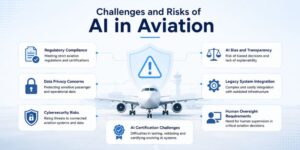
Challenges and Risks of AI in Aviation
While artificial intelligence is transforming the aviation industry in powerful ways, its adoption also comes with several important challenges and risks. Since aviation is a highly regulated and safety-critical sector, even small errors in AI systems can have serious consequences. This makes it essential to carefully manage implementation within the AI in Aviation Industry while maintaining strict oversight and compliance.
Regulatory Compliance
One of the biggest challenges is ensuring that AI systems meet global aviation regulations. Aviation authorities require strict certification and approval processes for any technology used in flight operations. Since AI systems continuously learn and evolve, aligning them with fixed regulatory frameworks becomes complex and time-consuming.
Data Privacy Concerns
AI in aviation depends heavily on large volumes of data, including passenger information, flight records, and operational details. This raises concerns about how data is collected, stored, and used. Airlines must ensure that sensitive data is protected and used in compliance with privacy laws to avoid misuse or unauthorized access.
Cybersecurity Risks
As aviation systems become more connected, they also become more vulnerable to cyberattacks. Hackers targeting airline databases, air traffic systems, or aircraft communication networks can create serious risks. Therefore, strong cybersecurity frameworks are essential to protect AI-driven aviation infrastructure.
AI Bias and Transparency Issues
AI systems are only as good as the data they are trained on. If the data contains bias, it can lead to inaccurate or unfair decision-making. In aviation, this could affect areas such as crew scheduling, passenger prioritization, or safety predictions. Additionally, many AI systems operate as “black boxes,” making it difficult to understand how decisions are made, which raises transparency concerns.
Legacy System Integration Challenges
Most airlines and airports still rely on older legacy systems. Integrating modern AI technologies with these outdated systems is often complex and expensive. This lack of compatibility can slow down digital transformation efforts across the aviation sector.
Human Oversight Requirements
Despite AI automation, human supervision remains essential in aviation. Critical decisions—especially those related to safety—cannot be fully delegated to machines. Maintaining the right balance between automation and human control is a key challenge for the industry.
AI Certification Challenges
Before AI systems can be deployed in aviation, they must undergo strict testing and certification. However, because AI models continuously learn and change, certifying them under traditional aviation standards is extremely difficult. This creates delays in adoption and implementation.
Future of AI in Aviation
The next decade will mark a major transformation in global aviation, driven by advanced artificial intelligence systems. The Future of AI in Aviation is expected to move beyond automation into intelligent, semi-autonomous, and highly connected ecosystems that redefine how flights, airports, and passenger experiences are managed.
AI-Assisted Cockpits
In the coming years, cockpits will become significantly smarter with AI-assisted systems that support pilots in real time. These systems will provide predictive alerts, navigation support, and decision-making assistance, reducing workload and improving flight safety. Pilots will increasingly rely on AI as a co-pilot rather than just a monitoring tool.
Semi-Autonomous Flight Systems
While fully autonomous commercial flights may still take time, semi-autonomous systems are expected to become more common. AI will handle routine flight operations such as cruising, altitude adjustments, and navigation support, while human pilots will oversee critical decisions and emergency situations.
Autonomous Airport Operations
Airports of the future will operate with minimal human intervention. AI-driven systems will manage baggage handling, security screening, gate allocation, and passenger flow autonomously. This will significantly reduce delays and improve operational efficiency.
Advanced Air Mobility
AI will play a key role in the development of advanced air mobility solutions such as flying taxis and urban air transport systems. These systems will rely on AI for navigation, traffic management, and safety coordination in densely populated urban environments.
Hyper-Personalized Passenger Journeys
Passenger experiences will become highly personalized through AI. From booking to arrival, every step of the journey will be tailored based on individual preferences, travel history, and real-time behavior. Airlines will use AI to offer dynamic upgrades, customized services, and real-time travel recommendations.
AI-Driven Sustainability Programs
Sustainability will be a central focus of future aviation systems. AI will optimize fuel usage, reduce emissions, and support carbon-neutral flight initiatives. Airlines will increasingly rely on AI to meet global environmental targets and regulatory requirements.
Real-Time Aviation Intelligence
The future aviation ecosystem will operate on real-time intelligence platforms that integrate data from aircraft, airports, and air traffic control systems. This will allow instant decision-making and seamless coordination across the entire aviation network.
Large-Scale Aviation Digital Twins
Digital twin technology will expand to create full-scale virtual models of aircraft fleets, airports, and even entire air traffic systems. These simulations will allow operators to predict disruptions, test scenarios, and optimize performance at a system-wide level.
Workforce Transformation Through AI
AI will significantly change the aviation workforce. While some manual roles may be reduced, new roles focused on AI monitoring, data analysis, and system management will emerge. Continuous training and upskilling will become essential for aviation professionals.
Expert Predictions for the Next Decade
Experts predict that by 2035, AI will be deeply embedded in nearly every aspect of aviation. From autonomous ground systems to intelligent flight operations, AI will become the backbone of global aviation infrastructure, making the industry more efficient, safe, and environmentally sustainable.
How AI Development Services for Aviation Drive Innovation
The aviation industry is evolving rapidly, and off-the-shelf software solutions are often not enough to handle its complex operational, safety, and regulatory demands. This is where AI Development Services for Aviation play a critical role. By building tailored artificial intelligence systems specifically designed for aviation use cases, airlines, airports, and aviation technology providers can unlock higher efficiency, better safety, and stronger innovation across operations.
Why Aviation Businesses Need Custom AI Solutions
Every aviation organization operates differently based on fleet size, airport infrastructure, passenger volume, and regulatory environment. Generic software solutions often fail to address these unique requirements. Custom AI development allows aviation companies to build systems that are specifically aligned with their operational workflows, compliance standards, and business goals.
With tailored AI solutions, airlines can integrate predictive maintenance models into their specific aircraft systems, while airports can design AI-driven passenger flow systems based on real-time terminal layouts and traffic patterns. This level of customization ensures more accurate results, better performance, and stronger return on investment.
Key Aviation AI Solutions
AI development services in aviation cover a wide range of intelligent systems designed to improve different parts of the ecosystem.
Predictive Maintenance Platforms help airlines monitor aircraft health in real time by analyzing sensor data and predicting potential failures before they occur. This reduces downtime and improves safety.
Airport Automation Systems streamline operations such as baggage handling, check-in processes, and resource allocation, making airport management more efficient and less dependent on manual processes.
Aviation Analytics Dashboards provide real-time insights into flight performance, passenger behavior, and operational efficiency, enabling data-driven decision-making across departments.
AI-Powered Passenger Applications enhance customer experience through mobile apps that offer personalized travel recommendations, real-time updates, and automated customer support.
Flight Operations Management Systems optimize scheduling, routing, and crew allocation by analyzing multiple operational factors such as weather, fuel usage, and air traffic conditions.
Companies investing in Aviation Software Development in Dubai are increasingly adopting these AI-driven systems to modernize operations and stay competitive in a fast-changing industry.
Similarly, organizations looking for scalable and tailored digital transformation often rely on Custom Aviation Software Solutions in Dubai to build fully integrated platforms that connect airlines, airports, and ground operations seamlessly.
Benefits of Working With Aviation AI Experts
Collaborating with specialized AI development experts ensures that aviation businesses receive solutions that are not only technologically advanced but also industry-compliant and highly reliable. These experts understand aviation regulations, safety requirements, and operational complexities, which helps in building systems that meet real-world aviation standards.
Additionally, aviation AI specialists accelerate innovation by implementing cutting-edge technologies such as machine learning, computer vision, and predictive analytics in a structured and scalable way. This reduces development risks, improves system accuracy, and ensures faster deployment of AI solutions across aviation environments.
Ultimately, working with AI experts allows aviation companies to stay ahead in a highly competitive industry by improving operational efficiency, enhancing passenger experience, and building future-ready aviation ecosystems.
Why SISGAIN for Aviation Software Solutions
SISGAIN stands out as a trusted partner for delivering advanced AI Development Services for Aviation, helping airlines, airports, and aviation enterprises move toward intelligent, data-driven operations.
With proven expertise in Aviation Software Development in Dubai, SISGAIN builds scalable and secure AI-powered platforms that improve operational efficiency, safety, and decision-making across the aviation ecosystem.
Through its Airport Management Software in Dubai, SISGAIN enables airports to streamline passenger flow, automate operations, and enhance real-time resource management using AI-driven insights.
In addition, SISGAIN offers Custom Aviation Software Solutions in Dubai designed to meet unique business needs, from predictive maintenance systems to AI-based scheduling and aviation analytics platforms.
Choosing SISGAIN means partnering with a technology expert focused on innovation, reliability, and future-ready aviation solutions powered by AI.
Ready to Build AI-Powered Aviation Solutions?

Conclusion
Artificial intelligence is no longer an emerging concept in aviation—it has become a foundational technology reshaping how the entire industry operates. From airlines and airports to aircraft manufacturers, AI is transforming traditional processes into intelligent, data-driven systems that improve efficiency, safety, and overall performance across the ecosystem.
One of the key insights from this guide is that AI is reshaping every aspect of the aviation ecosystem. Whether it is predictive maintenance, flight optimization, passenger services, or airport operations, AI is now deeply embedded in core aviation functions.
Another important takeaway is the rapid pace of adoption. Airlines, airports, and manufacturers are increasingly integrating AI-powered solutions to solve complex operational challenges and stay competitive in a highly dynamic market. This widespread adoption highlights how essential AI has become for modern aviation success.
Looking ahead, the future of aviation will be defined by innovations focused on automation, intelligence, sustainability, and efficiency. Technologies such as generative AI, digital twins, autonomous systems, and real-time aviation intelligence will continue to reshape how the industry functions over the next decade.
Ultimately, organizations that invest in AI today will be significantly better positioned for long-term success. Early adoption not only improves current operations but also builds a strong foundation for future technological advancements in the aviation sector.
Frequently Asked Questions (FAQs)
What are the trends in AI in aviation?
AI trends in aviation include predictive maintenance, autonomous airport operations, AI copilots, digital twins, smart aviation analytics, and real-time decision-making systems.
How can AI be used in aviation?
AI is used in aviation for flight route optimization, predictive aircraft maintenance, air traffic management, crew scheduling, passenger personalization, security screening, and airport operations automation.
What are the 5 current trends in AI?
The 5 major AI trends are generative AI, predictive analytics, computer vision, autonomous systems, and AI-powered automation across industries including aviation.
What is predictive maintenance in aviation?
Predictive maintenance uses AI and sensor data to detect potential aircraft issues before they happen, helping airlines fix problems early, reduce downtime, and improve safety.