The economics of sports traffic change dramatically during a global tournament year. What works profitably during a normal football season often becomes unstable once FIFA World Cup demand compresses inventory, CPC competition rises, and audience behavior becomes more emotionally reactive. For operators, affiliates, sportsbooks, and betting-focused advertisers, the challenge is no longer simply getting impressions. The real challenge is choosing ad formats that can still deliver conversion efficiency once traffic inflation begins.
In most large-scale FIFA world cup advertising environments, campaign failure usually comes from a format mismatch rather than a lack of audience demand. Many advertisers push high-volume inventory into funnels that are not designed for event-driven sports behavior. This becomes especially visible during major match windows, where cheap traffic can produce inflated click activity but weak deposit intent.
The platform, such as 7SearchPPC often referenced in gambling advertisement discussions because advertisers frequently test multiple sports traffic sources simultaneously during tournament cycles. The format itself — not just the traffic source — often determines whether campaigns remain scalable once competition intensifies.
In 2026, advertisers running FIFA advertising campaigns will need to think beyond reach metrics. The strongest campaign structures will focus on audience timing, intent alignment, mobile engagement behavior, and post-click conversion quality.

Why Ad Format Selection Matters More During FIFA 2026
World Cup traffic behaves differently from standard sports advertising campaigns. Audience urgency increases, emotional betting behavior becomes more impulsive, and mobile sessions shorten considerably during live match periods. This changes how users interact with ads.
One recurring issue is that advertisers often optimize only for click-through rate during major football tournament advertising cycles. Higher CTRs can look impressive during the event, but they frequently hide weak downstream metrics such as registration completion, deposit quality, or retention value.
At lower budgets, this problem can stay hidden, but at scale, format inefficiencies become expensive quickly.
For FIFA 2026 marketing campaigns, the most effective formats are usually those that:
- Match fast mobile consumption behavior
- Reduce friction before registration
- Maintain visibility during live-event traffic spikes
- Avoid aggressive moderation triggers
- Balance volume with user intent quality
This is why many operators diversify across native, push, display, and retargeting layers instead of depending entirely on one acquisition channel.
Native Ads Continue to Perform Well for Football Betting Audiences
Native ads for FIFA campaigns remain one of the more stable formats for sportsbook and gambling-related traffic acquisition because they integrate naturally into content-heavy sports environments.
During large sporting events, users spend substantial time consuming predictions, line movement analysis, match previews, fantasy sports discussions, and injury news. Native placements work well inside these behavioral flows because they align with information consumption rather than interrupting it aggressively.
Advertisers often notice that native traffic converts more efficiently when campaigns focus on contextual urgency instead of bonus-heavy messaging alone. Messaging tied to match momentum, betting opportunity windows, or tournament narratives usually performs better than generic acquisition copy.
Why Native Traffic Often Produces Better Conversion Quality
Native formats tend to filter accidental engagement more effectively than broad display inventory. Users clicking contextual sports recommendations generally show stronger intent compared to users interacting with purely interruptive formats.
This becomes particularly important during FIFA World Cup ad campaigns, where inflated audience excitement can distort traffic quality metrics.
Advertisers using an ad platform such as 7SearchPPC frequently test native inventory alongside broader sports event advertising campaigns because it provides a more balanced mix of scale and user engagement depth.
Another operational advantage is moderation flexibility. Native creatives can often communicate sports-related narratives more naturally than aggressive gambling-style banner messaging, which helps reduce approval volatility during high-risk tournament periods.
Push Ads Work Best for Time-Sensitive Match Windows
Push ads for sports traffic become especially effective when campaigns depend on immediacy.
Few advertising environments create urgency like the FIFA World Cup. Line movement changes rapidly. Match odds fluctuate continuously. User attention spikes shortly before kickoff and during halftime. Push notifications align extremely well with these behavioral patterns.
However, the mistake many advertisers make is overusing push inventory for cold acquisition without segmentation.
Push campaigns usually perform strongest when they are tied to:
- Live betting opportunities
- Pre-match odds changes
- Country-specific match excitement
- Retargeting previous sportsbook visitors
- Tournament milestone moments
The best-performing FIFA sponsorship advertising campaigns rarely rely on broad generic notifications alone. Precision timing matters more than volume.
A concise and direct execution model generally works best here. Short copy paired with emotionally relevant match context tends to outperform complex promotional messaging.
During high-competition traffic periods, advertisers also notice that push inventory can deteriorate quickly if frequency caps are ignored. Repeated notifications may sustain clicks temporarily while damaging conversion quality over time.
Display Advertising Still Delivers Reach — But Quality Control Is Critical
Display advertising for football traffic remains useful for broad tournament visibility, especially during awareness-heavy campaign phases. But display campaigns become risky when advertisers chase cheap impressions without monitoring behavioral quality indicators.
World Cup ad campaigns generate massive inventory expansion across sports publishers, streaming environments, and mobile entertainment apps. On the surface, this creates scale opportunities. In practice, it also introduces low-intent traffic pockets.
Many operators underestimate how quickly display campaigns can become inefficient once tournament hype increases. Cheap CPM inventory often correlates with weaker session depth, lower deposit completion rates, and higher bounce behavior.
Where Display Formats Usually Work Best
Display campaigns generally contribute more effectively when positioned as part of a layered acquisition structure rather than acting as the entire funnel.
For example:
- Display for awareness and reach
- Native for engagement
- Push for urgency
- Retargeting for conversion recovery
This structure tends to stabilize campaign economics during volatile sports traffic environments.
Advertisers exploring broader strategies to improve sports ad performance often discover that display inventory becomes far more efficient once audience segmentation and placement filtering improve.
The strongest FIFA marketing campaigns in 2026 will likely focus less on raw exposure and more on sequencing users across multiple ad interactions.
Video Ads Gain Strength During Mobile-Heavy Tournament Consumption
Short-form video has become increasingly important in sports advertising because mobile football audiences now consume tournament content continuously throughout the day.
During FIFA 2026, match predictions, reaction clips, lineup analysis, and tournament commentary will dominate social and mobile media consumption. Video formats integrate naturally into this ecosystem.
But there is a strategic nuance here.
Long-form promotional sportsbook videos often underperform during live tournament cycles because users prioritize immediacy. Faster creative pacing generally works better.
The highest-performing video ads usually:
- Deliver context within the first few seconds
- Use tournament-specific emotional triggers
- Reference current matches or betting momentum
- Avoid excessive promotional language
- Focus on action rather than explanation
Many football advertising strategies fail because creatives are produced like generic brand commercials instead of reactive sports media assets.
In high-pressure seasonal acquisition environments, creative speed frequently matters more than production polish.
Also Read On: Struggling with Sports Betting Ads? Try These Better Strategies
The Biggest Mistake in FIFA World Cup Ads Campaigns
The most common failure point is treating all sports traffic equally.
Not every football user behaves like a bettor. Not every bettor behaves like a depositor. And not every depositor becomes a profitable long-term customer.
Many campaigns appear successful at the surface level because the event itself generates enormous engagement volume. But once advertisers analyze post-click metrics, weaker patterns emerge:
- Low registration completion
- Bonus-only user behavior
- Short retention windows
- High bounce rates after signup
- Poor first-time deposit quality
This is why format selection matters so heavily.
Different ad formats attract different user psychology profiles. Push traffic often captures urgency. Native traffic captures interest. Display captures visibility. Video captures emotional engagement.
The best World Cup advertising strategy is usually not choosing one format over another. It is aligning each format with the correct funnel role.
Building a Balanced FIFA 2026 Advertising Structure
Most scalable FIFA World Cup advertising structures in 2026 will likely follow a multi-layered acquisition model instead of depending entirely on single-source traffic spikes.
A balanced framework often looks like this:
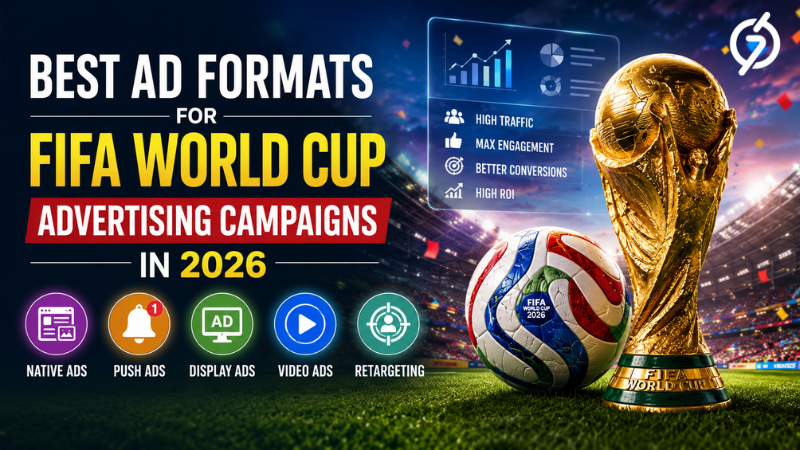
- Native ads for sports-content engagement
- Push notifications for live-event urgency
- Display inventory for awareness expansion
- Video creatives for mobile engagement
- Retargeting for conversion recovery
This diversification matters because tournament traffic environments are unstable by nature. CPCs fluctuate aggressively. Creative fatigue accelerates. Approval standards tighten unexpectedly. User behavior changes based on tournament momentum.
Operators that remain flexible across formats generally maintain stronger efficiency control during high-pressure acquisition periods.
The campaigns that scale most sustainably are rarely the loudest campaigns. They are usually the ones that maintain traffic quality discipline while adapting quickly to behavioral shifts across the tournament timeline.
Frequently Asked Questions (FAQs)
Which ad format performs best for FIFA World Cup betting campaigns?
Ans. There is no single universal winner. Native ads often produce stronger engagement quality, while push ads perform well during live-event urgency windows. The best-performing campaigns usually combine multiple formats strategically.
Are push ads effective for sports betting traffic?
Ans. Yes, particularly for time-sensitive promotions tied to live matches, odds changes, or tournament milestones. However, excessive notification frequency can reduce conversion quality over time.
Why do some FIFA World Cup ads generate clicks but poor deposits?
Ans. This usually happens when campaigns optimize for low-cost traffic volume instead of user intent quality. High engagement metrics during sporting events can hide weak post-click behavior.
How important is mobile optimization during FIFA 2026 campaigns?
Ans. Extremely important. Most World Cup traffic environments are heavily mobile-driven, especially during live match consumption periods. Ad formats, landing pages, and creative pacing should all be optimized for fast mobile interaction.
Should advertisers rely on one traffic source during the World Cup?
Ans. Generally no. Tournament traffic conditions change rapidly, and relying on one source increases risk exposure. Diversified campaign structures typically provide more stable performance and better scaling control.