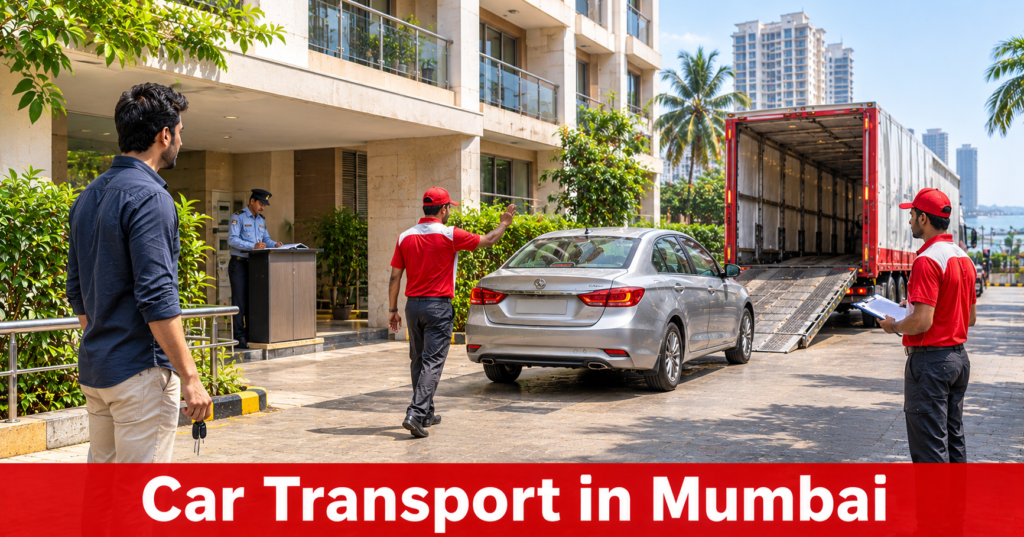
Mumbai is one of the hardest cities in India from which to move a car and one of the busiest. Parking is tight, society rules are strict, and the monsoon can turn a routine pickup into a damp, delayed one. At the same time, the city sends vehicles in every direction: south to Goa, east to Pune, west to Ahmedabad and north to Delhi. Anyone arranging car transport in Mumbai is making decisions that depend as much on the season and the building as on the destination.
This guide covers how cars leave Mumbai, whether you call it car shifting, vehicle transport or car relocation, what the main routes cost, how the rain changes the risk, and what to check before and after the journey. If you are comparing operators for car transport in Mumbai, the sections below will help you ask the right questions.
Why Car Transport in Mumbai Is Different
Four features of the city decide most of what happens on collection day.
Basement and tight parking. Many Mumbai buildings have basement or stilt parking with limited clearance, and a full-size car carrier usually cannot enter. The car is typically driven to a collection point outside the gate. Agree in advance who drives it and over what distance.
Society rules. Co-operative societies often set their own rules for commercial vehicles, including permitted hours and advance intimation to the committee. Confirm the window before booking, since a carrier that arrives outside it can lose hours at the gate.
Traffic and vehicle timing. Heavy vehicles are often restricted from parts of the city during peak hours, and a short drive between suburbs can take half a day. Early morning is usually the practical window for loading.
The monsoon. From June to September, rain affects both the car and the carrier. Water exposure, wet roads and delays are the main risks, and they are covered in their own section below.
Open or Enclosed for Car Transport in Mumbai
An open carrier loads the car onto a multi-vehicle platform, exposed to weather but secured throughout. It is appropriate for standard hatchbacks, sedans and SUVs on most routes outside the monsoon. An enclosed carrier seals the car inside a covered truck body, which suits luxury vehicles, electric cars and any car where paintwork matters. Enclosed transport typically costs 25 to 40 percent more.
Mumbai adds two reasons to prefer enclosed. Between June and September, rain on an open carrier means hours of water exposure on a long route. And the coastal air is hard on exposed surfaces, so a premium car travelling for several days benefits from the extra protection.
What Car Transport in Mumbai Costs
These are approximate 2026 figures for a standard sedan on an open carrier, door to door.
| Route from Mumbai | Distance | Open carrier | Typical transit |
|---|---|---|---|
| Pune | 150 km | Rs. 3,500-6,000 | Same day |
| Ahmedabad | 530 km | Rs. 5,000-9,000 | 1 to 2 days |
| Goa | 590 km | Rs. 6,000-10,000 | 1 to 2 days |
| Hyderabad | 710 km | Rs. 8,000-13,000 | 1 to 2 days |
| Bangalore | 1,000 km | Rs. 9,000-15,000 | 2 to 3 days |
| Delhi | 1,400 km | Rs. 11,000-18,000 | 3 to 5 days |
These are estimates. Actual cost depends on the vehicle, carrier type, season and the operator you choose. The last week of any month and the April to June period are usually busier and cost more.
Car Transport in Mumbai to Goa: The Coastal Route
Goa is among the most requested destinations for car transport in Mumbai, driven by relocations, second homes and people buying or selling vehicles across the two. At about 590 km, it is a one to two day journey in normal conditions.
The route is where the monsoon matters most. Between June and September, the coastal highway can see slowdowns on ghat sections and in heavy rain, so do not tie delivery to a hard deadline. Ask for a written delivery window, confirm the car will be covered or enclosed, and check that water damage is addressed in the insurance. For the Goa end, it is worth comparing operators offering car transport in Goa, since a carrier already positioned there often prices the return trip well.
Car Transport in Mumbai to Pune and Ahmedabad
Pune at 150 km is a same-day job and one of the most frequent short routes in the country. Because the distance is small, people skip the paperwork. Do not: the handover record matters just as much on a three-hour trip.
Ahmedabad at 530 km is a business route driven by Gujarat’s commercial links, and it usually takes one to two days. Enclosed carriers are common for premium vehicles on this corridor.
Both routes are well served, so availability is good and prices are competitive. The risk is rarely the road. It is the collection point in Mumbai and a handover without a written condition record. On short routes in particular, ask how many cars share the carrier and how the car will be secured, because a full carrier means more handling at every stop.
Moving the Household as Well
Many car transport in Mumbai jobs are part of a larger relocation. A car travels on a separate carrier from household goods, so ask for both quotes at the same time and confirm the dates line up. Ask each operator who the single point of contact is, because two separate bookings with no coordination are the usual cause of a car arriving a week before or after the furniture. If your household is heading to Delhi, compare quotes from the best packers and movers in Delhi, and ask each how they coordinate with a vehicle carrier. A mover that knows the destination will quote more accurately.
Mumbai to Delhi NCR: The Long Route
At roughly 1,400 km and three to five days, Delhi and the NCR are the longest of the common routes for car transport in Mumbai, and the one where careful preparation matters most. The car spends several days on a carrier, crossing multiple states and climate zones.
Choose the carrier type deliberately. For a luxury car, an electric vehicle or anything where paintwork matters, an enclosed carrier is worth the premium over this distance.
Get a delivery window, not a date. Several days across multiple states cannot be promised to the hour.
Insist on tracking. Ask for live GPS tracking or regular updates, because being unable to see where the car is, or reach anyone, is the biggest source of anxiety on a long route.
Ask about winter rules at the Delhi end. In the colder months, air-quality restrictions can affect which goods vehicles may enter Delhi, depending on where the vehicle is registered and its emission standard. Ask the operator where the carrier is registered and what happens to your booking if restrictions apply on your date. The rules are revised periodically, so check current measures with the Commission for Air Quality Management.
If you have a two-wheeler travelling north as well, bike transportation in the NCR is booked separately. Operators offering bike transportation in Ghaziabad can collect a bike at the Delhi NCR end, and it is sensible to request the car and bike quotes together.
Mumbai to Chandigarh and the North
Car transport in Mumbai to Chandigarh is less common than the other routes, because Chandigarh sits well beyond the main corridors, at around 1,700 km. The journey takes longer and is exposed to more varied conditions, including winter fog on the northern plains. Plan extra time between December and January.
Because fewer carriers run this route, ask the operator directly how often they do, and whether your car will travel alone or share a carrier with vehicles heading to other cities. A shared carrier that stops in several places adds days. Ask for a written delivery window, and confirm who you can call when the carrier is a thousand kilometres away.
On a route this long, confirm three documents before the car leaves: the signed pickup receipt with the odometer reading, the insurance certificate, and a contact number for the carrier’s office. Photograph the receipt and keep it with your other papers, since you will need it to make a claim if anything goes wrong at the other end.
For a motorcycle heading the same way, bike transport in Chandigarh is a separate booking, and a bike needs the same careful handling: a rack carrier or crate, a signed condition note and a confirmed insurance certificate.
Preparing for Car Transport in Mumbai
Preparation takes about an hour and applies on every route.
- Wash the car, so existing scratches are visible.
- Photograph all four sides, the roof, the wheels and the odometer in daylight.
- Remove personal items, because insurance covers the vehicle and not its contents.
- Reduce fuel to roughly a quarter tank.
- Get a signed pickup receipt recording the condition, the odometer reading and the delivery window.
The Monsoon and Car Transport in Mumbai
Between June and September, a few extra steps are worth taking.
Choose enclosed for long routes. Open carriers expose the car to rain for hours, so enclosed is strongly worth it for premium vehicles.
Check the seals and windows. Make sure all windows, the sunroof and the boot are fully closed, since water finds its way in through small gaps.
Photograph before loading. Wet conditions make fresh damage easier to dispute, so a dated record matters more.
Confirm the insurance covers water damage. Many policies do not unless it is stated, so ask specifically and get the certificate before loading.
Checks Before You Pay for Car Transport in Mumbai
- GST registration, verified on the government portal, with the registered name matching the company on the quote.
- A written quote stating the route, carrier type, delivery window and whether GST is included.
- The insurance certificate, obtained before loading, with a note of what is covered and excluded.
- Partial advance only, twenty to thirty percent at booking, the balance on delivery, paid to the registered business account.
- Route experience. Ask how often the operator runs your route.
- Tracking and a contact number that is not only the driver’s.
A quote far below every other usually means a shared or poorly secured load, no real insurance, or charges that appear later.
On Delivery
Inspect before you sign. Walk all four sides in good light and compare with your pickup photographs, check the roof and alloys, read the odometer, and start the engine. Note any damage on the receipt before signing it, and raise it in writing the same day.
Frequently Asked Questions
How much does car transport in Mumbai cost?
It depends mainly on the route. As a guide, an open carrier for a standard sedan runs about Rs. 3,500 to Rs. 6,000 to Pune, Rs. 6,000 to Rs. 10,000 to Goa, Rs. 9,000 to Rs. 15,000 to Bangalore, and Rs. 11,000 to Rs. 18,000 to Delhi. Compare at least three written quotes.
How long does car transport in Mumbai take?
Pune is same day, Ahmedabad, Goa and Hyderabad one to two days, Bangalore two to three, and Delhi three to five. Waiting for a full load can add a day at the start.
Should I choose open or enclosed for car transport in Mumbai?
Open is fine for most standard cars outside the monsoon. Choose enclosed for luxury vehicles, electric cars, long routes, or any journey between June and September.
Can the carrier collect from my building’s basement?
Usually not, because of height clearance. The car is normally driven to a collection point outside the complex.
Can I keep belongings in the car?
No. Transit insurance covers the vehicle, not its contents, and most operators will not accept responsibility for items left inside.
What if the car arrives damaged?
Note it on the delivery receipt before signing, photograph it immediately and contact the operator in writing the same day.
Can I get a GST invoice for employer reimbursement?
Yes, from a GST-registered operator, if you ask at booking.
The Short Version
Car transport in Mumbai comes down to four decisions: the route, the carrier type, how the car is protected in the rain, and how you check it on arrival. Wash and photograph the car, get a signed condition note, confirm the insurance before loading, and inspect carefully before you sign.
To compare verified providers of car transport in Mumbai with free quotes and no obligation, ShiftEazy connects you with verified operators across Mumbai and other major cities.’