The dive watch began as a safety tool and became a daily staple. That history explains why luxury dive watches for men are still judged by standards set for divers in the early 1950s. The link remains, but execution has changed.
The Origin Of The Modern Diver Watch
The first modern divers appeared in 1953 and 1954, one for French combat divers and one for public sale. Both answered a problem created by the Cousteau-Gagnan Aqua Lung. Divers needed a sealed case, a readable dial, and a way to time a dive.
Those models set the template. Screw down the crown, unidirectional bezel with 60-minute scale and highlighted first 15 minutes, high-contrast dial with heavy lume, and at least 100 meters resistance. The pattern moved from military to sport diving in the 1960s and became the baseline.
What Defines Classic Diver Watches
The classic definition comes from function first. ISO 6425 from 1996 codified it.
Core Functional Requirements
ISO 6425 defines a diver watch as a watch that withstands 100 meters minimum and passes specific checks. It needs a time preselecting device protected against accidental movement, so bezels turn one way only. The dial must be readable in darkness at 25 centimeters. The watch must show it is running and resist salt water, thermal shock, overpressure, shock, and magnetism.
Brands add margin. Many list 200, 300, or 600 meters, beyond the 35- to 40-meter limit for recreational diving. Classic cues include sapphire crystal, a solid case back, crown guards, and a strap that extends over a wetsuit.
Why Those Rules Still Matter
Each rule fixes a failure point. A unidirectional bezel can only shorten a timed interval if knocked, so a diver surfaces early, not late. Heavy lume reduces misreading at depth. Screw-down crowns and gaskets keep sealing after salt and temperature cycles. These are safety logic, not decoration.
How Luxury Interpretations Changed the Formula
Luxury divers keep safety logic but refine materials and comfort.
Materials and Finishing
Steel remains standard, but luxury versions add ceramic inserts that resist scratching, sapphire bezels with lume-filled markers, and refined finishing. Cases stay around 39 to 44 millimeters, often with shorter lug-to-lug, so a 44 wears like a 42. Some models hit 600 meters at 12.3 millimeters thin.
Bracelets evolved. Classic divers used rubber or simple steel. Luxury versions add tapered bracelets with micro-adjust, plus a second strap in rubber or Kevlar.
Movement and Everyday Wearability
Classic divers used simple three-hand automatics. Luxury versions keep automatic winding but focus on regulation, power reserve, and serviceability. The Swiss Sellita SW200-1 is common in American assembled brands for accuracy and parts availability. Higher-end models add in-house calibers with 60- to 120-hour reserves.
Daily comfort drives refinements. Anti-reflective sapphire, better anti-magnetism, better crown ergonomics, and quick strap changes make the watch practical in an office and on a boat.
Where Luxury And Classic Diver DNA Still Overlap
Most luxury divers still meet or exceed ISO style criteria for resistance, legibility, and bezel function. They keep a unidirectional bezel, luminous markers, a screw-down crown, and instant reading.
Buyers still use classic tests. Does the bezel align and click firmly? Does lume stay readable for hours? Does the crown screw down with a clear seal?
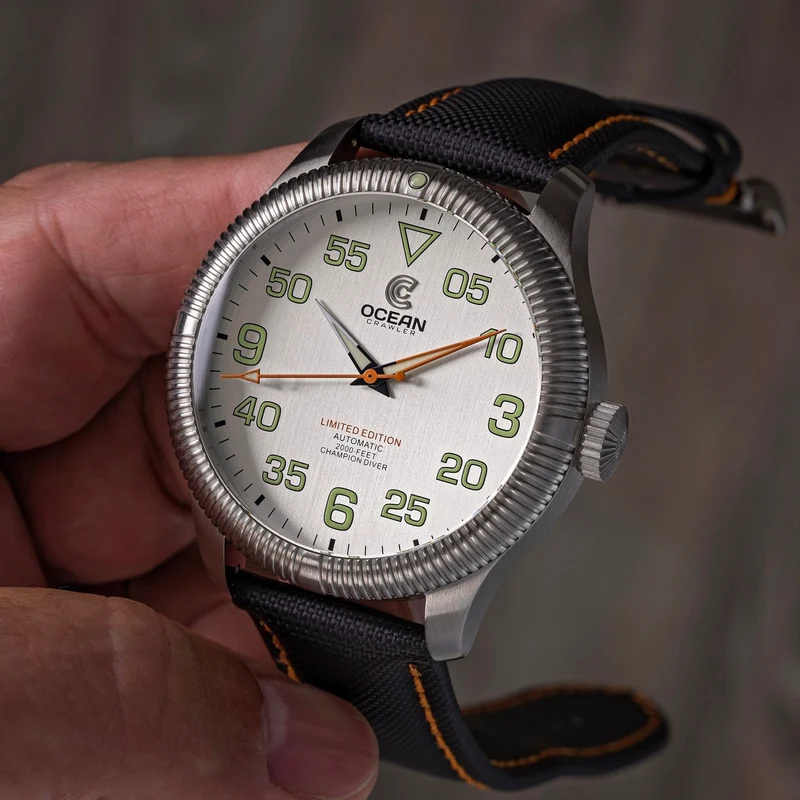
That is where small batch makers align with classic values. Ocean Crawler builds professional diver watches with 600-meter resistance, sapphire construction, screw-down crowns, helium escape valves on select models, and seven layers of Swiss lume. Each piece is assembled in the United States by a single watchmaker, regulated and pressure tested, and produced in limited runs of 100 to 300 pieces with a 5-year warranty.
To Conclude
The classic diver design created a safety-first template that luxury models refined, not replaced. The bezel, crown, crystal, lume, and resistance that defined 1950s tools still define how a good diver works.
If a watch respects the functional checklist while improving fit and testing, it stays tied to the classic. That is why collectors still choose luxury dive watches for men that look appropriate in a meeting but are built to the standards of dive watches used for real water time.
FAQs
Are Luxury Dive Watches Safe For Scuba Diving?
Yes, if they list at least 200 meters, have a screw-down crown and unidirectional bezel, and are pressure tested. Many meet or exceed ISO 6425.
What Makes a Watch ISO 6425 Compliant?
It must withstand 100 meters minimum, have a protected time preselecting device, be readable at 25 centimeters in darkness, show it is running, and pass tests for salt water, thermal shock, overpressure, shock, and magnetism.
Why Use a Unidirectional Bezel?
It tracks elapsed time. One way rotation means knocks can only shorten the interval, prompting earlier ascent. Two-way rotation could add time and increase risk.
How Important Is Lume?
Critical for low light. Look for Swiss Super-LumiNova or C3 on hands, indices, and bezel pip. Multi-layer application improves readability.
Does Ocean Crawler Make True Dive Watches?
Yes. Most models feature 600-meter resistance, sapphire crystals, screw-down crowns, helium escape valves on select references, Swiss automatic movements, and individual pressure testing. Production is limited edition and assembled in the United States.