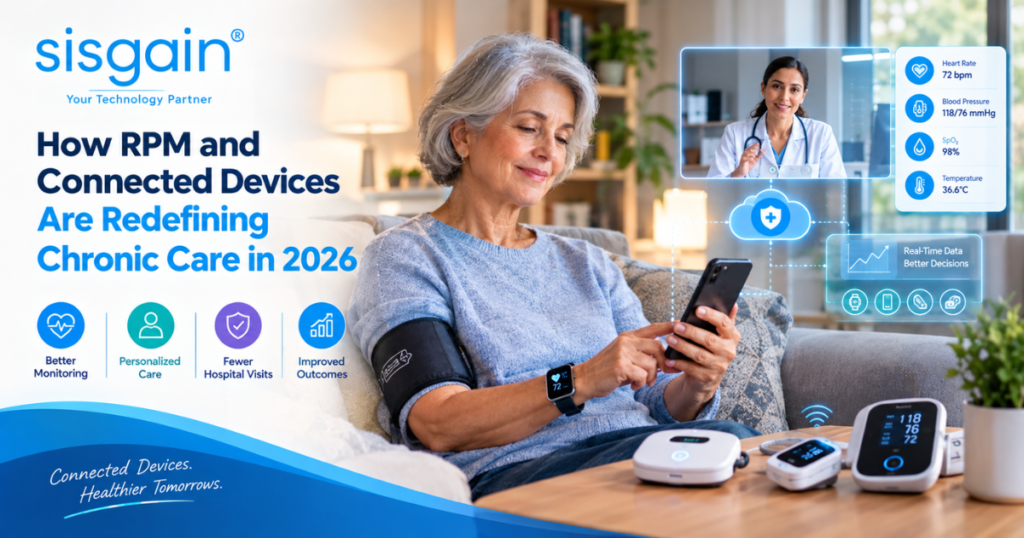
Healthcare is undergoing a quiet but fundamental shift. For decades, chronic disease management has been built around episodic care — a patient feels unwell, books an appointment, waits weeks to be seen, and receives guidance based on a single snapshot of their health. That model is giving way to something more continuous. Connected devices, automated alerts, patient-facing apps, and real-time clinical dashboards now allow providers to see what is happening between visits, not just during them.
At the center of this shift is remote patient monitoring software, which enables healthcare organizations to collect, transmit, analyze, and act on patient-generated health data outside the four walls of a clinic. Cellular blood pressure cuffs, glucose meters, connected weight scales, pulse oximeters, and wearable sensors have moved from novelty to necessity for organizations serious about managing chronic conditions at scale.
The scale of the opportunity is hard to ignore. The global remote patient monitoring market is projected to reach approximately $36.29 billion in 2026 and climb to roughly $66.33 billion by 2031, according to MarketsandMarkets. On the reimbursement side, Medicare payments for RPM services reached approximately $536 million in 2024, based on data from the HHS Office of Inspector General. Those figures tell a consistent story: remote monitoring is no longer an experimental add-on. It is becoming core infrastructure for chronic care delivery.
This guide — How RPM and Connected Devices Are Redefining Chronic Care in 2026 — walks through what RPM actually involves, how it differs from Remote Therapeutic Monitoring (RTM), why cellular-enabled devices matter, the highest-value clinical use cases, the growing role of AI, and what organizations need to get right before scaling a program in 2026.
What Is Remote Patient Monitoring?
Remote Patient Monitoring refers to the collection and transmission of patient health data generated outside a traditional healthcare facility — typically from the patient’s home. The data collected can include a wide range of physiological measurements, such as:
- Blood pressure
- Blood glucose
- Body weight
- Oxygen saturation
- Heart rate
- Temperature
- Medication-related measurements
- Activity and sleep patterns
A functioning RPM program is rarely just “a device and an app.” It generally depends on five interconnected components working together:
- A connected medical device capable of capturing accurate readings.
- A patient enrollment and education workflow that sets expectations and builds confidence in the technology.
- Secure data transmission from the device to a central platform.
- A clinician or nurse-facing dashboard that turns raw data into something reviewable.
- Alert management and clinical intervention protocols that determine what happens when a reading falls outside expected ranges.
Cellular-enabled devices play a particularly important role in this chain because they remove a major point of friction: the patient does not need to configure Wi-Fi or pair a device with a smartphone. This matters enormously for populations that struggle most with technology adoption — older adults, patients with limited digital literacy, and people living in areas where home broadband is unreliable or unavailable. A device that “just works” out of the box is far more likely to be used consistently than one that requires ongoing technical troubleshooting.
It’s worth emphasizing that a successful RPM program is not defined by how many readings it collects. It is defined by how effectively it converts patient data into timely clinical action. A dashboard full of readings that nobody reviews, or that triggers alerts nobody responds to, is not a monitoring program — it is a data warehouse.
RPM and RTM: Different but Related
RPM and RTM are often mentioned in the same breath, but they are not interchangeable services, and healthcare organizations that treat them as identical tend to build workflows that fit neither well.
Remote Patient Monitoring is generally centered on physiological data — the vital signs and biometric measurements described above. Remote Therapeutic Monitoring, by contrast, focuses on therapeutic and functional information tied to a treatment plan rather than a biological signal. RTM programs commonly track:
- Medication adherence
- Respiratory symptoms
- Musculoskeletal function
- Treatment response
- Pain levels
- Patient-reported outcomes
- Use of prescribed therapy
To see the distinction in practice, consider two patients with very different needs. A heart-failure patient enrolled in an RPM program might have their daily weight and blood pressure monitored to catch early signs of fluid retention. A patient recovering from orthopedic surgery, enrolled in an RTM program, might have their platform track whether they are completing prescribed physical therapy exercises and how their pain levels are trending over time.
The clinical goals, the data sources, the escalation pathways, and even the billing requirements differ between the two. This is why modern healthcare platforms should be built to support both RPM and RTM as distinct but complementary capabilities, rather than forcing every monitoring use case through a single generic template.
Why Cellular Devices Matter
Connected devices form the foundation of any monitoring program, but not all connectivity approaches are equal. A device can be clinically appropriate and still fail in practice if it is too difficult for patients to set up or maintain.
Cellular-enabled devices offer several practical advantages over Wi-Fi or Bluetooth-dependent alternatives:
- No dependence on home internet access or router configuration
- Automatic transmission of readings without patient action
- Fewer setup steps, reducing onboarding friction
- Better support for remote, rural, or underserved populations
- Improved visibility into adherence, since missing readings are easy to flag
- Reduced reliance on manual data entry, which lowers the risk of transcription errors
Consider a hypertension management program built around cellular blood pressure monitoring. A patient takes a reading each morning with a cellular-enabled cuff. The reading transmits automatically to the provider’s dashboard — no app to open, no button to press beyond the measurement itself. If the reading crosses a predefined clinical threshold, the system generates an alert. A nurse reviews the patient’s recent history, places a follow-up call, and escalates to a physician if the pattern warrants it.
It’s important to be clear about where the actual value sits in that workflow. The alert itself is not the intervention — it is simply a trigger. The value comes from what the care team does after the alert fires: the review, the outreach, the clinical judgment, and the follow-through. Organizations that invest heavily in device technology but underinvest in the human workflow around alerts tend to see disappointing results, regardless of how sophisticated their remote patient monitoring software is.
High-Value Chronic Care Use Cases
Hypertension Management
Hypertension remains one of the clearest and most widely adopted applications of RPM. Because blood pressure can fluctuate significantly throughout the day and across weeks, a single in-office reading offers a limited picture. Home monitoring allows physicians and nurses to observe trends rather than isolated data points.
A well-designed hypertension program typically includes:
- Cellular blood pressure cuffs
- Automated patient reminders
- Threshold-based clinical alerts
- Medication review workflows
- Nurse-facing dashboards
- Physician escalation pathways
- Patient education materials
- Longitudinal reporting for long-term trend analysis
The real clinical value tends to come from trend analysis rather than any single reading. A platform that can flag a recurring pattern — for example, a patient who consistently spikes in the early morning, or one whose blood pressure has remained uncontrolled despite medication adjustments — gives clinicians information they simply cannot get from quarterly office visits alone.
Diabetes Management
Diabetes care lends itself naturally to connected monitoring because glucose control depends heavily on frequent, granular data. Diabetes monitoring software can integrate traditional glucose meters, continuous glucose monitors, coaching applications, and medication-tracking tools into a single view.
With the right integration, care teams can use this data to:
- Review glucose trends over days, weeks, and months
- Identify hypoglycemic or hyperglycemic events as they occur
- Deliver personalized coaching based on real behavior patterns
- Track patient engagement with the monitoring program itself
- Coordinate timely medication adjustments
- Connect glucose data with the broader health record
That last point deserves emphasis. Glucose readings are far more useful when viewed alongside a patient’s diagnoses, current medications, recent lab results, and clinical notes. A glucose spike means something different for a newly diagnosed patient than it does for someone with an established, complex treatment history — and only integrated data lets a clinician tell the difference quickly.
Post-Discharge Heart-Failure Monitoring
Heart failure is a condition where subtle deterioration can precede a visible crisis by days. Patients often gain fluid weight, experience shortness of breath, or show blood pressure changes well before symptoms become severe enough to prompt an emergency room visit. Daily weight tracking, blood pressure measurement, and structured symptom questionnaires can surface these warning signs early.
A typical post-discharge RPM workflow might look like this:
- The patient receives connected devices before being discharged from the hospital.
- The patient records weight and blood pressure daily at home.
- Readings transmit automatically into the monitoring platform.
- The system flags concerning changes based on clinical thresholds.
- A nurse reviews the patient’s status and recent trend data.
- The care team contacts the patient directly or schedules a timely intervention.
Done well, this kind of program can support earlier clinical action and help avoid preventable complications. That said, outcomes are never guaranteed by technology alone — they depend heavily on appropriate patient selection, clearly defined clinical protocols, adequate staffing to review alerts promptly, and consistent follow-up. A cellular scale without a responsive care team behind it will not move the needle on readmissions.
Respiratory and Musculoskeletal Care
Remote Therapeutic Monitoring is especially useful for conditions where therapeutic participation and functional progress — rather than a single physiological metric — are the primary concern.
Respiratory programs commonly track symptom severity, inhaler usage, and adherence to prescribed breathing exercises. Musculoskeletal programs, often used following surgery or injury, may monitor completion of home exercise plans, self-reported pain scores, range-of-motion progress, and broader functional improvement over time.
What distinguishes these programs is that they combine patient-reported data with structured, sequential care pathways. The objective isn’t simply to observe the patient passively — it’s to keep the patient actively engaged with their own treatment plan, since therapeutic outcomes in these areas depend heavily on consistent participation rather than a single measurable event.
The Role of AI in Connected Care
As monitoring programs scale to hundreds or thousands of enrolled patients, the sheer volume of incoming data becomes a challenge in its own right. This is where artificial intelligence has started to play a meaningful supporting role.
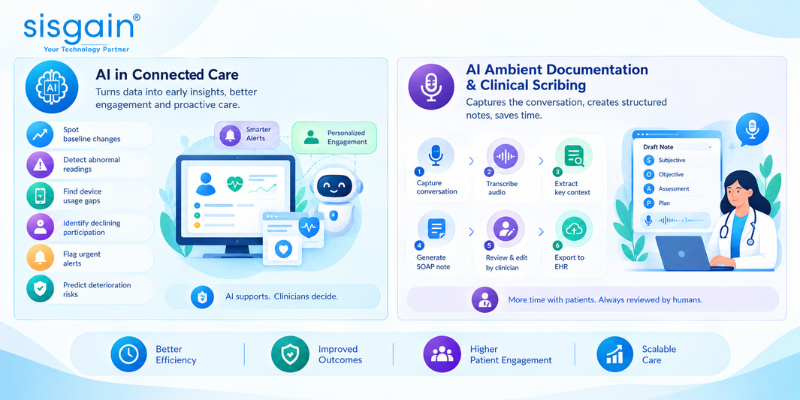
Rather than presenting clinicians with an undifferentiated stream of raw readings, AI-enabled platforms can help surface what actually matters, including:
- Meaningful changes in a patient’s individual baseline
- Repeated or persistent abnormal readings
- Gaps in device usage that suggest disengagement
- Patients trending toward reduced participation
- Alerts that require immediate clinical review
- Patterns historically associated with clinical deterioration
Beyond triage, AI can also assist with patient communication, initial risk scoring, and helping care teams prioritize their limited time toward the patients who need it most. However, healthcare organizations should be deliberate about treating AI as a decision-support layer that augments clinical judgment — not as an unsupervised replacement for it. The clinical stakes involved in chronic disease management mean that a human should always remain in the loop for meaningful decisions.
AI Ambient Documentation and Clinical Scribing
A related and rapidly growing development is the use of ambient listening tools for clinical documentation. These systems capture the natural conversation between a patient and clinician during a visit and generate structured documentation automatically, including draft SOAP notes.
A typical ambient documentation workflow includes:
- Ambient audio capture during the patient encounter.
- Speech recognition and transcription.
- Extraction of clinically relevant context from the conversation.
- Generation of draft subjective, objective, assessment, and plan sections.
- Clinician review and editing of the draft note.
- Export of the finalized note into the EHR.
The administrative burden reduction from this kind of tool can be substantial, freeing clinicians to spend more of the visit actually engaging with the patient rather than typing. That said, every AI-generated note still requires human review before it becomes part of the permanent medical record — for accuracy, for completeness, for inappropriate assumptions the model may have introduced, and for privacy compliance.
What Healthcare Organizations Need in 2026
Deploying RPM successfully is not simply a matter of purchasing devices and shipping them to patients. It requires a coordinated technology and operational strategy across several dimensions.
Interoperability
RPM data delivers far more value when it doesn’t live in a silo. It should connect directly with an organization’s EHR, practice-management system, care-management tools, and billing workflows. APIs, FHIR-based interfaces, standardized device connectivity, and normalized data models all help prevent monitoring data from becoming disconnected from the rest of a patient’s clinical picture.
Organizations evaluating Custom EHR, EMR & PHR Software Development should treat remote monitoring as a core, first-class capability of that architecture — not as an isolated bolt-on system. When patient-generated data appears seamlessly alongside traditional clinical information, clinicians can make faster, better-informed decisions without switching between disconnected tools.
Clinical Workflows
Every alert generated by a monitoring platform needs a clearly defined owner and a documented response protocol. At minimum, an organization should define:
- Who is responsible for reviewing each type of alert
- How quickly a given alert must be reviewed
- Which alerts require a direct patient phone call
- When a physician needs to be notified
- How interventions are documented for the record
- When a patient should be escalated to emergency services
Poorly designed alert systems are one of the most common reasons RPM programs underperform. If alerts are too frequent, too broad, or poorly calibrated to actual clinical risk, care teams experience alarm fatigue and begin missing the alerts that genuinely matter. The goal should always be fewer, more meaningful alerts that reliably lead to appropriate clinical action — not maximum alert volume.
Security and Privacy
RPM platforms handle protected health information by definition, which means security cannot be an afterthought. Important safeguards include:
- Encryption of data both in transit and at rest
- Role-based access controls
- Multi-factor authentication for all users
- Comprehensive audit logging
- Secure, well-governed APIs
- Device identity management
- Clear data-retention policies
- Ongoing vendor-risk assessments
- Business associate agreements where applicable
Privacy and security should be built into the product design process from the very beginning, not layered on after a platform has already been built and deployed.
Patient Experience
Ultimately, an RPM program is only as effective as the patients who actively participate in it. Adoption improves dramatically when the technology is simple and the purpose is clearly communicated. Effective programs typically provide:
- Plain-language setup instructions
- Simple, low-friction device configuration
- Multilingual patient education materials
- Accessible technical support
- Flexible reminder preferences
- Accessibility accommodations for patients with disabilities
- Clear explanations of what alerts mean and what happens next
- Ongoing feedback about how the collected data is actually being used
Patient engagement should be treated as a clinical requirement, not a “nice to have.” If patients stop using their devices, the care team loses visibility into their condition — and the entire program stops delivering value, regardless of how sophisticated the underlying software is.
Choosing a Healthcare Technology Partner
Selecting the right partner is one of the most consequential decisions an organization will make when launching or scaling an RPM program. A capable healthcare software development company needs to understand both the technology and the clinical operations it will support.
When evaluating a potential development partner, healthcare organizations should look closely at:
- Direct experience building RPM and RTM platforms
- Depth of knowledge around healthcare interoperability standards
- Device integration capabilities across multiple manufacturers
- Proven EHR and EMR connectivity
- HIPAA-focused security practices baked into the development process
- Thoughtful clinical dashboard design that reduces cognitive load for care teams
- Experience designing effective alert-management workflows
- Scalable, cloud-native architecture
- Strong data analytics and reporting capabilities
- Ongoing support for evolving regulatory and billing requirements
The development process itself should always begin with workflow discovery rather than technology selection. Before choosing a specific device or designing a dashboard layout, an organization needs to clearly define its target patient population, its clinical objectives, its staffing model for reviewing alerts, its escalation protocols, and the specific metrics it will use to measure success. Skipping this discovery phase is one of the most common reasons RPM implementations stall or underdeliver after launch.
Measuring RPM Program Performance
An RPM program should be evaluated using both operational and clinical metrics — relying on either category alone tends to produce a distorted picture of how well the program is actually working.
Useful measures include:
- Patient enrollment rates
- Device activation rates
- Reading-transmission consistency
- Patient adherence over time
- Time to alert review
- Time to clinical intervention
- Hospital admission rates among enrolled patients
- Emergency department visit rates
- Medication adherence
- Blood pressure or glucose control outcomes
- Patient satisfaction scores
- Clinician workload impact
- Cost per enrolled patient
Financial performance obviously matters, but reimbursement should never be treated as the sole measure of success. A program that generates a steady stream of billable readings without meaningfully improving patient outcomes creates ongoing operational costs while delivering limited real value — and it also carries compliance risk.
That risk is not hypothetical. Recent CMS and HHS-OIG developments highlight why documentation quality, patient eligibility verification, clinical involvement, and billing controls require continuous attention. Medicare RPM payments reached approximately $536 million in 2024 alone, and as reimbursement volume grows, so does regulatory scrutiny of how that money is being spent. Organizations should verify current CMS requirements and coding guidance before launching or expanding any billable RPM service, since these rules continue to evolve.
The Future of Chronic Care
In 2026, chronic care is becoming more connected, more proactive, and more personalized than at any point in the past. RPM and RTM platforms give providers meaningful visibility into what is happening with patients between visits, while AI helps organize the resulting data and reduce the administrative burden on clinical staff.
The strongest programs going forward will combine four core capabilities:
- Reliable, easy-to-use connected devices
- Actionable, well-defined clinical workflows
- Interoperable healthcare software that connects monitoring data to the broader record
- Human-centered patient engagement that keeps people actively participating in their own care
Technology alone cannot solve the structural challenges of chronic-care management. The real opportunity lies in combining continuous, high-quality data with qualified clinical teams, timely interventions, and software genuinely designed around the needs of both patients and providers.
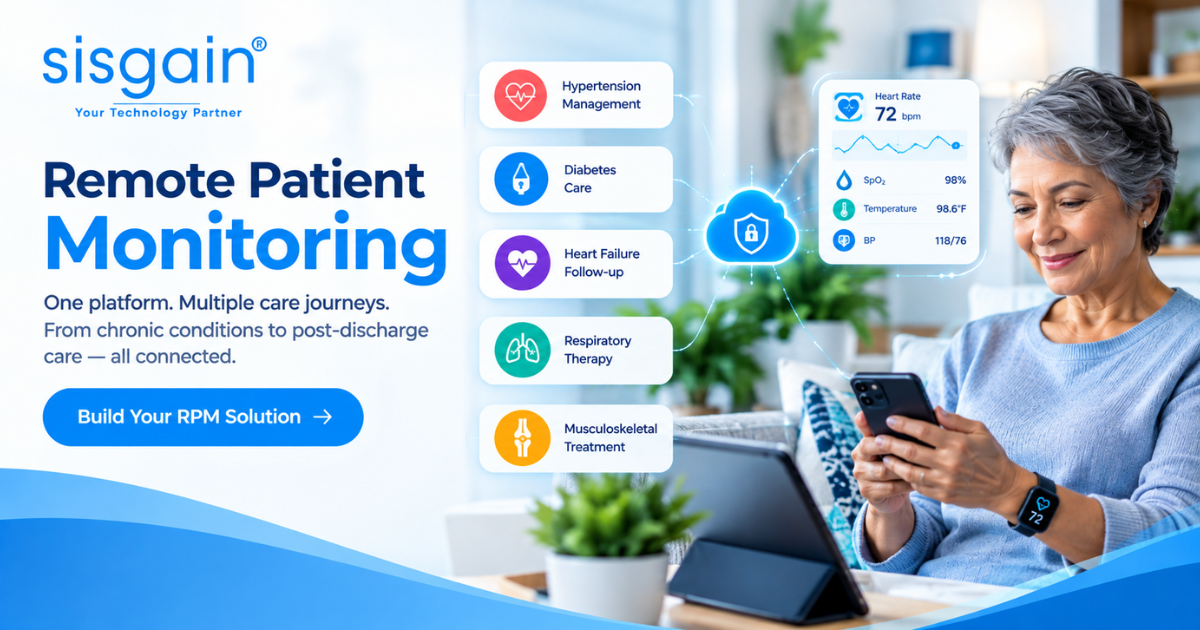
For healthcare organizations evaluating their next steps, investing in scalable remote patient monitoring software can create the foundation for hypertension management, diabetes care, post-discharge heart-failure follow-up, respiratory therapy, and musculoskeletal treatment — all under a single, interoperable architecture. The organizations that succeed in this next phase will be the ones that design RPM as a complete care-delivery model, not merely as a device-and-dashboard project bolted on