Key Highlights
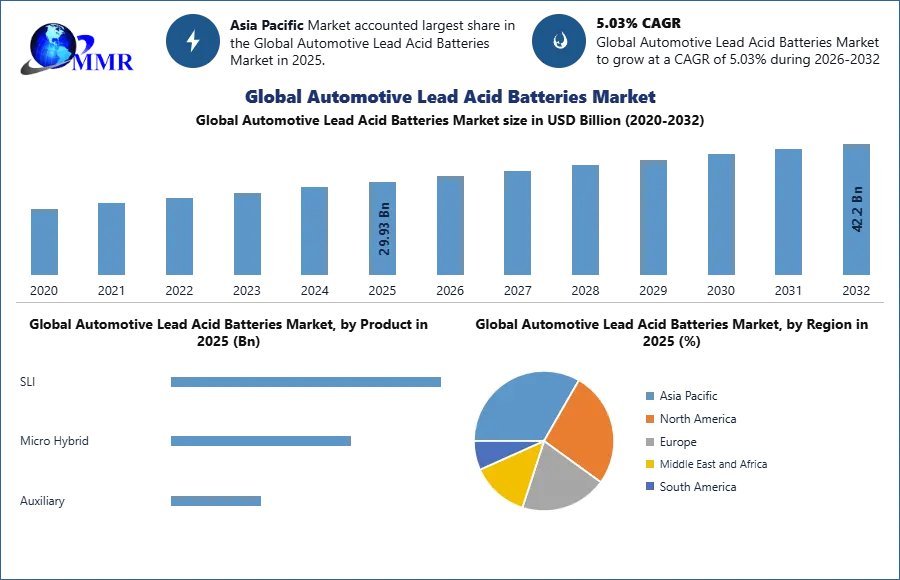
- The Automotive Lead Acid Batteries Market was valued at US$ 29.93 Bn in 2025, highlighting its substantial role in the global automotive supply chain.
- Revenue is expected to grow at a CAGR of 5.03% from 2026 to 2032, indicating continued commercial demand for established battery technologies.
- The market is projected to reach nearly US$ 42.2 Bn by 2032, creating opportunities for manufacturers, suppliers, recyclers, and distribution networks.
- Asia Pacific is expected to dominate, supported by vehicle demand and replacement activity.
- The market covers SLI, micro-hybrid, and auxiliary products across OEM and aftermarket channels.
Market Overview
The Automotive Lead Acid Batteries Market continues to demonstrate why mature technologies can remain strategically relevant in a rapidly changing automotive industry. Lead acid batteries are used for electricity storage and remain important across automotive applications, including passenger vehicles, light and heavy commercial vehicles, two-wheelers, and three-wheelers.
The market’s US$ 29.93 Bn valuation in 2025 represents a large existing commercial base. This scale matters because established manufacturing, replacement, and distribution systems can support sustained business activity while vehicle technologies continue to evolve.
Demand is closely connected to automotive industry performance. As vehicle production and sales expand, battery requirements also increase. At the same time, replacement demand creates an additional business channel, making the sector relevant to both original equipment manufacturers and aftermarket participants.
Why This Market Matters Now
The Automotive Lead Acid Batteries Market matters because the automotive industry requires dependable and commercially accessible energy-storage solutions across diverse vehicle categories. Growing demand from electric vehicles, hybrid vehicles, light motor vehicles, and heavy motor vehicles is identified as an important market driver.
For procurement leaders, the market’s continued relevance means battery sourcing remains closely linked with vehicle production and replacement cycles. For manufacturers, the opportunity extends beyond production volumes toward operational efficiency, product performance, and supply-chain capabilities.
Government support and stricter pollution-emission regulations are also expected to influence market growth. The business implication is clear: regulatory and industrial developments are shaping investment decisions across the broader automotive ecosystem.
Access a Free Sample Report Copy : https://www.maximizemarketresearch.com/request-sample/98248/
Key Trends Driving Growth
The Automotive Lead Acid Batteries Market is being influenced by advancements in manufacturing processes and growing battery sales. Manufacturers are increasingly focused on improving operational capabilities while serving changing vehicle requirements.
Another important trend is demand from modern vehicles, including those equipped with idling stop systems. Product development is therefore becoming increasingly important for companies seeking to maintain competitiveness.
Replacement demand remains particularly significant. Consumers with higher disposable incomes and large vehicle populations contribute to continued demand for battery replacement, strengthening opportunities across aftermarket channels.
However, the industry also faces competitive and environmental pressures. Growing demand for lithium-ion batteries, concerns regarding overcharging, and the environmental impact of high lead content remain important restraints. These challenges increase the need for manufacturers to strengthen technology, safety, and sustainability strategies.
Market Growth Outlook
The Automotive Lead Acid Batteries Market is expected to grow at 5.03% from 2026 to 2032 and reach nearly US$ 42.2 Bn by 2032. This projected expansion signals continued commercial opportunities for companies positioned across manufacturing, supply, recycling, and distribution.
The growth outlook also highlights the importance of long-term planning. Companies that align production capacity with automotive demand and replacement requirements may be better positioned to respond to changing regional and customer needs.
Market Segmentation
by Product
SLI
Micro Hybrid
Auxiliary
by Type
Flooded
VRLA
by Sales Channel
OEM
Aftermarket
by End-Use
Passenger Car
LCVs/HCVs
Two Wheeler
Three Wheelers
Regional Growth Story
Asia Pacific is expected to dominate the Automotive Lead Acid Batteries Market. Rising vehicle sales in countries including India and China are expected to support demand, while population growth, urbanization, and investment in end-use industries add momentum.
The region also benefits from significant replacement demand. Despite the emergence of lithium-ion technologies, lead acid batteries remain important because of their lower cost and performance in both cold and hot temperatures.
North America, Europe, the Middle East and Africa, and South America also form part of the market’s global structure, creating a geographically diverse competitive environment.
Competitive Landscape
Competition in the Automotive Lead Acid Batteries Market includes established manufacturers such as Clarios, Exide Technologies, Exide Industries Ltd., GS Yuasa Corporation, EnerSys, East Penn Manufacturing Company, Leoch International Technology Limited, and Panasonic Energy Co., Ltd.
Competitive strategies increasingly extend beyond battery production. Manufacturing capacity, regional supply capabilities, recycling operations, product performance, and supply-chain strength are becoming important areas of business differentiation.
Recent Developments
- Clarios acquired lead-battery recycling operations of Ecobat in Germany and Austria in August 2025, strengthening closed-loop supply-chain capabilities.
- GS Yuasa International renewed and consolidated its ECO. R Revolution battery series in May 2025 for modern vehicles with idling stop systems.
- EnerSys committed US$ 4.5 million in April 2025 to expand flooded lead-acid battery production capacity in Poland.
- Clarios announced a US$ 6 billion investment plan in March 2025 to expand U.S. manufacturing and strengthen battery supply chains.
Strategic Implications
The Automotive Lead Acid Batteries Market is entering a period where scale alone may not determine success. Manufacturers and investors must balance traditional demand with technological competition, environmental concerns, and evolving vehicle requirements.
The projected growth toward nearly US$ 42.2 Bn by 2032 makes supply-chain resilience, manufacturing efficiency, product development, and recycling increasingly important. Companies that respond to regional vehicle demand while strengthening sustainability and operational capabilities could gain a stronger position in the next phase of automotive battery competition.
Explore More Related Reports:
For additional insights and reports on related industries and markets, visit our website to stay updated with the latest market research and industry developments.
About Maximize Market Research:
Maximize Market Research is one of the fastest-growing market research and business consulting firms serving clients globally. Our revenue impact and focused growth-driven research initiatives make us a proud partner of majority of the Fortune 500 companies. We have a diversified portfolio and serve a variety of industries such as IT & telecom, chemical, food & beverage, aerospace & defense, healthcare and others.
Contact Maximize Market Research:
MAXIMIZE MARKET RESEARCH PVT. LTD.
⮝ 3rd Floor, Navale IT park Phase 2,
Pune Banglore Highway, Narhe
Pune, Maharashtra 411041, India.
✆ +91 9607365656