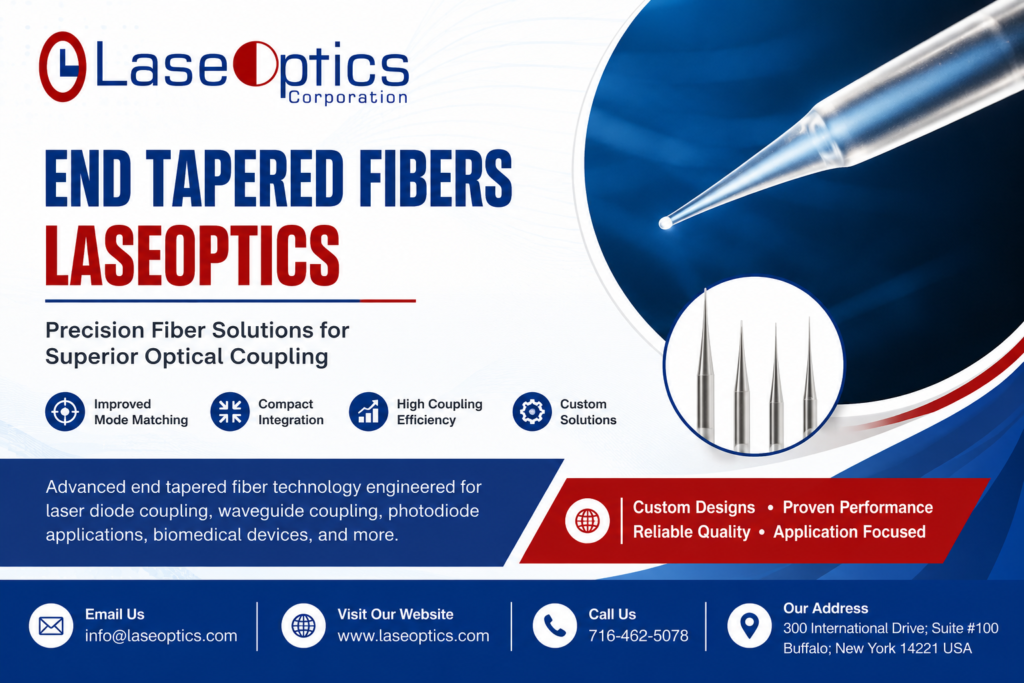
In modern photonics, the performance of an optical system often depends on details that may appear small but have a major effect on overall efficiency. The geometry of a fiber termination is one such detail. When conventional optical fibers need to connect with laser diodes, photodiodes, waveguides, sensors, or other compact optical components, achieving efficient light transfer can be challenging because the optical modes and numerical apertures may not match. End tapered fibers LaseOptics offer an engineered solution by gradually reducing the fiber diameter toward the end of the fiber, helping modify the optical mode and improve compatibility with specific optical devices.
What Are End Tapered Fibers?
End tapered fibers are optical fibers that gradually decrease in diameter toward one end. Instead of maintaining the same diameter throughout the entire fiber, the final section is carefully tapered to create a controlled transition in optical geometry. This transition can influence the propagation of light, mode size, numerical aperture, and beam characteristics at the fiber output. LaseOptics provides tapered optical fiber solutions designed for applications where precise optical coupling and specialized fiber geometries are required. End tapering can be especially useful when a standard fiber cannot efficiently match the optical characteristics of a small laser emitter, integrated waveguide, photodiode, or other photonic component.
The main advantage of an end tapered structure is that the optical transformation occurs close to the device interface. As the fiber becomes narrower, the optical field can become more concentrated, creating a smaller effective mode area and potentially increasing the numerical aperture near the tip. This makes the technology useful for applications where the fiber needs to interact with a small optical area. The actual performance depends on factors such as fiber type, wavelength, taper geometry, taper length, surface quality, and the characteristics of the receiving device.
How End Tapered Fibers Improve Optical Coupling
Efficient optical coupling requires the optical field leaving one component to match the optical acceptance characteristics of another component. When there is a large mismatch between the two, a portion of the available optical power can be lost. End tapered fibers can help reduce this mismatch by gradually changing the optical properties of the fiber near its termination.
For example, a laser diode may produce a beam with a small or highly divergent optical mode. Coupling this beam directly into a conventional fiber can be difficult because the fiber’s mode field and numerical aperture may not correspond to the laser’s output. A properly engineered taper can modify the optical field near the fiber tip and provide a more suitable transition between the laser and fiber. The same principle can be applied to fiber-to-chip and fiber-to-waveguide coupling, where the dimensions of an integrated optical waveguide may be considerably smaller than the mode supported by a standard optical fiber.
This makes tapered fiber coupling an important technique for photonics engineers working on compact and high-performance optical systems. Instead of treating the fiber as a simple transmission medium, the tapered termination can be designed as part of the optical interface itself.
End Tapered Fibers vs. Center Tapered Fibers
End tapered fibers and center tapered fibers both use a reduced fiber diameter, but the location of the taper creates different possibilities. A center tapered fiber has its reduced section somewhere between two full-diameter fiber sections. This type of structure is frequently studied for optical sensing, coupling, nonlinear optics, microresonators, and evanescent-field applications because the tapered region can interact strongly with its surrounding environment.
An end tapered fiber, by comparison, places the tapered section at the end of the fiber. This makes it particularly suitable for direct optical coupling applications because the modified geometry is located exactly where the fiber meets another optical component. Applications can include laser diode coupling, photodiode coupling, waveguide coupling, optical probes, biomedical devices, and compact OEM optical assemblies. The appropriate design depends on where the optical transformation needs to occur and what performance characteristics are required.
Benefits of End Tapered Fibers LaseOptics
One of the key benefits of end tapered fibers LaseOptics is their potential to improve mode matching between optical components. Mode matching is especially important in systems where light must travel between components with different optical dimensions. A customized taper can help transform the mode near the interface and support more efficient light transfer.
Another advantage is compact optical integration. Conventional optical systems may require separate lenses, mounts, and alignment components to focus light into a small active region. Tapered and lensed fiber structures can integrate some of these optical functions directly into the fiber termination. This can reduce the physical footprint of an optical assembly and simplify certain packaging configurations.
Customization is another important benefit. Different applications require different fiber geometries, wavelengths, working distances, spot sizes, and coupling characteristics. LaseOptics provides various tapered and lensed fiber configurations intended for specialized optical applications. Its broader product range includes conical, ball, spherical, wedge-chisel, angled, and perpendicular lensed fiber designs, allowing engineers to select or develop a geometry according to the requirements of their optical system.
Applications of End Tapered Optical Fibers
Laser diode coupling is one of the most important applications for tapered fiber technology. Semiconductor laser emitters can produce highly divergent or asymmetric optical beams, making efficient coupling into a fiber challenging. An appropriately designed tapered fiber can help provide a more controlled optical interface between the laser source and the fiber. This type of technology can be useful in laser pigtails, optical transmitters, semiconductor laser packages, and other laser-based systems.
Waveguide coupling is another major application. Integrated photonic circuits often use waveguides with very small optical modes, while conventional fibers have comparatively larger mode fields. The difference creates a coupling challenge at the fiber-to-chip interface. A tapered fiber can provide a gradual transition between these optical structures, helping improve the compatibility of the fiber mode with the waveguide mode. Research organizations such as NIST have investigated tapered-fiber approaches for low-loss fiber-to-chip coupling, demonstrating the importance of controlled taper structures in integrated photonics.
End tapered fibers can also be used for photodiode coupling. In these applications, the primary objective may be to deliver an adequate amount of optical power onto the detector’s active area. Because photodiode coupling requirements can differ from those of laser or waveguide coupling, the taper geometry can be optimized according to the detector dimensions, wavelength, optical power, and alignment requirements.
Biomedical and sensing applications provide another area of interest. Smaller fiber tips can be valuable when designing compact optical probes for biological measurements, spectroscopy, and other specialized systems. Tapered optical fibers are also widely researched for sensing applications because reducing the fiber diameter can alter the interaction between guided light and the surrounding environment. For these applications, engineers may prioritize sensitivity, mechanical size, wavelength response, and environmental compatibility.
Important Specifications for Selecting an End Tapered Fiber
Selecting the right end tapered fiber requires careful consideration of the complete optical system rather than focusing on the taper alone. The operating wavelength is one of the first parameters to establish because fiber transmission characteristics and optical coatings depend on wavelength. The fiber type is also important because single-mode, multimode, and polarization-maintaining fibers have different optical properties.
The required spot size is another important consideration. If the fiber is being coupled to a laser diode or waveguide, the output mode should be appropriately matched to the receiving component. Working distance is also important when the optical focus needs to occur at a specific location rather than directly at the fiber surface.
Engineers should also consider numerical aperture, taper angle, taper length, optical power, beam profile, polarization requirements, mechanical packaging, connector requirements, environmental conditions, and required production volume. LaseOptics documentation indicates that its lensed and tapered fiber capabilities can cover a broad range of application requirements, including wavelengths, spot sizes, working distances, and taper geometries. Exact specifications should always be confirmed for the particular custom design.
End Tapered Fibers and Lensed Fibers
End tapered fibers and lensed fibers are closely related technologies, but they perform different optical functions. A tapered fiber uses a gradual reduction in fiber geometry to influence the propagation of light and modify the mode near the fiber termination. A lensed fiber uses a specially shaped end to provide lens-like behavior, such as focusing or collimation.
In some advanced optical designs, these concepts can be combined. A fiber may first be tapered to transform the optical mode and then shaped at the end to produce a specific focusing characteristic. This type of combination can be useful when an application requires precise control over spot size, working distance, beam divergence, or coupling efficiency.
LaseOptics offers both tapered and lensed fiber technologies for applications involving laser diodes, photodiodes, waveguides, optical systems, and other photonic devices. Selecting between a tapered fiber, lensed fiber, or combined configuration depends on the optical performance and mechanical requirements of the final assembly.
How to Specify a Custom End Tapered Fiber
When ordering or developing a custom end tapered fiber, engineers should provide as much information about the application as possible. The operating wavelength should be specified first, followed by the fiber type and the device that the fiber will interface with. The target spot size, working distance, optical power, beam characteristics, and desired coupling performance should also be identified.
Mechanical requirements are equally important. The manufacturer may need information about whether the fiber will be supplied as a bare fiber, connectorized fiber, ferrule assembly, pigtail, or another type of optical package. Environmental requirements such as temperature, vibration, humidity, vacuum exposure, and other operating conditions should also be communicated when relevant.
Providing this information helps a manufacturer design the fiber termination around the actual application rather than relying on a generic configuration. For OEM projects, prototype development, and specialized research systems, this application-specific approach can be particularly valuable.
What Makes a High-Quality End Tapered Fiber?
A high-quality end tapered fiber requires more than simply reducing the fiber diameter. The taper must be manufactured with controlled geometry and appropriate surface quality so that the optical transition is consistent and suitable for the intended application. Manufacturing repeatability is especially important for OEM applications because large quantities of components may need to provide consistent optical performance.
Important quality factors include a controlled taper profile, smooth transition, appropriate end geometry, low optical loss, consistent dimensional characteristics, suitable mechanical strength, and compatibility with the required optical wavelength and power level. Depending on the design, additional processes such as polishing, shaping, thermal processing, or coating may be used to achieve the required performance.
LaseOptics works with specialized fiber shaping and manufacturing processes for tapered and lensed fiber solutions. Its capabilities are intended to support customized optical components for research, commercial, and OEM applications.
Future of End Tapered Fiber Technology
As photonic devices become smaller and optical systems become increasingly integrated, the demand for compact and efficient optical coupling solutions is expected to continue. Fiber-to-chip coupling, laser packaging, optical sensing, biomedical instruments, telecommunications, and advanced photonic systems all require reliable interfaces between different optical components.
The development of increasingly precise tapered geometries can help engineers address these challenges. Future designs are likely to place greater emphasis on application-specific mode matching, improved manufacturing tolerances, higher optical power handling, compact packaging, and integration with photonic chips and semiconductor devices.
For this reason, an end tapered fiber should not simply be viewed as a modified fiber tip. In many applications, it functions as a precision optical component that plays an important role in the performance of the complete system.
Conclusion
End tapered fibers LaseOptics provide a flexible approach to solving optical coupling challenges where conventional fiber terminations may not provide sufficient mode matching or optical control. By gradually reducing the fiber diameter toward the end, tapered structures can modify the optical mode and numerical aperture while supporting compact interfaces with laser diodes, waveguides, photodiodes, sensors, and other photonic devices.
The ideal solution depends on several factors, including wavelength, fiber type, taper geometry, spot size, working distance, numerical aperture, optical power, beam profile, and mechanical packaging. For demanding applications, customized fiber geometry can provide advantages over standard components because the termination can be developed around the requirements of the target device.
LaseOptics provides tapered and lensed fiber technologies for research, commercial, and OEM applications. If your project requires a specialized optical interface, contact LaseOptics with your wavelength, fiber, target device, coupling requirements, and packaging specifications to discuss a custom end tapered fiber solution.