
Starting a company in Dubai is an exciting decision, but it comes with one question that trips up almost every founder: which legal structure should you actually choose. Get this decision right and your company can operate smoothly, scale quickly, and stay fully compliant with UAE law. Get it wrong and you may face restricted market access, unnecessary costs, or even the need to restructure the entire company later on.
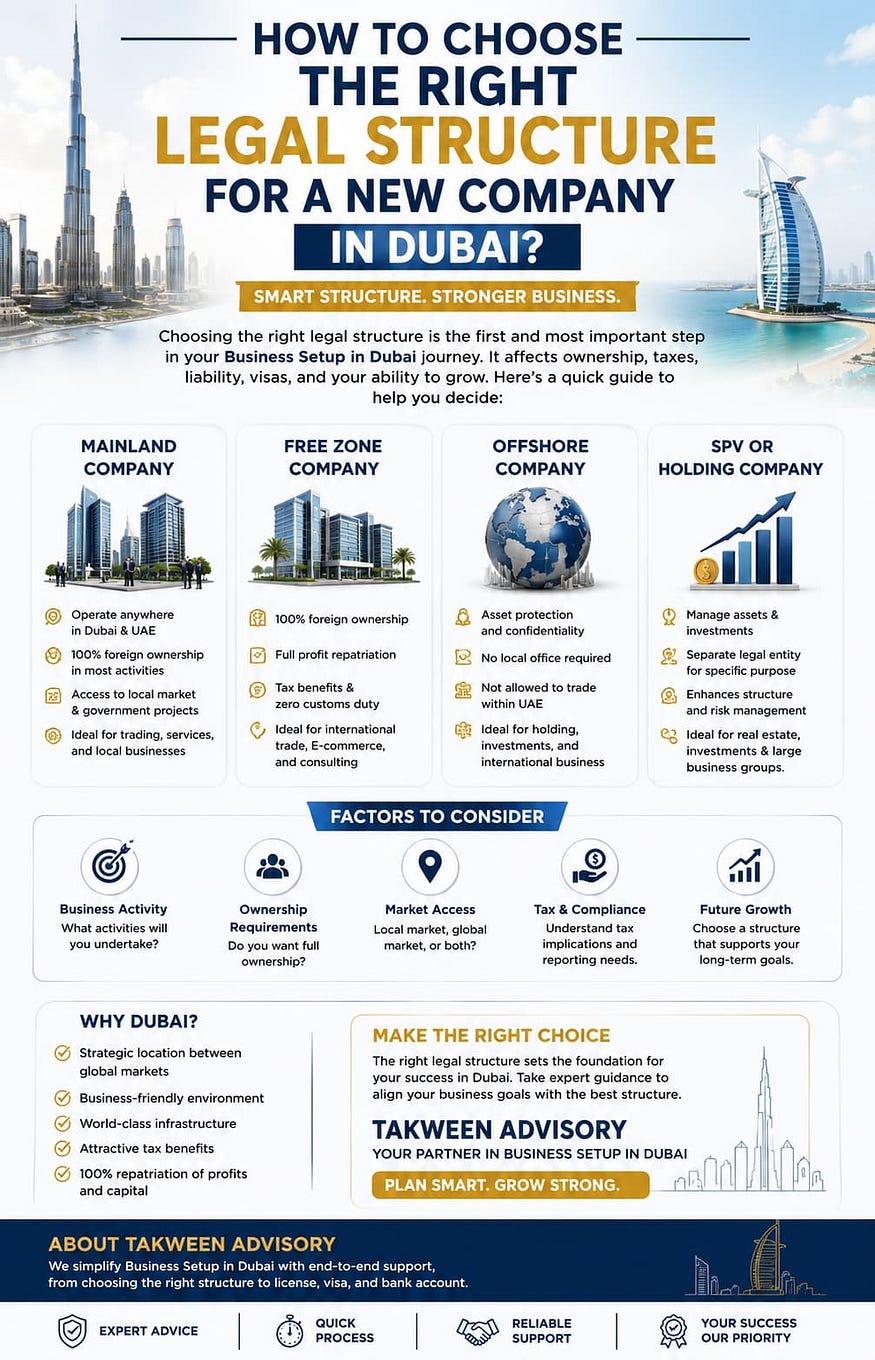
This guide walks you through everything you need to know about business setup in Dubai, from the different legal structures available to the practical factors that should guide your final decision. Whether you are a solo entrepreneur, a small trading company, or an international investor exploring company formation in Dubai, this article will help you understand your options in plain, simple language.
By the end of this article, you will understand the main legal structures available in Dubai, how ownership and taxation rules work, what documents and steps are involved, and how to avoid the common mistakes that catch new business owners off guard.
Why the Legal Structure You Choose Matters So Much
Every business in Dubai must operate under a specific legal structure that is registered with a licensing authority. This structure determines who can own the company, where it can legally trade, how it is taxed, how many visas it can sponsor, and what kind of banking and compliance obligations apply.
Dubai is often described as a city of opportunity, and that reputation is well earned. It offers zero personal income tax, a relatively low corporate tax regime compared to many global markets, strong banking infrastructure, and a strategic location that connects Europe, Asia, and Africa. But none of these advantages work in your favor automatically. They only apply correctly when your business is set up under the right legal and jurisdictional framework from day one.
Choosing the wrong structure is one of the most common and costly mistakes new entrepreneurs make. A business that plans to sell directly to walk-in customers across Dubai, for example, may find itself unable to do so if it is registered in a free zone that restricts direct mainland trading. Correcting this later often means additional paperwork, extra government fees, and lost time, so it pays to understand your options clearly before you begin.
The Main Legal Structures Available in Dubai

Dubai offers three broad categories of company formation, and within each category there are several specific legal forms depending on the number of owners, the nature of the activity, and the sponsoring authority.
1. Mainland Company
A mainland company is licensed by the Dubai Department of Economy and Tourism, commonly referred to as DET. This structure allows a business to trade freely anywhere in Dubai and across the wider UAE market, take on government contracts, and open branches in multiple emirates without additional licensing hurdles.
Following amendments to the UAE Commercial Companies Law, most mainland business activities now allow full foreign ownership without requiring a local Emirati partner, although a narrow list of strategic sectors, such as those linked to national security or specific regulated industries, still require Emirati majority ownership or a local service agent. This shift has made mainland company formation in Dubai far more attractive to international entrepreneurs than it was in the past.
Common mainland structures include:
Limited Liability Company, suited to most trading, consulting, and service businesses with two or more shareholders
Sole Establishment, suited to individual entrepreneurs offering professional or civil services
Civil Company, used for licensed professionals such as consultants, doctors, engineers, and lawyers
Branch of a Foreign or Local Company, used by companies expanding an existing legal entity into Dubai without creating a new one
2. Free Zone Company
Dubai has dozens of free zones, each generally focused on particular industries such as technology, media, logistics, finance, or manufacturing. Free zone companies benefit from full foreign ownership, streamlined registration processes, and in many cases zero percent corporate tax on qualifying income, provided the business meets the conditions to be treated as a Qualifying Free Zone Person under UAE corporate tax law.
The tradeoff is that free zone companies are generally restricted from trading directly with the UAE mainland market unless they appoint a local distributor, open a mainland branch, or obtain a dual license where applicable. This makes free zones an excellent fit for export focused businesses, digital and technology companies, holding structures, and firms whose clients are mostly outside the UAE.
Common free zone structures include:
Free Zone Establishment, owned by a single shareholder
Free Zone Company, owned by two or more shareholders
Branch of an Existing Company, extending operations into a specific free zone
3. Offshore Company
An offshore company is a non resident legal entity typically used for holding assets, managing international investments, protecting intellectual property, or structuring cross border trade. Offshore companies cannot lease physical office space in the same way onshore entities do, cannot sponsor employee visas, and are not permitted to conduct business directly within the UAE market.
Offshore structures are commonly used by holding companies, family offices, and international investors who want a stable, well regulated jurisdiction to hold shares, real estate, or other assets without needing a physical presence in Dubai. Offshore companies generally sit outside the standard UAE corporate tax net, since they are treated as non resident entities with no local operations, though each case should be reviewed individually with a tax professional.
Comparing Mainland, Free Zone, and Offshore at a Glance
Choosing between these three broad categories usually comes down to three questions: where do you want to trade, do you need to sponsor visas, and how important is full ownership and privacy to your business model.
If your goal is to serve customers directly within Dubai and the wider UAE, including retail, government contracts, or walk-in service businesses, a mainland company is usually the right fit. If your business is export oriented, digital, or focused on international clients, a free zone company often provides a faster and more cost efficient path. If you are purely looking to hold assets, shares, or intellectual property without an operational presence in the UAE, an offshore structure is typically the most appropriate choice.
Key Factors to Consider Before Choosing Your Legal Structure

Business Activity and Industry
Every license in Dubai is tied to a specific business activity, and the activity you choose determines which authority regulates you and which jurisdiction is available to you. A logistics company, a media production house, and a financial consultancy will each be steered toward different free zones or mainland categories based on their core activity.
Ownership Requirements
If you want complete control of your company without a local partner, most free zone and many mainland activities now support full foreign ownership. However, a small number of strategic sectors still require Emirati participation, so it is worth confirming the ownership rules for your specific activity before committing to a structure.
Market Access
Ask yourself honestly where your customers are. A structure that limits you to international trade will not serve a business built around local UAE clients, and a mainland license may be more than you need if your entire customer base is overseas.
Office Space and Physical Presence
Mainland companies generally require a physical office that meets Ejari registration requirements. Free zones often offer flexible options ranging from shared desks and flexi-desks to dedicated offices and warehouses. Offshore companies, by contrast, do not require or permit a physical office in the same way.
Visa Requirements
The number of employee and investor visas you can sponsor is directly tied to your license type, office size, and jurisdiction. If you plan to build a sizeable team in Dubai, this should factor heavily into your choice of structure and facility size.
Taxation and Compliance
Under current UAE corporate tax rules, taxable income up to AED 375,000 is taxed at zero percent, with a 9 percent rate applying above that threshold. Businesses with total revenue at or below AED 3 million can, subject to conditions, elect Small Business Relief and be treated as having zero taxable income for that period. Free zone companies are not automatically tax exempt; they must meet a defined set of conditions, including maintaining real economic substance in the free zone, to qualify for the 0 percent rate on qualifying income. Every UAE business, regardless of its tax rate, is required to register with the Federal Tax Authority and file returns.
Setup and Renewal Costs
Costs vary considerably depending on business activity, license type, chosen jurisdiction, office requirements, visa quota, and approvals needed from specific government authorities. As a general guide, low cost business setup in Dubai through certain free zones can start from a modest annual license fee for a single activity with no visa allocation, while mainland licenses with office space and multiple visas typically involve higher combined costs once government fees, office rent, and visa charges are added together. These figures should be treated as indicative only, since Dubai business setup cost estimates change based on the specific package and authority involved.
Step by Step Process to Choose and Register Your Legal Structure

Working through this decision methodically makes the process far less overwhelming. Here is a practical sequence to follow.
Step 1: Define your core business activity clearly, since this single decision shapes almost every other choice you make afterward.
Step 2: Decide where your customers are based, so you can determine whether mainland, free zone, or offshore access suits your trading needs.
Step 3: Assess your ownership and control preferences, and confirm whether your chosen activity allows full foreign ownership.
Step 4: Shortlist two or three jurisdictions, whether that means DET for mainland or a small group of relevant free zones, and compare their fee structures and facility options.
Step 5: Estimate your visa and office space needs based on your expected team size over the next twelve to twenty four months.
Step 6: Request a formal quotation from a licensed business setup consultant so you understand the full picture of government fees, consultancy charges, and any third party costs involved.
Step 7: Prepare your documentation, which typically includes passport copies, a business plan or activity description, and, for certain structures, a No Objection Certificate or additional approvals from sector specific regulators.
Step 8: Submit your trade name reservation and initial approval application through the relevant authority.
Step 9: Finalize your Memorandum of Association or equivalent incorporation documents, and settle the applicable license fees.
Step 10: Complete post licensing steps, including opening a corporate bank account, registering for corporate tax with the Federal Tax Authority, and applying for any employee or investor visas you require.
Real World Example: Choosing Between Free Zone and Mainland
Consider a small e-commerce brand founded by two partners who plan to sell products online across the UAE and internationally, with the majority of revenue expected from regional online marketplaces rather than a physical shop. In this scenario, a free zone company focused on e-commerce or general trading activities is often the more practical starting point, since it supports full ownership, keeps initial costs manageable, and aligns well with an online, export oriented sales model.
Now consider a catering company planning to supply corporate offices and host in-person events across Dubai. Because this business depends on direct, ongoing transactions with mainland clients, a mainland license under DET is generally the more suitable route, even though it may involve a higher initial cost than certain free zone packages.
These examples illustrate why there is no single right answer for every business. The correct legal structure depends entirely on how, where, and to whom your company plans to sell.
Pros and Cons of Each Structure
Mainland Company
Advantages include unrestricted access to the UAE market, eligibility for government contracts, and flexibility to open multiple branches across emirates. The main drawback is a generally higher setup and office cost compared to some free zone packages, along with mandatory Ejari-registered office space.
Free Zone Company
Advantages include full foreign ownership, streamlined registration, industry focused ecosystems, and potential access to the 0 percent qualifying income tax rate. The main drawback is restricted direct trading within the UAE mainland unless additional arrangements are made.
Offshore Company
Advantages include strong privacy, asset protection, and a straightforward structure for holding shares or property. The main drawback is that offshore companies cannot conduct commercial activity within the UAE or sponsor employee visas.
Frequently Asked Questions
What is the fastest legal structure to set up in Dubai?
Many free zone company formations can be completed within a matter of days once documentation is complete, making them a popular choice for entrepreneurs who want to start operating quickly.
Can a free zone company later convert to a mainland company?
In many cases, yes. Businesses often start in a free zone and later add a mainland branch or fully migrate once their market access needs grow, though this involves separate licensing and approval steps.
Do I need a local sponsor to own 100 percent of my Dubai company?
For most business activities today, full foreign ownership is permitted under both mainland and free zone structures, though a limited number of strategic activities still require Emirati participation.
Is business setup in Dubai expensive?
Costs vary widely depending on business activity, license type, office requirements, and visa needs. Some free zone packages offer low cost business setup in Dubai for single activity licenses, while more complex mainland setups with larger office space and visa quotas cost more.
Do free zone companies pay corporate tax?
Free zone companies are not automatically exempt. They must meet specific conditions, including maintaining genuine economic substance, to qualify for the 0 percent rate on qualifying income, and non qualifying income is taxed at the standard 9 percent rate above the AED 375,000 threshold.
Which structure is best for a small startup with a limited budget?
Many early stage founders start with a free zone license because of its comparatively lower entry cost and full ownership benefits, then scale into a mainland presence once local demand justifies the additional investment.
A Note on Costs, Fees, and Regulatory Changes
Every cost mentioned in this article is indicative and intended purely as general guidance. Actual government fees, license charges, visa costs, and office rent depend on your specific business activity, chosen license type, jurisdiction, office space requirements, and any additional approvals required from government authorities. Government fees, regulations, and licensing policies in Dubai and the wider UAE can change over time without prior notice, so figures should always be reconfirmed before you budget or commit to a setup plan.
It is also important to distinguish between official government charges and the fees charged by consultancy or professional service providers. Consultancy charges, professional service fees, and third party costs, such as those from PRO services, document clearance agents, or office space providers, are separate from government fees and can differ significantly between one service provider and another. For accurate, current pricing tailored to your specific business activity, it is best to speak directly with a licensed consultant rather than relying solely on published estimates.
Conclusion
Choosing the right legal structure is one of the most important decisions you will make during business setup in Dubai, and it deserves careful thought rather than a rushed guess. Mainland companies offer unrestricted access to the local market, free zone companies offer full ownership with strong cost efficiency for international and digital businesses, and offshore companies serve a very specific purpose around holding assets and protecting privacy. The right choice depends on your business activity, your target customers, your ownership preferences, and your budget for both government fees and professional support.
If you are still weighing your options, working with experienced business setup consultants in Dubai can save you significant time, money, and stress. Takween Advisory specializes in guiding entrepreneurs and investors through every stage of company formation in Dubai, from selecting the most suitable jurisdiction and legal structure to handling licensing, visas, and ongoing compliance. The team at Takween Advisory can help you compare mainland, free zone, and offshore options side by side, request accurate and up to date quotations, and avoid the costly mistakes that come from choosing the wrong structure.
If this guide helped clarify your next steps, share it with a fellow entrepreneur who is also exploring business setup services in UAE, leave a comment with your questions below, or reach out to Takween Advisory directly for a personalized consultation. Getting expert guidance early is one of the simplest ways to set your new Dubai company up for long term success.
Thank you for reading this blog and learning more about offshore company setup. An offshore company setup is a strategic solution for entrepreneurs, international investors, holding companies, and family offices seeking an efficient corporate structure for international business, asset ownership, investment management, and global expansion. The setup process generally begins with selecting the appropriate offshore jurisdiction, choosing the most suitable legal structure, preparing the required incorporation documents, appointing shareholders and directors where applicable, and completing company registration with the relevant authority. Depending on the business objectives, additional steps may include opening a corporate bank account, maintaining statutory records, meeting ongoing compliance requirements, and implementing effective corporate governance practices. Proper planning, accurate documentation, and compliance with applicable regulations are essential for establishing a legally compliant offshore company that supports long term business and investment goals. Professional guidance helps investors choose the right offshore structure, simplify the incorporation process, and manage regulatory requirements efficiently. If you are planning an offshore company setup in the UAE, visit the Takween Advisory website to explore expert company formation, banking assistance, corporate structuring, compliance support, and business advisory solutions tailored to your international business and investment needs.