csat syllabus for upsc
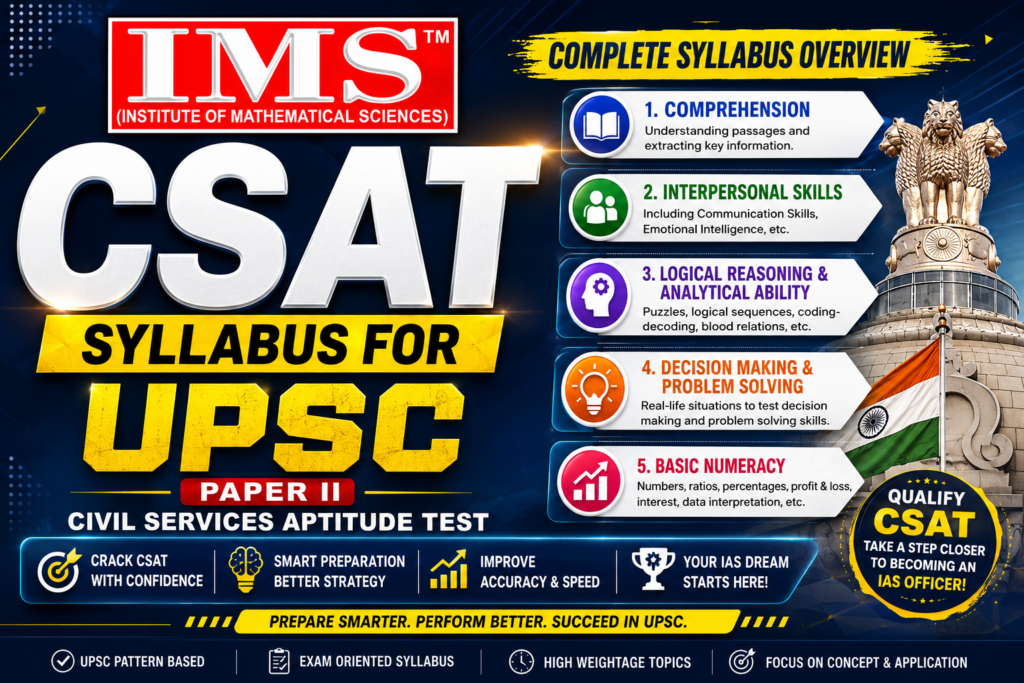
The CSAT syllabus for UPSC covers Comprehension, Interpersonal Skills, Logical Reasoning, Decision Making, General Mental Ability, Basic Numeracy (Class X level), and Data Interpretation. Known as GS Paper-II in the Civil Services Examination Prelims, it is qualifying in nature, requiring a minimum of 33% (66 marks out of 200) to clear.
CSAT Syllabus for UPSC 2026
| Topic Area | Key Sub-Topics | Approx. Weightage |
| Comprehension | Reading passages, inference, vocabulary in context | High |
| Interpersonal Skills | Communication skills, teamwork scenarios | Low-Moderate |
| Logical Reasoning & Analytical Ability | Puzzles, syllogisms, seating arrangement, blood relations | High |
| Decision Making & Problem Solving | Situational judgment, ethical dilemmas | Moderate |
| General Mental Ability | Series, coding-decoding, analogies | Moderate |
| Basic Numeracy (Class X level) | Number systems, percentages, ratios, averages, profit & loss | High |
| Data Interpretation | Tables, graphs, charts, data sufficiency | High |
Note: UPSC does not release an official percentage-wise weightage; the table above reflects patterns observed across previous years’ papers. Always cross-check the latest details in the official UPSC notification at upsc.gov.in.
Key Takeaways
- CSAT is officially called GS Paper-II and is qualifying, not merit-based.
- Candidates need 33% (66/200 marks) to qualify for Mains evaluation.
- Basic Numeracy questions are set at Class X standard, not advanced mathematics.
What Is CSAT in the UPSC Exam?
CSAT stands for Civil Services Aptitude Test. It was introduced in 2011 to test reasoning, comprehension, and basic numerical ability rather than subject knowledge.
It forms Paper-II of the UPSC Prelims, alongside GS Paper-I. While GS Paper-I decides your Prelims rank, CSAT only decides whether your GS Paper-I gets evaluated at all.
Failing to clear CSAT means your GS Paper-I score is not considered, regardless of how well you performed in it. This makes CSAT a silent filter that many aspirants underestimate.
Key Takeaways
- CSAT is not a ranking paper; it is a qualifying hurdle.
- A weak CSAT attempt can disqualify an otherwise strong Prelims performance.
- The paper tests aptitude, not memorized facts.
UPSC CSAT Syllabus: Exam Pattern at a Glance
| Detail | Specification |
| Paper Name | General Studies Paper-II (CSAT) |
| Total Marks | 200 |
| Number of Questions | 80 |
| Marks per Question | 2.5 |
| Duration | 2 hours |
| Negative Marking | 1/3rd mark deducted per wrong answer |
| Qualifying Marks | 33% (66 marks) |
| Nature | Qualifying only |
This pattern has remained largely stable since CSAT’s introduction, though question difficulty and comprehension complexity have gradually increased in recent cycles.
Key Takeaways
- 80 questions in 2 hours means roughly 90 seconds per question.
- Negative marking makes guesswork risky; accuracy matters more than attempt count.
- Qualifying marks apply uniformly, but general category candidates should aim comfortably above 33% for safety margin.
CSAT Paper-II vs GS Paper-I: What’s the Difference?
| Aspect | GS Paper-I | CSAT Paper-II |
| Nature | Merit-based (used for ranking) | Qualifying only |
| Subjects | History, Polity, Geography, Economy, Environment, Science | Reasoning, Comprehension, Numeracy, Decision Making |
| Marks | 200 | 200 |
| Qualifying Criteria | Cutoff varies yearly | Fixed at 33% |
| Impact on Mains | Determines Prelims rank | Determines eligibility only |
Many aspirants focus entirely on GS Paper-I and treat CSAT as an afterthought. This is one of the most common reasons capable candidates miss the Mains cutoff.
Indian Forest Service Syllabus: How CSAT Fits In
Aspirants preparing for the Indian Forest Service (IFoS) exam often ask whether CSAT applies here too. The IFoS Prelims uses the same CSAT paper as the Civil Services Examination, since both exams share a common Preliminary stage.
This means your CSAT preparation for IAS also directly serves your IFoS Prelims attempt. However, IFoS Mains has a distinct syllabus centered on core science and forestry subjects, which candidates should study separately using a dedicated Indian Forest Service Syllabus guide.
Key Takeaways
- CSAT syllabus is common to both Civil Services and IFoS Prelims.
- IFoS Mains is entirely different from the Civil Services Mains syllabus.
- One round of CSAT preparation benefits both exam tracks.
Mathematics Optional for UPSC: Does It Help with CSAT?
Many students confuse Mathematics Optional for UPSC with the CSAT numeracy section. They are different in scope and difficulty.
CSAT numeracy is at Class X level and tests speed and application. Mathematics Optional, chosen for the Mains exam, involves graduate-level topics like Linear Algebra, Calculus, and Differential Equations.
That said, aspirants with a mathematics background often find CSAT’s quantitative and reasoning sections easier due to stronger foundational logic and number sense.
Key Takeaways
- CSAT numeracy ≠ Mathematics Optional; the difficulty levels are far apart.
- A mathematics background gives a natural edge in CSAT’s reasoning and numeracy sections.
- Aspirants considering Mathematics Optional should evaluate it separately from CSAT strategy.
Common Mistakes to Avoid in CSAT Preparation
- Ignoring CSAT until the last month: Many candidates start CSAT revision too late, leaving little time for practice under timed conditions.
- Overestimating comfort with reasoning: Confidence without practice often leads to careless errors in logical puzzles.
- Skipping data interpretation practice: DI questions are time-consuming without practice, even for those comfortable with mathematics.
- Not simulating exam-day timing: Practicing untimed leads to poor pacing on exam day.
- Neglecting comprehension speed: Slow reading directly eats into time for numeracy and reasoning sections.
- Attempting too many questions randomly: Negative marking punishes guesswork; selective attempting is safer.
Preparation Strategy for CSAT Syllabus 2026
- Start early alongside GS Paper-I. Dedicate at least 2-3 sessions weekly to CSAT from the start of your preparation, not just before Prelims.
- Master basic numeracy fundamentals first. Revise Class VIII-X level mathematics concepts like percentages, ratios, and averages before attempting advanced problems.
- Practice daily comprehension passages. Read editorials and practice inference-based questions to build reading speed.
- Solve topic-wise reasoning sets. Focus on puzzles, syllogisms, and seating arrangements, which appear frequently.
- Take timed mock tests regularly. Simulate the 2-hour format at least once a week closer to the exam.
- Analyze UPSC Previous Year Papers. Reviewing actual CSAT papers reveals recurring question patterns and difficulty trends.
- Build a UPSC Preparation Strategy that balances both papers. Don’t let CSAT confidence come at the cost of GS Paper-I preparation, or vice versa.
Recommended Resources for CSAT Preparation
- Official UPSC Notification and Syllabus PDF – available at upsc.gov.in, the only authoritative source for exam pattern updates.
- NCERT Mathematics textbooks (Class VIII-X) – ideal for building basic numeracy fundamentals.
- UPSC Previous Year Papers – essential for understanding real exam difficulty and question style.
- Standard reasoning and aptitude practice books – for logical reasoning and data interpretation practice.
- Daily newspaper editorials – to strengthen comprehension and reading speed.
FAQs
Q1. What is the CSAT syllabus for UPSC?
The CSAT syllabus covers Comprehension, Interpersonal Skills, Logical Reasoning, Decision Making, General Mental Ability, Basic Numeracy at Class X level, and Data Interpretation. It forms GS Paper-II of the UPSC Prelims and is qualifying in nature, requiring 33% marks to clear.
Q2. Is CSAT compulsory to clear for UPSC Prelims?
Yes. Candidates must score at least 33% (66 out of 200 marks) in CSAT. If you fail to clear this threshold, your GS Paper-I is not evaluated, and you cannot proceed to the Mains stage regardless of your GS Paper-I performance.
Q3. How difficult is the mathematics section in CSAT?
The mathematics section in CSAT is set at Class X level, covering percentages, ratios, averages, and basic number systems. It is far simpler than Mathematics Optional for UPSC, which is a Mains-level subject with graduate-level topics.
Q4. Does the Indian Forest Service exam use the same CSAT syllabus?
Yes. The Indian Forest Service (IFoS) Prelims shares the same CSAT paper as the Civil Services Examination. However, the IFoS Mains syllabus is entirely different, focusing on science and forestry-related subjects.
Q5. How many questions are asked in the UPSC CSAT paper?
CSAT consists of 80 multiple-choice questions carrying 2.5 marks each, totaling 200 marks. Candidates get 2 hours to complete the paper, with a negative marking of 1/3rd mark for each wrong answer.
Q6. Can someone without a mathematics background clear CSAT?
Yes. CSAT tests basic aptitude, not advanced subject knowledge. With consistent practice in Class X level numeracy, reasoning, and comprehension, candidates from any academic background can qualify comfortably.
Q7. What is the qualifying mark for CSAT in UPSC 2026?
The qualifying mark for CSAT remains 33%, which is 66 marks out of 200. This criterion has stayed consistent since CSAT’s introduction in 2011 and applies uniformly to all categories of candidates.
Q8. Where can I check the official CSAT syllabus for UPSC 2026?
The official CSAT syllabus is published in the UPSC Civil Services Examination Notification, available for download at the official UPSC website, upsc.gov.in, under the examinations section.
Ready to Master CSAT and Mathematics for UPSC?
Clearing CSAT comfortably, and choosing Mathematics Optional the right way, both need structured guidance and consistent practice, not guesswork. At the Institute of Mathematical Sciences, our faculty helps aspirants build strong numerical foundations, sharpen reasoning skills, and approach both CSAT and Mathematics Optional with confidence and clarity.
Whether you’re strengthening your CSAT basics or exploring Mathematics Optional for UPSC, Institute of Mathematical Sciences offers structured mentorship designed around how the exam actually works. Reach out today to build a preparation plan that fits your goals.