The good thing about an Angioplasty procedure is that it is minimally invasive, and usually the patient gets discharged from the hospital the same day. In Angioplasty, the pain is less, as the recovery is faster.
But first, let’s get an overview of what exactly happens in an Angioplasty procedure. In Coronary Artery Disease (CAD) the arteries get narrowed or blocked due to the plaque build-up, which in turn blocks the blood supply to the heart muscle. CAD is dangerous if not attended to immediately, because due to the lack of blood supply, the heart muscle starts dying. So, it becomes imperative that the blood supply is restored, precisely for which the Angioplasty procedure is performed.
In the procedure, with the help of a catheter, a thin wire with a small balloon at its tip is guided toward the narrowed spot. Once it reaches the narrowed spot, the balloon is inflated, the plaque is removed and the stent is placed to keep the artery open. The stent, a mesh-like metal tube, is needed to avoid the possibility of restenosis (re-narrowing of the artery) after the treatment. Angioplasty recovery time is minimal, as it is a minimally invasive procedure done with the help of a catheter and an image-guided system. In case there are no complications in the procedure, the patient can leave for home the same day.
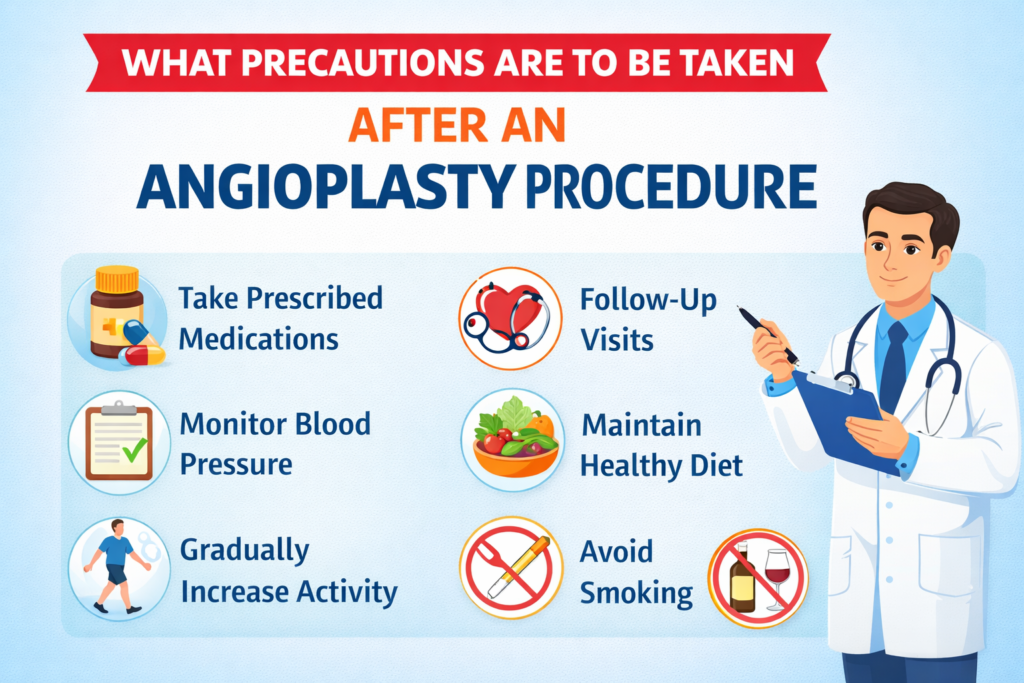
Precautions After Angioplasty:
Immediate Precautions –
First things first, rest! Avoid heavy lifting or strenuous physical activities.
If a stent is placed, the medication after Angioplasty must be observed exactly as they are prescribed to avoid the formation around the stent.
In case you feel chest pain, especially like the one that brought you to the hospital in the first place, or notice any swelling, bleeding or extreme pain, fever or chills, or numbness in the arms or legs, contact your doctor immediately. Only if it is mild bruising, it is okay.
Long-Term Precautions –
- Give up smoking, as it increases the chances of clotting in the arteries.
- A heart-healthy diet goes a long way and helps with long-term outcomes.
- Keep your Cholesterol, stress levels, diabetes, and hypertension in check.
- Keep your alcohol intake to a moderate level. If your cardiologist asks, you might also have to cut it off completely.
- Maintain a healthy weight, as being overweight puts extra pressure on your heart.
- If your work stresses you out, it won’t work for your heart and might leave you with further complications.
Medication After Angioplasty:
The medications after the Angioplasty procedure are to minimise further heart complications. It is to note that medications help you recover faster if you complement them with a heart-healthy lifestyle.
General Medications after Angioplasty:
- Antiplatelets – the blood thinners that minimise the chances of blood clot formation around the stent, which considerably reduce the chances of a heart attack.
- Lipid-lowering medication – Also known as Statins, these medications are used to control cholesterol levels in your blood, which further reduces the risk of heart attack and stroke
- Blood Pressure medication – given to those who have pre-existing heart conditions, such as Hypertension
Diet After Angioplasty:
A diet that is rich in Vitamins, Minerals, antioxidants, and Dietary Fibre and one that is devoid of excessive salts, sugars, and Unsaturated Fats, is considered an ideal heart-healthy diet. Include more fruits, green vegetables, nuts, and seeds in your diet to further reduce the risk of heart disease.
Exercising After Angioplasty:
It is a proven fact that being physically active helps patients recover faster. Exercising helps manage a healthy weight, hypertension, and keeps cholesterol levels in check. Your cardiologist will help you with your exercise program, and follow it to the letter.
After Angioplasty: Precautions Heal Faster Than Medication
Angioplasty procedure is quite effective in restoring the blood flow, but it is the patient’s lifestyle choices after the surgery that make the real difference in shortening the Angioplasty recovery time, and result in long-term consequences. Is it as important to follow the precautions after Angioplasty as it is to know what to do after stenting? In case there is any doubt or apprehension, consult your cardiologist immediately.