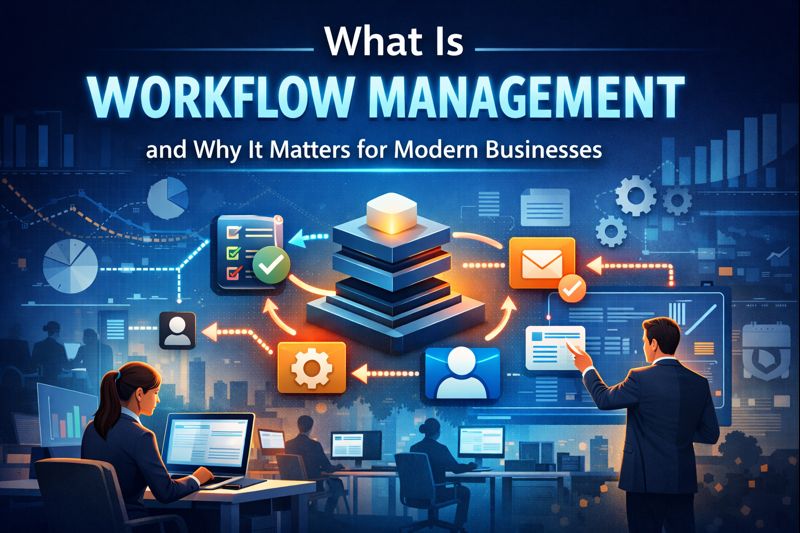
In the modern digital world, growing at a fast pace, companies should be able to work fast, accurately and efficiently to remain competitive. Whether it is a small service company or a big one, improperly managed processes may result in delays, errors, miscommunication and eventually unhappy customers. This is where the Workflow Management is the key. With the insight of the workflow management concept and how the appropriate Workflow Software can revolutionize business processes, organisations will be able to simplify operational processes, enhance productivity, and attain a stable outcome.
What Is Workflow Management?
The term Workflow Management denotes the design, automation, monitoring and optimization of business tasks. All organisations have workflows, i.e. chains of activities that should be fulfilled to provide a product or service. They can include onboarding of employees, purchase order approval, customer support tickets, or field service operations.
Conventional processes tend to be manual, which operates under emails, spreadsheets, and verbal communication. This manual method results in bottlenecks, hiddenness, failure to communicate, and administration which is time consuming. Workflow management focuses on addressing these issues by developing a system which follows a systematic approach in work beginning to end with the least possible friction.
The workflow management systems are now modernized and technology is being used to automate repetitive work, direct information to the appropriate individuals and ensure that every activity is done correctly and in time.
The use of Workflow Software.
Workflow Software is a computer-based tool that allows businesses to automate, monitor and simplify routine tasks to effectively manage and optimise business processes. Workflow software assists organisations in identifying the organisation processes, allocate tasks, set deadlines, track real time progression. This guarantees the flow of work between departments.
Potent workflow software framework such as those employed by progressive companies can:
- Standardise and get business processes digitised.
- Automation of manual and repetitive work.
- Improve team collaboration
- Give complete transparency of workflows.
- Reduce operational costs
- Improve accountability and accuracy.
Workflow software allows companies to do away with guesswork and develop a process of doing something in an orderly manner.
The Relevance of Workflow Management in the Modern Business
1. Enhanced Efficiency and Productivity.
Paper-based processes are a waste of resources and time. Workflow management helps remove these inefficiencies through automation of repetitive tasks, minimized delays and teams are notified of what they should do next. There is less time wasted by employees as they find the information and more time is used in constructive work.
2. Better Interdepartmental Cooperation.
When businesses are growing, work can be carried out by various departments, i.e. HR, finance, operations and customer service, etc. In the absence of a suitable system, there is bound to be communication gaps. Workflow management offers a common platform, on which all individuals can work together, access data, and monitor task updates. This minimizes confusion and work processes between teams are smooth.
3. More Transparency and Management.
Lack of transparency is one of the most significant problems of the traditional processes. There is always a difficulty of managers in identifying who does what, where there is a delay, and time taken in executing each activity. Workflow Software also provides dashboards, analytics as well as real-time tracking to ensure that the decision-makers have a clear view of the whole situation occurring in the organisation. This assists in the detection of the bottlenecks and facilitates improved planning.
4. Consistency and Standardisation.
Any business desires a steady performance- but when processes are relying on memory or manualisation, inconsistency is bound to occur. Workflow management enables you to standardise your processes through the determination of step-by-step processes. The workflow makes sure that the customer is onboarded, the invoice is approved, and the inventory is handled the same way each time to enhance the quality and minimize errors.
5. Faster Decision-Making
The workflow management systems offer real-time data, automatic alarms, and real-time notifications to the team. The managers are able to see what is required to be attended to swiftly and make informed decisions. The ability to have information flow freely can help businesses react quicker to customer demands, market trends and internal problems.
6. Enhanced Audits and Compliance.
Workflow management is a game changer in industries that have a high level of compliance requirements. Workflow software is also capable of automatically documenting all movements done and this leaves transparent audit trails. This makes it adhere to the internal policies, industry standards, and regulatory requirements, minimizing risks and promoting accountability.
7. Business Growth Scalability.
With the growth of businesses, their operations are more complicated. Automated systems just do not facilitate high growth. Workflow management makes the processes efficient and scalable. Through workflow software, a business may expand the existing operations by adding new steps, users, approvals, or departments without difficulty.
Picking the Right Workflow Software
The appropriate workflow software is very vital in attaining long run operations efficiency. A tool desired by businesses should:
- Easy to customise
- User-friendly for all teams
- Ability of integrating with existing business systems.
- Expansible with the growth of the organisation.
- With automation features.
- Appropriate to simple and complex workflows.
Systems such as those of a modern business, such as the solutions provided in the https://addrslabs.com/ offer the flexibility and ability to optimize operations with ease.
Conclusion
Workflow Management has become a necessity and not an option in the era when speed, efficiency, and accuracy are the elements that define the success of businesses. Using the latest Workflow Software, companies are able to automatize the mundane, boost productivity, and visibility as well as provide consistent output. Workflow management is a base to more intelligent, quicker, and nimble operations whether you are planning to boost productivity, lower operations or enhance customer satisfaction.
The adoption of workflow management in organisations is not only an optimisation of the current processes, but also a way of future-proofing by the organisations, as it is increasingly scalable and digital.