In 2026, drones, or UAVs, are everywhere. They’re used for commercial delivery, agriculture, media production, and military operations. Drone revenue worldwide may surpass USD 10.5 billion in 2026, and this growth is owing to both commercial and civil applications. With millions of units flying, it is essential to ensure safety and security in the airspace.
Fast growth has created a high demand for sky defense tech. This includes drone signal jammer systems and DJI drone radar solutions. These systems can quickly detect, track, and stop unauthorized drone activities. Let’s explore how these devices work, why they matter, and the trends shaping their use.
What Is a Drone Signal Jammer?
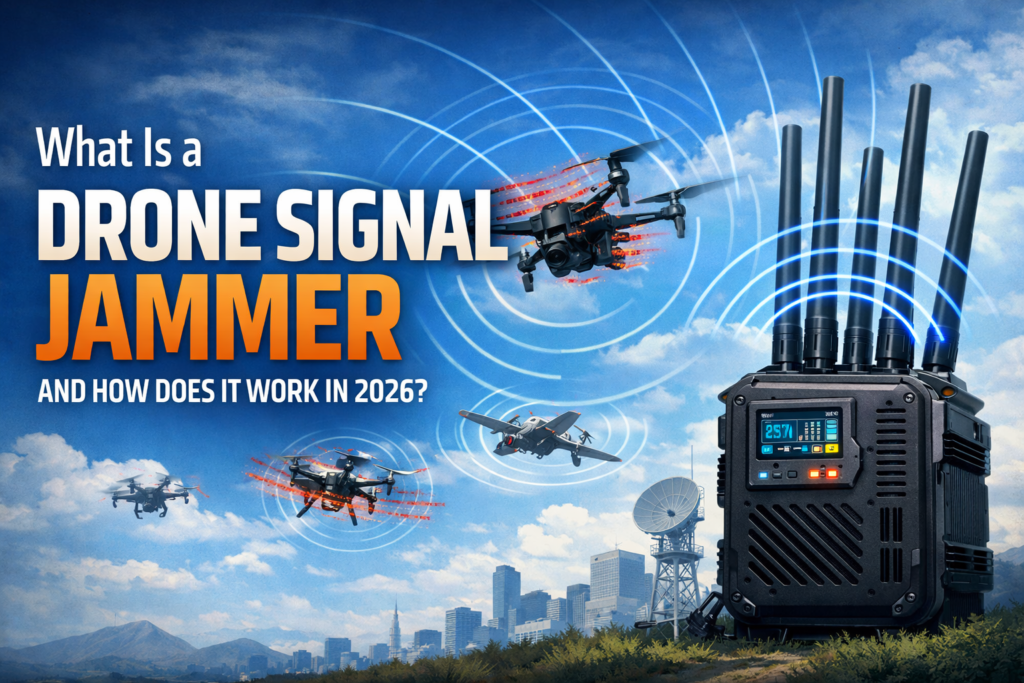
A drone signal jammer is a device that disrupts radio frequency (RF) signals. It interferes with the communication between a drone and its operator. These links are used to send essential control commands and telemetry signals. Signal jammers flood or cut off signals to force drones into a safety procedure. These drones might stay in place, return home, or land. This process does not allow the operator to take control again.
Most consumer and commercial drones use RF communication and GPS signals to fly and stay in control. A jammer broadcasts noise at the same frequencies, usually 2.4 GHz and 5.8 GHz. This noise overwhelms signals and disrupts the link between the drone and its pilot.
Key Functions of a Drone Signal Jammer
- Block RF control signals stop control signals from reaching the drone.
- Disrupting GPS navigation messes up the UAV’s location-tracking systems.
- Drones today mostly switch to a safe fallback if they lose control.
How Does Drone Signal Jamming Work in Practice?
Signal jammers function by causing electronic interference that drowns out legitimate communication:
1. Radio Frequency Interference
The jammer sends signals on the same frequency bands that the drone operators use. This increases the background “noise” in the signal. It confuses the drone’s receiver. As a result, the real control commands get completely “drowned out.”
2. GPS Disruption
GPS is critical for navigation and autonomous flight. If these satellite signals are jammed, the drone can get lost, and it may start drifting in altitude or land automatically.
3. Protocol and Signature Targeting
Today, systems can detect the communication protocols of different UAVs. They can also adjust their jamming signals to be more effective. High-tech DJI drone radar systems help find exact DJI drone signatures. These systems then aim countermeasure signals at them.
What Is DJI Drone Radar and Why It Matters
In 2026, drone radar technologies will form an integral part of airspace security systems. Radar is a feature that enhances the capabilities of jammers by allowing the detection and tracking of targets. Radars watch the airspace for moving targets. They calculate speed and altitude. This helps security personnel tell drones apart from birds or other aircraft.
Once the drone is detected and tracked, the signal jammer can be deployed precisely. This means the jamming signal activates only after confirming the target. As a result, unwanted disruptions are minimized. This tandem is widely used to protect critical infrastructure, military areas, and manage airspace over public events.
How Radar Enhances Countermeasures
- Automated detection: Radar systems quickly alert us when they spot a UAV in restricted airspace.
- Tracking & classification: Using advanced radar, one can obtain a drone’s speed, direction, and size profile.
- Jam trigger automation: After detection, radars can first confirm the threat before allowing jammers to act.
Legal & Safety Considerations
Drone jammers may be potent instruments; however, they are intensely regulated, for example:
- In many areas, like the US and EU, using jammers without permission can disrupt licensed communications. This may lead to penalties.
- Performing the procedure safely requires getting approval from the authorities. These rules may be even more strict near airports or in public places.
Following the rules of the land and international airspace laws is an essential element of a decent anti-aircraft system.
UAV Defence: A Leader in Anti-Drone Tech
UAV Defence is one of the leading players in this specific market. They offer innovative drone detection radar and jamming solutions. These solutions meet safety and regulatory standards while enhancing airspace security. Providers use detection, tracking, and countermeasures to protect sensitive locations and public spaces from illegal drone intrusions.
Final Thoughts
It’s important to understand what a drone signal jammer is. Also, knowing how devices like the DJI drone radar work is key. Drones are filling our skies, making them crowded and contested. Drones are quickly being adopted by many industries. Forecasts show a big growth in the market. So, solutions for managing and securing airspace are becoming essential. These technologies are vital for effective drone use.
The latest counter-UAV solutions will remain vital in 2026 and beyond. They combine detection, tracking, and jamming features. This integration allows for smart responses that improve safety, supervision, and security.