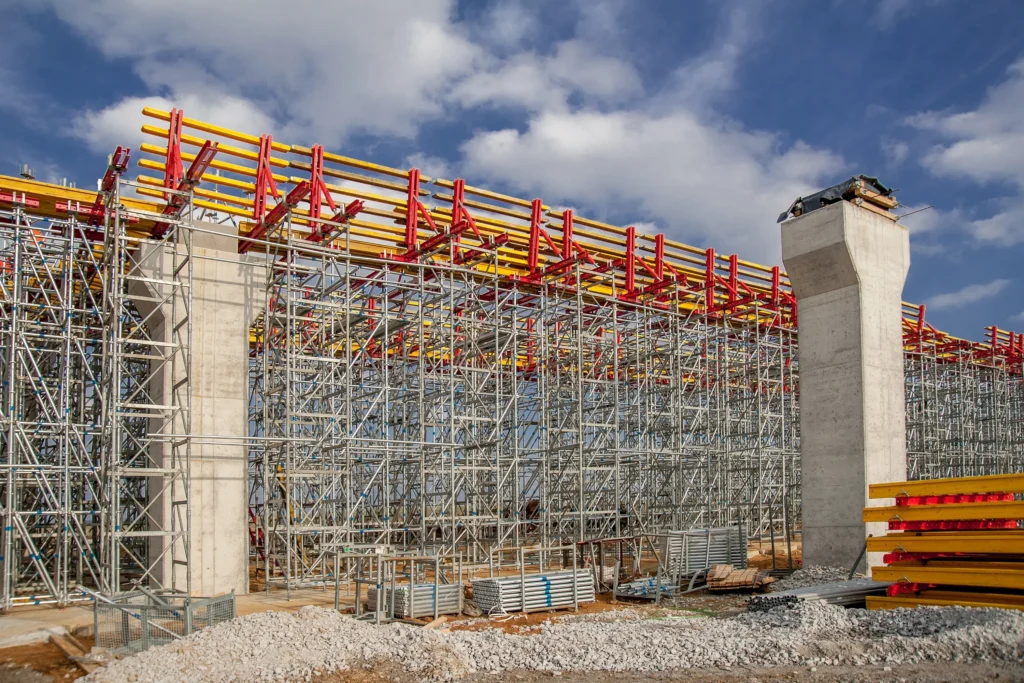
Heavy-duty scaffolding and formwork serving as essential temporary works in building construction to ensure stability and safety during the project.A detailed photograph showcasing extensive metal falsework and yellow formwork beams set up against a blue sky. This structure illustrates the critical engineering required for temporary works in building construction, designed to support elevated concrete elements before they become self-supporting.
Temporary works in building construction are essential systems and structures used to support, protect, or provide access during the construction process. Although these works are not part of the finished building, they play a vital role in maintaining safety, stability, and efficiency on site. Without properly designed and managed temporary works, construction activities such as excavation, concrete works, demolition, and structural alterations would be unsafe or impossible.
This guide explains the concept of temporary works in building construction, their importance, and provides a detailed list of commonly used temporary works across residential and commercial projects.
What Are Temporary Works in Building Construction?
Temporary works in building construction refer to any temporary structure or support system required to safely carry out permanent construction works. These systems are installed for a specific purpose and duration and are removed once their role has been fulfilled and the permanent structure becomes self-supporting.
Temporary works often require separate design, checking, and approval processes due to the high level of risk involved if they fail.
Why Temporary Works Are Important
Temporary works are critical because they:
-
Protect workers and the general public
-
Maintain structural stability during construction stages
-
Enable safe excavation and demolition
-
Allow efficient sequencing of construction activities
-
Prevent damage to existing buildings and infrastructure
In the UK, temporary works are typically managed following recognised standards such as BS 5975, which outlines responsibilities, design checks, and site controls.
Common Types of Temporary Works in Building Construction
Below is a detailed list of temporary works commonly used on construction sites.
1. Formwork
Formwork is a temporary mould used to shape concrete until it gains sufficient strength.
Common examples include:
-
Slab formwork
-
Beam and column formwork
-
Wall and core formwork
-
Jump form and slip form systems
Properly designed formwork ensures accurate dimensions and surface finishes.
2. Falsework
Falsework consists of temporary load-bearing structures that support permanent elements during construction.
Applications include:
-
Supporting concrete slabs and beams
-
Transfer structures
-
Bridge decks
Falsework must be carefully designed to handle construction loads safely.
3. Scaffolding
Scaffolding provides safe access and working platforms at height and is one of the most visible temporary works in building construction.
Types include:
-
Tube and fitting scaffolding
-
System scaffolding
-
Mobile scaffold towers
Scaffolding also provides edge protection and fall prevention.
4. Shoring Systems
Shoring is used to temporarily support walls or structures during alterations, excavation, or repairs.
Types of shoring include:
-
Raking shores
-
Flying shores
-
Dead shores
Shoring is particularly important during refurbishment and extension projects.
5. Excavation Support and Earth Retention
Excavation works require temporary support systems to prevent soil collapse and protect nearby structures.
Common systems include:
-
Sheet piling
-
Soldier piles and lagging
-
Trench boxes
-
Temporary retaining walls
These systems are widely used in basement and foundation construction.
6. Temporary Propping and Needling
Temporary propping supports existing structural elements while permanent changes are made.
Examples include:
-
Acrow props
-
Steel beams for needling
-
Back-propping systems
These are commonly used when creating openings or removing load-bearing walls.
7. Temporary Access and Working Platforms
Temporary access systems allow workers and materials to move safely around the site.
Examples include:
-
Temporary staircases
-
Walkways and ramps
-
Gantries
These systems improve site safety and productivity.
8. Temporary Works for Demolition
During demolition, temporary works control structural behaviour and protect surrounding areas.
Examples include:
-
Crash decks
-
Temporary bracing
-
Protection fans
-
Temporary enclosures
They help manage debris, vibration, and safety risks.
9. Temporary Services
Temporary services are required to keep construction sites operational.
These include:
-
Temporary electrical supply
-
Temporary water supply
-
Temporary drainage
-
Temporary lighting and ventilation
Such services are essential from site setup to project completion.
10. Public Protection and Traffic Management
In urban construction projects, temporary works are used to protect pedestrians and manage vehicle movement.
Examples include:
-
Hoarding and fencing
-
Pedestrian walkways
-
Temporary barriers and signage
These works help meet legal and safety requirements.
11. Temporary Works for Lifting Operations
Heavy lifting activities require specialised temporary works to ensure stability.
Examples include:
-
Crane bases and mats
-
Temporary lifting beams
-
Spreader frames
These systems distribute loads safely and prevent ground failure.
12. Temporary Weather and Environmental Protection
Temporary works also protect construction activities from environmental conditions.
Examples include:
-
Temporary roofing systems
-
Shrink wrapping
-
Dust and noise control barriers
These measures help maintain quality and programme efficiency.
Temporary Works Design and Specialist Support
Temporary works must be properly designed, checked, and supervised to avoid failures. Specialist engineers are often involved to ensure compliance, particularly for complex or high-risk projects. Guidance from experienced temporary works design professionals helps ensure that construction activities remain safe and well-coordinated throughout the project lifecycle.
Temporary Works in New Build Construction
Temporary works are especially important in new build projects, where foundations, structural frames, and concrete elements are constructed in stages. During the delivery of custom new build homes in the UK, temporary works enable safe excavation, structural support, and sequencing before the permanent structure becomes stable.
Conclusion
Temporary works in building construction are a critical part of every successful project. From formwork and scaffolding to excavation support and temporary services, these systems provide the foundation for safe and efficient construction.
Understanding and correctly applying temporary works reduces risk, improves productivity, and ensures that permanent structures are delivered safely and to a high standard. Regardless of project size, effective temporary works management is essential for achieving construction success.