Power Cable Solutions for Modern Power Networks – Engineering-Grade Reliability by HNBF PowerPower Cable Solutions for Modern Power Networks – Engineering-Grade Reliability by HNBF Power
power cable
In today’s fast-evolving transmission and distribution infrastructure, the power cable is no longer a simple commodity product. For utilities, EPC contractors, and industrial developers, power cables directly determine system safety, energy efficiency, maintenance cost, and long-term operational reliability.
As a global manufacturer of overhead conductors and insulated cable systems, HNBF Power provides engineered power cable solutions designed for modern grid projects, renewable integration, and industrial power distribution. This guide explains how professional buyers and engineers can select the right power cable and why engineering-driven manufacturing matters for real-world projects.
Understanding the Role of Power Cable in Today’s Grid Infrastructure
A power cable is the primary medium for transmitting and distributing electrical energy between substations, transformers, and end-use loads. In utility-scale and industrial networks, the cable must perform reliably under:
-
Continuous thermal loading
-
Mechanical stress during installation
-
Environmental exposure such as moisture, chemicals, and UV radiation
-
Electrical stress from switching and short-circuit events
For engineers and procurement teams, selecting the right power cable directly impacts project lifetime, outage risk, and total cost of ownership.
Key Types of Power Cable Used in Utility and Industrial Projects
Low-Voltage Power Cable for Distribution Networks
Low-voltage power cable is widely used for:
-
Secondary distribution lines
-
Commercial and industrial buildings
-
Infrastructure facilities and substations
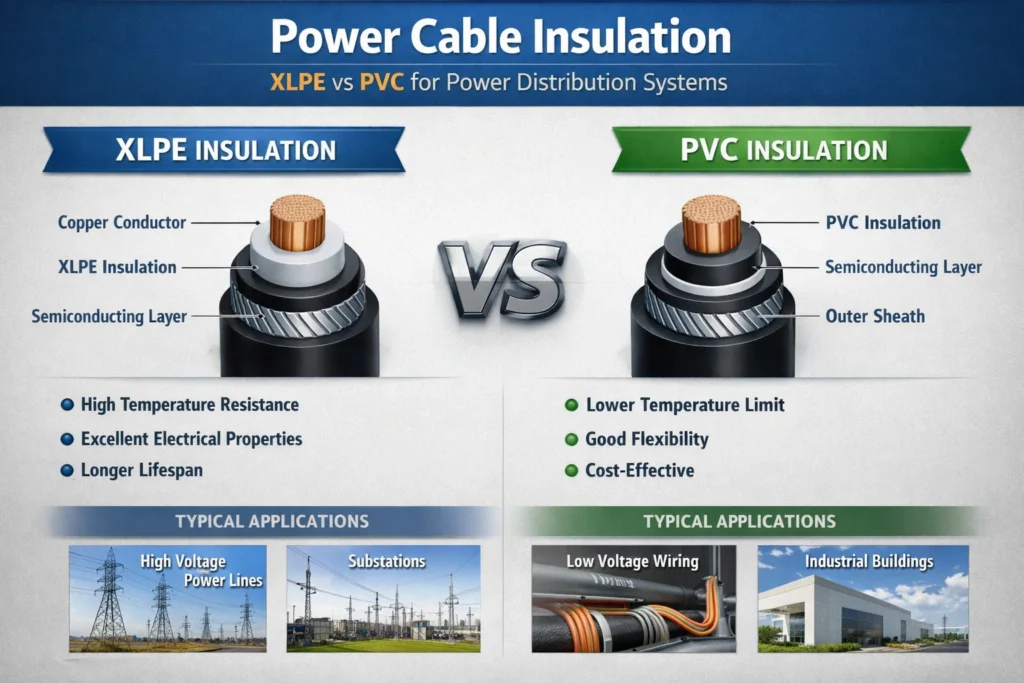
Typical designs include copper or aluminum conductors with PVC or XLPE insulation and optional armoring for mechanical protection.
HNBF Power manufactures LV power cable systems optimized for large-scale deployment, offering consistent conductor geometry, stable insulation thickness, and strict production control for project reliability.
Medium-Voltage Power Cable for Utility and Industrial Feeders
Medium-voltage power cable is essential for:
-
Utility distribution feeders
-
Renewable power plants
-
Mining and industrial campuses
MV cables require enhanced electrical performance, precise insulation centering, and strong partial discharge control to ensure long service life. Engineers should pay special attention to insulation material, conductor compaction, and shielding system design.
Overhead and Aerial Power Cable Solutions
In many transmission and distribution projects, overhead conductors and aerial bundled cables remain the most economical and operationally flexible solution.
HNBF Power supplies:
-
AAC, AAAC, and ACSR conductors
-
ABC (aerial bundled cable) systems
-
Concentric and service drop cables
These solutions are engineered to match utility standards and harsh environmental conditions, supporting both rural electrification and dense urban networks.
Critical Engineering Parameters When Selecting Power Cable
Conductor Material and Construction
The choice between aluminum and copper conductors significantly affects project cost, weight, installation practices, and mechanical performance.
For utility and EPC projects, aluminum power cable is widely preferred due to:
-
Lower weight for easier handling
-
Lower overall system cost
-
Excellent performance when properly engineered
Conductor compaction and stranding design influence current-carrying capacity and flexibility during installation.
Insulation Technology and Thermal Performance
Modern power cable systems rely heavily on advanced insulation materials such as XLPE to deliver:
-
Higher continuous operating temperature
-
Lower dielectric losses
-
Improved resistance to electrical aging
For long-distance feeders and industrial networks, insulation quality plays a decisive role in preventing premature failure.
Mechanical Protection and Installation Environment
Power cables installed in underground ducts, tunnels, or direct burial environments require mechanical protection such as steel tape or wire armoring.
Procurement teams must consider:
-
Soil conditions and moisture exposure
-
Installation pulling forces
-
Chemical and corrosion risks
Selecting the right construction minimizes long-term maintenance and unexpected downtime.
Why Manufacturing Quality Matters for Power Cable Projects
Even when a power cable meets standard technical specifications, inconsistent production quality can introduce hidden risks.
HNBF Power applies strict quality control throughout:
-
Conductor drawing and stranding
-
Insulation extrusion and cross-linking
-
Shielding and jacketing processes
-
Final testing and inspection
This production discipline ensures dimensional accuracy, stable electrical properties, and consistent mechanical strength across large project volumes an essential requirement for utilities and international EPC contractors.
Power Cable Solutions Tailored for Utility and EPC Buyers
Large infrastructure projects demand more than off-the-shelf products. Engineering coordination, batch consistency, and project documentation are equally important.
HNBF Power supports professional buyers with:
-
Customized conductor sizes and constructions
-
Project-specific cable designs
-
Technical drawings and compliance documentation
-
Stable lead times for large-volume supply
Whether supporting grid expansion, industrial plants, renewable energy installations, or urban distribution upgrades, HNBF Power delivers power cable systems aligned with international utility expectations.
How HNBF Power Supports Transmission and Distribution Projects
With a comprehensive portfolio covering overhead conductors, ABC systems, LV power cables, and concentric cables, HNBF Power provides integrated solutions for:
-
Power utilities and grid operators
-
EPC and turnkey contractors
-
Industrial and infrastructure developers
By combining manufacturing expertise with engineering support, HNBF Power helps customers reduce procurement risks, streamline installation, and ensure long-term network reliability.
Frequently Asked Questions (FAQs)
1. How do I choose the right power cable for a utility distribution project?
Engineers should evaluate voltage level, installation environment, current load, short-circuit requirements, and applicable utility standards before selecting the appropriate power cable construction.
2. Is aluminum power cable suitable for large industrial and utility networks?
Yes. Properly designed aluminum power cable offers excellent electrical performance, lower weight, and significant cost advantages for large-scale distribution and feeder systems.
3. What is the difference between overhead conductors and insulated power cable?
Overhead conductors are typically bare and used for transmission or open-air distribution, while insulated power cable is designed for underground, building, or protected installations.
4. Can power cable designs be customized for specific projects?
Yes. Customized conductor sizes, insulation types, shielding systems, and mechanical protection can be engineered to match project requirements and installation conditions.
5. Why is supplier quality control critical when sourcing power cable?
Inconsistent production can lead to insulation defects, conductor irregularities, and reduced service life. Strong quality systems ensure reliable long-term operation and reduced maintenance risk.
Partner with HNBF Power for Your Next Power Cable Project
If you are planning a transmission, distribution, or industrial power project and need reliable, engineered power cable solutions, contact HNBF Power today.
Our technical team is ready to support your project with customized designs, compliant manufacturing, and dependable global supply for your utility and EPC requirements.