Google Ads can be one of the most powerful tools for generating leads and sales online. Businesses use it to appear at the exact moment when potential customers are searching for products or services. When campaigns are managed correctly, Google Ads can produce highly qualified traffic and measurable results.
However, many businesses experience a frustrating problem: they receive plenty of clicks but very few conversions. Their ads attract visitors, but those visitors rarely turn into leads or paying customers.
A low conversion rate usually means something in the campaign is misaligned. It could be the keywords, the ad messaging, the landing page, or the overall campaign structure. Even small issues can significantly reduce the number of conversions your campaign generates.
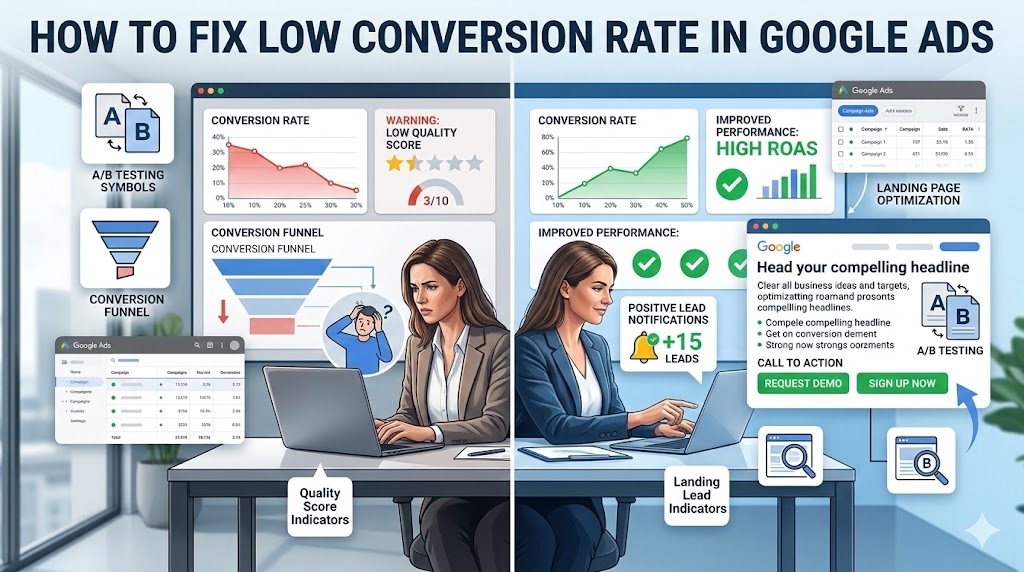
The good news is that most conversion problems can be fixed with the right strategy and optimization. In this guide, we will explore the most common reasons Google Ads campaigns struggle with low conversion rates and how businesses can fix them to generate better results.
Understanding Conversion Rate in Google Ads
Before fixing conversion issues, it is important to understand what conversion rate actually means.
A conversion occurs when a visitor takes a desired action after clicking your ad. This action might include filling out a contact form, making a purchase, calling your business, or signing up for a service.
Your conversion rate is the percentage of users who complete that action.
For example, if 100 people click your ad and 5 of them become customers or leads, your conversion rate is 5 percent.
A low conversion rate does not always mean your ads are failing. Often, it indicates that the traffic reaching your website is not properly aligned with what your landing page offers. Fixing this alignment is the key to improving performance.
Mismatched Keyword Intent
What the Problem Is
One of the most common causes of low conversion rates is targeting keywords that do not match the user’s intent. Businesses often choose keywords based on search volume rather than buying intent.
For example, someone searching for “what is Google Ads” is likely looking for information. Someone searching for “Google Ads management services” is much more likely to be ready to hire an expert.
Why It Reduces Conversions
When keywords attract users who are only researching or learning, they are unlikely to convert into customers. Even if the ad receives many clicks, the visitors may not be ready to take action.
This leads to high traffic numbers but very few leads or sales.
How to Fix It
Businesses should focus on keywords that clearly indicate commercial intent. These keywords often include terms such as service, agency, consultant, pricing, or near me.
Long-tail keywords are especially valuable because they are more specific and often indicate stronger purchase intent.
For example, instead of targeting a broad keyword like “digital marketing,” a better keyword would be “digital marketing agency for small business.” This type of search typically comes from someone who is actively looking for help.
By aligning keywords with user intent, businesses can attract visitors who are much more likely to convert.
Weak or Unclear Ad Copy
What the Problem Is
Your ad copy is the first impression users have of your business. Many businesses create ads that are too generic and fail to clearly communicate the value of their service or product.
A typical weak ad might simply say something like “Professional Marketing Services – Contact Us Today.”
Why It Reduces Conversions
Generic ads do not attract highly qualified users. They often generate clicks from people who are curious but not necessarily interested in the specific offer.
If the ad message does not clearly communicate benefits, users may click without fully understanding what they will receive.
This mismatch between expectations and reality often leads to low conversions.
How to Fix It
Effective ad copy should clearly explain the benefits of your service or product. It should highlight what makes your business different and why someone should choose you.
Strong ads often include elements such as experience, guarantees, pricing transparency, or unique selling points.
For example, an improved ad might say:
“Certified Google Ads Experts – Increase Your Leads with a Free Campaign Audit.”
This type of messaging attracts users who are specifically interested in improving their advertising performance.
Testing multiple versions of your ads can also help identify which messages generate the highest conversion rates.
Poor Landing Page Experience
What the Problem Is
Even when ads attract the right audience, conversions can suffer if the landing page is not optimized for user experience.
Many businesses send Google Ads traffic directly to their homepage. While homepages may contain useful information, they are often too broad and unfocused for ad traffic.
Visitors who click an ad are usually looking for a specific solution, not general information about a company.
Why It Reduces Conversions
When users arrive on a page that does not match the message in the ad, they often leave quickly. Confusing layouts, unclear headlines, or too many navigation options can also distract visitors from taking action.
If users cannot immediately understand the value of the offer, they are unlikely to convert.
How to Fix It
A dedicated landing page designed specifically for your ad campaign can significantly improve conversions.
The headline should closely match the message in the ad and clearly explain the solution being offered. The page should focus on a single goal, such as requesting a quote or scheduling a consultation.
Clear calls to action are essential. Visitors should immediately see what step they need to take next.
Reducing distractions and simplifying the page layout often leads to higher conversion rates.
Slow Page Speed
What the Problem Is
Website speed plays an important role in user experience. Many landing pages load slowly because of large images, unnecessary scripts, or poor hosting performance.
Even a delay of a few seconds can negatively affect conversion rates.
Why It Reduces Conversions
Modern users expect websites to load quickly. If a page takes too long to appear, many visitors will leave before even seeing the content.
Slow page speed also affects mobile users more significantly. Since a large portion of Google Ads traffic comes from mobile devices, a slow site can drastically reduce conversions.
How to Fix It
Improving page speed is one of the simplest ways to increase conversion rates.
Optimizing images, removing unnecessary scripts, and improving server performance can significantly reduce loading times.
Businesses should also ensure their landing pages are fully optimized for mobile devices. A fast and responsive page improves user experience and increases the likelihood of conversions.
Lack of Trust Signals
What the Problem Is
Visitors are often cautious when interacting with businesses online. If a landing page does not provide enough trust signals, users may hesitate to submit their information or make a purchase.
Trust signals help reassure visitors that your business is credible and reliable.
Why It Reduces Conversions
Without trust signals, visitors may question the legitimacy of your offer. Even if they are interested in your service, they may hesitate because they are unsure whether the business is trustworthy.
This uncertainty can prevent users from completing the desired action.
How to Fix It
Adding trust elements to your landing page can significantly improve conversion rates.
Customer testimonials, client logos, case studies, and ratings help demonstrate that others have successfully worked with your business.
Security badges, guarantees, and clear contact information can also build confidence. When visitors feel comfortable and confident, they are far more likely to convert.
Incorrect Audience Targeting
What the Problem Is
Google Ads allows advertisers to target specific locations, demographics, and audiences. However, many campaigns target audiences that are too broad.
For example, a local service provider might run ads across an entire country instead of focusing on their actual service area.
Why It Reduces Conversions
When campaigns target broad audiences, ads may appear to users who cannot realistically become customers. This results in clicks that do not generate leads or sales.
Irrelevant traffic lowers conversion rates and increases advertising costs.
How to Fix It
Refining audience targeting can significantly improve campaign performance.
Businesses should focus on geographic areas where their customers are located. Demographic adjustments and audience signals can also help ensure ads reach the most relevant users.
For example, a local dental clinic should primarily target nearby neighborhoods rather than an entire region.
By narrowing the audience, businesses attract users who are more likely to become customers.
Missing or Incorrect Conversion Tracking
What the Problem Is
Conversion tracking allows businesses to measure which actions users take after clicking an ad. Unfortunately, some campaigns run without proper tracking.
Without this data, businesses cannot accurately evaluate which keywords or ads generate results.
Why It Reduces Conversions
When conversion tracking is missing or inaccurate, campaign decisions are based on assumptions rather than real data.
Businesses may continue spending money on keywords that generate clicks but no leads. At the same time, high-performing keywords may be overlooked.
This lack of insight prevents effective optimization.
How to Fix It
Proper conversion tracking should be implemented before launching or scaling a campaign.
Businesses should track important actions such as form submissions, phone calls, purchases, or demo requests. Tools such as Google Tag Manager and analytics integrations make this process easier.
Once tracking is in place, campaign managers can analyze performance data and focus budgets on the most profitable keywords and ads.
Conclusion
Low conversion rates in Google Ads can be frustrating for businesses that are investing time and money into paid advertising. Receiving clicks without leads or sales often signals that something in the campaign is misaligned.
Issues such as mismatched keyword intent, weak ad copy, poor landing page experience, slow page speed, lack of trust signals, broad audience targeting, and missing conversion tracking can all reduce conversion rates.
The good news is that these problems are not permanent. With the right strategy and continuous optimization, businesses can significantly improve the performance of their campaigns.
Focusing on high-intent keywords, writing compelling ad copy, optimizing landing pages, and using accurate conversion tracking can transform underperforming campaigns into profitable marketing channels.
For businesses that want to generate consistent leads and maximize their advertising return, effective Google Ads management is essential. By improving campaign structure and focusing on data-driven optimization, businesses can turn more clicks into real customers and long-term growth.