Frozen Meat Market Forecast: Growth Potential Across Key Segments
Overview
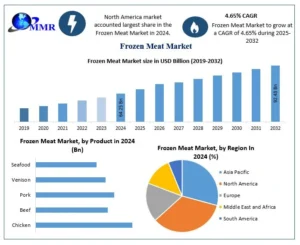
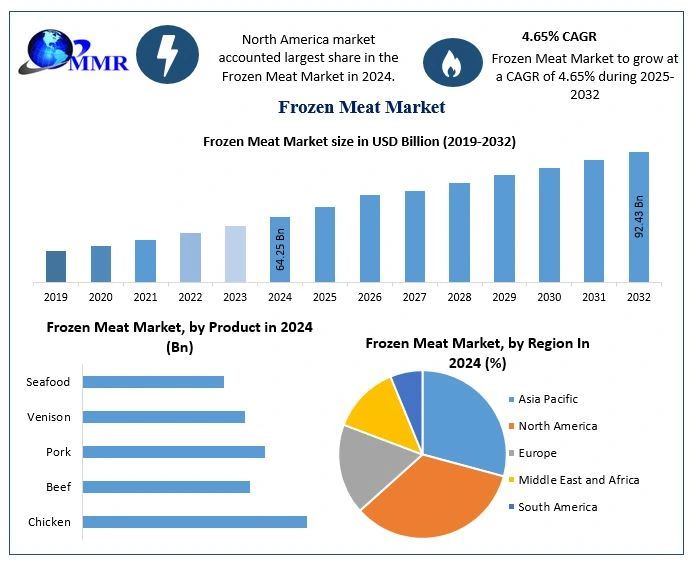
The global Frozen Meat Market is witnessing steady growth, fueled by evolving consumer lifestyles and increasing demand for convenient, long-lasting food products. The market was valued at USD 64.25 billion in 2024 and is projected to grow at a CAGR of 4.65% from 2025 to 2032, reaching approximately USD 92.43 billion by 2032.
Download Free Sample & Check the Latest Market Analysis: https://www.maximizemarketresearch.com/request-sample/221709/
Frozen meat refers to meat preserved through freezing at temperatures typically below -18°C, which helps extend shelf life while retaining nutritional value and quality. As urbanization accelerates and working populations expand globally, consumers are increasingly turning to frozen meat products as practical and time-saving meal solutions. Additionally, growing awareness regarding food safety, hygiene, and nutritional benefits has further strengthened the adoption of frozen meat across both developed and emerging economies.
The market is also benefiting from advancements in cold chain logistics, innovative freezing technologies such as Individual Quick Freezing (IQF), and improved packaging solutions. These developments ensure better preservation of taste, texture, and nutritional content, making frozen meat a reliable alternative to fresh meat.
Key Market Drivers & Trends
One of the primary drivers of the frozen meat market is the shift in consumer lifestyles, particularly in urban areas where busy schedules demand quick and convenient meal options. The rising popularity of ready-to-cook and ready-to-eat products, such as marinated chicken, sausages, and pre-seasoned beef cuts, highlights this trend.
The growing working population and increasing number of dual-income households have significantly contributed to the demand for frozen meat. Consumers are seeking hassle-free cooking solutions without compromising on nutrition, which has led to increased consumption of frozen protein products.
Another major trend is the expansion of e-commerce and online food delivery platforms, which has improved accessibility to frozen meat products. Supermarkets, hypermarkets, and online channels now offer a wide variety of frozen meat options, enhancing consumer convenience.
Download Free Sample & Check the Latest Market Analysis: https://www.maximizemarketresearch.com/request-sample/221709/
Health awareness is also shaping the market, with rising demand for low-fat, preservative-free, and organic frozen meat products. Consumers are increasingly looking for high-protein diets, and frozen meat offers a rich source of protein, vitamins, and essential minerals such as zinc and phosphorus.
Additionally, sustainability trends are influencing market dynamics. Companies are investing in eco-friendly packaging solutions and energy-efficient freezing technologies to reduce environmental impact. The introduction of biodegradable packaging materials aligns with the preferences of environmentally conscious consumers.
Key Segments Covered
The Frozen Meat Market is segmented based on product, type, end user, distribution channel, and region.
By product, the market includes chicken, beef, pork, venison, seafood, and others, with chicken dominating due to its affordability and widespread consumption.
Based on type, the market is divided into Frozen Processed Meat and Frozen Whole Cuts. Frozen processed meat holds a dominant share, driven by its convenience and longer shelf life. Products such as sausages, bacon, and pre-seasoned cuts are widely preferred by consumers. However, frozen whole cuts are gaining traction among health-conscious individuals seeking minimally processed options.
By end user, the market caters to food service providers and retail customers, while distribution channels include hypermarkets/supermarkets, specialty stores, convenience stores, and online platforms.
Download Free Sample & Check the Latest Market Analysis: https://www.maximizemarketresearch.com/request-sample/221709/
Regional Breakdown
North America dominates the global frozen meat market, supported by advanced infrastructure, strong cold chain systems, and high consumer demand for convenience foods. The United States and Canada are key contributors, with increasing consumption of ready-to-cook meat products.
Europe follows closely, with countries such as Germany, the United Kingdom, France, and Italy driving demand. The region benefits from well-established food processing industries and a growing preference for frozen and packaged foods.
The Asia-Pacific region is emerging as the fastest-growing market, led by China, India, Japan, and South Korea. Rapid urbanization, rising disposable incomes, and changing dietary habits are fueling demand for frozen meat products. The expansion of e-commerce platforms and adoption of Western food habits are further accelerating market growth in this region.
Other regions, including Latin America and the Middle East & Africa, are also witnessing gradual growth due to increasing consumption of processed and convenience foods.
Market Challenges & Growth Potential
Despite its growth, the frozen meat market faces several challenges. One of the major concerns is the rising popularity of plant-based meat alternatives, which are gaining traction among health-conscious and environmentally aware consumers. These alternatives, including plant-based burgers and sausages, directly compete with traditional frozen meat products.
Health concerns related to processed meat consumption, such as links to cardiovascular diseases, also pose a restraint to market growth. Additionally, the high energy costs associated with freezing and storage increase product prices, affecting affordability in price-sensitive markets.
Maintaining an efficient cold chain infrastructure remains a challenge, particularly in developing regions where logistics and storage facilities may be inadequate. Quality degradation over time, including changes in taste and texture after thawing, is another concern among consumers.
However, the market presents significant growth opportunities. The introduction of organic, antibiotic-free, and specialty frozen meat products is attracting health-conscious consumers. Innovations in freezing techniques, such as blast freezing and cryogenic freezing, are enhancing product quality and shelf life.
Expanding into emerging markets, leveraging direct-to-consumer online channels, and forming strategic partnerships with retailers and food service providers are key strategies for future growth. Companies are also focusing on product diversification, including ready-to-eat meals and customized portion sizes to meet evolving consumer preferences.
Leading Industry Players
The global frozen meat market is highly competitive, with key players focusing on innovation, expansion, and strategic collaborations. Major companies include:
- Tyson Foods, Inc.
- Cargill Incorporated
- JBS S.A.
- BRF S.A.
- Kerry Group Plc
- Hormel Foods Corporation
- Conagra Brands, Inc.
- Nestlé S.A.
- Kraft Heinz Company
- Marfrig Global Foods S.A.
Recent developments highlight the dynamic nature of the market. Companies are investing in new product launches, acquisitions, and geographic expansion to strengthen their market presence. For instance, product diversification into organic and specialty frozen meat categories and expansion into emerging markets are key focus areas.
FAQ
1. What are the key growth drivers for the Frozen Meat Market?
The major growth drivers include rising demand for convenient and ready-to-cook food, increasing urbanization, expansion of e-commerce platforms, and growing health awareness among consumers.
2. What opportunities exist in the Frozen Meat Market?
Opportunities lie in the development of healthier frozen meat options, adoption of advanced freezing technologies, expansion into emerging markets, and growth of online distribution channels.
3. Which region dominates the Frozen Meat Market?
North America currently leads the global market due to strong infrastructure, high consumption of convenience foods, and the presence of major industry players.
4. What was the market size in 2024?
The global Frozen Meat Market was valued at USD 64.25 billion in 2024.
5. What segments are covered in the market?
The market is segmented by product (chicken, beef, pork, etc.), type (processed and whole cuts), end user, distribution channel, and region.
Most performing reports:
Global Fast Food Market https://www.maximizemarketresearch.com/market-report/global-fast-food-market/28718/
Acai Berry Market https://www.maximizemarketresearch.com/market-report/global-chocolate-market/13157/
Global Coffee Market https://www.maximizemarketresearch.com/market-report/global-coffee-market/110762/
Connect With Us:
MAXIMIZE MARKET RESEARCH PVT. LTD.
2nd Floor, Navale IT park Phase 3,
Pune Banglore Highway, Narhe
Pune, Maharashtra 411041, India.
+91 9607365656
sales@maximizemarketresearch.com
About Maximize Market Research:
Maximize Market Research is one of the fastest-growing market research and business consulting firms serving clients globally. Our revenue impact and focused growth-driven research initiatives make us a proud partner of majority of the Fortune 500 companies. We have a diversified portfolio and serve a variety of industries such as IT & telecom, chemical, food & beverage, aerospace & defense, healthcare and others.