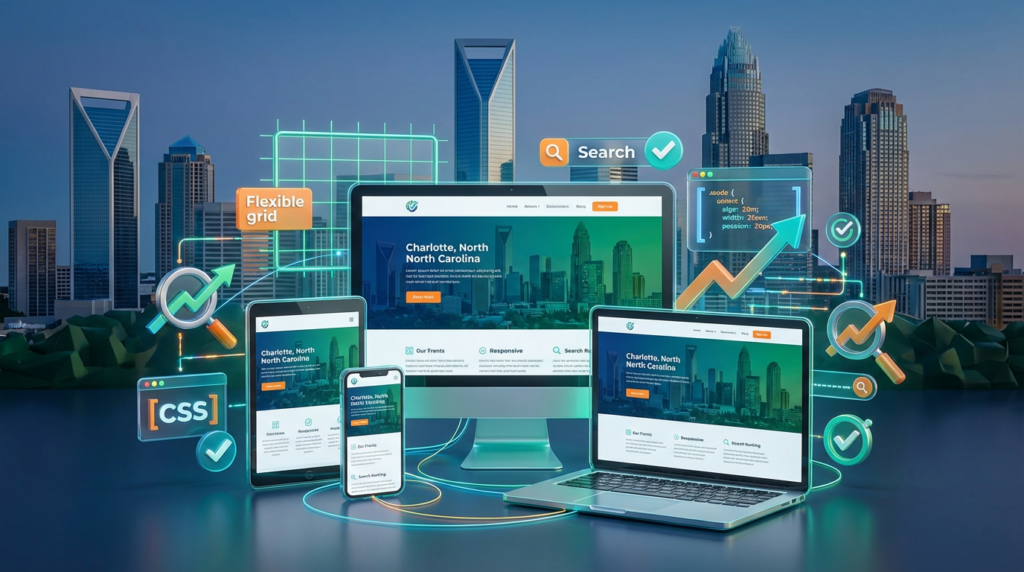
Create a Responsive Website: Expert Tips
With the current trend towards mobile-first, knowing how to build a website that works on any device is critical for businesses to have long-term success. As an industry leader in Charlotte for Search Engine Optimisation (SEO), we have assisted many local businesses in improving their Online presence through responsive web design. Whether you are working with a Charlotte Web Design Company or building your website, or being built by someone else in-house; developing a knowledge of the basic principles of responsive web design will benefit you in the long term.
What Makes a Website Truly Responsive?
A responsive website will automatically adjust its layout, photos, and features to deliver the best possible experience to its users on any device, whether desktop, tablet, or smartphone. This doesn’t just mean creating smaller versions of everything; it also means creating entirely new ways of displaying and accessing content based on the size of the screen used by the user.
The need for responsive design has increased dramatically as mobile use has become over 60% of all web traffic at this time. If you run a Charlotte-based business and compete with other companies in your area that have a non-responsive website, then you are not just missing out on potential customer opportunities but also have to compete against those company websites that offer superior mobile user experiences rather than simple mobile web sites.
Start with the Right Foundation: Website Hosting Service
To begin developing your design elements, you first must find a reliable base upon which to build your design elements. Your hosting service is one of the most important parts of the underlying infrastructure; many times, businesses will spend most of their time on the design and have a responsive site without considering how to host it or how their infrastructure will support it.
Things to think about when trying to choose a hosting service for your responsive website:
- Speed and Performance – Since responsive websites serve customers different images based on the size of a device being used, your hosting must be able to handle the requests quickly without any lag time.
- Uptime Reliability – If you have a nicely designed responsive website, but your site is down consistently, then the site has no value. To that end, always find hosting service providers that can guarantee you have 99.9% uptime.
- Scalability – As your Charlotte, NC, grows, so will your website traffic; therefore, your hosting must also scale in size and not hurt your website’s performance.
- Security Features – SSL Certificates, backups, and malware protection are all critical to the protection of both your company and your customers.
- Mobile Optimisations – Some hosting services provide special optimisations for better mobile performance through the use of designing/creating the CDN (Content Delivery Network) to serve the content from the nearest geographical location to your current customer/user’s device, be it their home or their office.
Essential Elements of Responsive Design
You need to be aware of some fundamental principles of responsive design if you’re going to use either an established firm or undertake your own Charlotte, NC web project.
- Flexible Grids – A flexible grid has a percentage-based width rather than a fixed pixel width. This means that the content will resize better as it is being viewed on different-sized devices.
- Responsive Images – When creating a responsive website, your images must scale appropriately without losing image quality or causing delay in load times. Therefore, use the srcset attribute to provide multiple versions of an image depending on the device it is being displayed.
- CSS Media Queries – The use of CSS media queries allows you to apply styles to your website based on the size, orientation and resolution of the viewing device. Therefore, CSS media queries form the basis of responsive design.
- Mobile-First – When designing your custom website, start with the mobile device and build out to a larger screen size-based website. By designing a responsive site with mobile users first, you will have a site that provides optimal performance across all devices.
- Touch Target Size – When designing your website navigation, make sure that all action links and buttons are large enough to accommodate finger taps and provide enough spacing between other action links or buttons to avoid accidental touches.
- Font Legibility – When designing a responsive website for readability, make sure that your text is sized appropriately with a relative size of either em or rem. This means that your text will illustrate a good level of legibility without having to zoom in on it.
The SEO Connection
As an SEO Firm that serves Charlotte businesses, we highlight how much mobile responsive design affects whether or not your site ranks well in the SERPs. With Google’s mobile-first indexing, your rankings are based primarily on their index of your mobile site.
A responsive web design offers the following benefits:
- Single URL format (easier to have a single URL per page when a user searches)
- Decreased mobile user bounce rate
- Faster page load time (higher scores)
- More user engagement (i.e., time spent on website)
- Increased visibility of local businesses in the search engines
All of these factors work together to result in higher search rankings for your Charlotte building business, which ultimately results in parents earning their Charlotte home-based business more organic traffic.
Testing and Optimisation
Continuously testing and improving the design of a responsive site (a site that adjusts automatically according to the size of the browser window).
Examples:
- Cross-browser Testing – Use real devices (not just emulator software) to test the website on different devices because many mobile devices (phones, tablets) render web pages differently.
- Performance Monitoring – Use tools such as Google PageSpeed Insights to gain insight into issues that are hindering performance for mobile users.
- User Behaviour Analysis – Use Visitor Stats to monitor the way visitors use the site on different devices (i.e., high mobile bounce rates suggest that users may not be enjoying their experience on the site).
- Regular Maintenance – As manufacturers release new mobile devices and the size of displays changes, your responsive design will require modifications.
Common Mistakes to Avoid
Even experienced Charlotte Web Design Firms sometimes encounter these pitfalls:
- Hiding important content on mobile versions
- Using non-scalable elements like Flash
- Neglecting page load speed optimisation
- Implementing separate mobile URLs (m.yoursite.com)
- Forgetting to test forms and checkout processes on mobile
- Choosing an inadequate website hosting service that can’t support responsive features
Taking Action
In order to build a responsive website, you will need technical know-how, design talent, and continual optimisation efforts. For businesses in Charlotte wanting to succeed with digital, the best way to do this is by partnering with an SEO Company Charlotte that is familiar with both responsive design and search engine optimisation.
Your website is often the first thing that potential customers see when they come into contact with your business. So make sure that it looks great and performs flawlessly on all devices, is hosted on a reliable host so it loads quickly, and has a high rank in search engines. In Charlotte’s competitive marketplace, responsive design is not just a good practice—it is also critical for your future development.