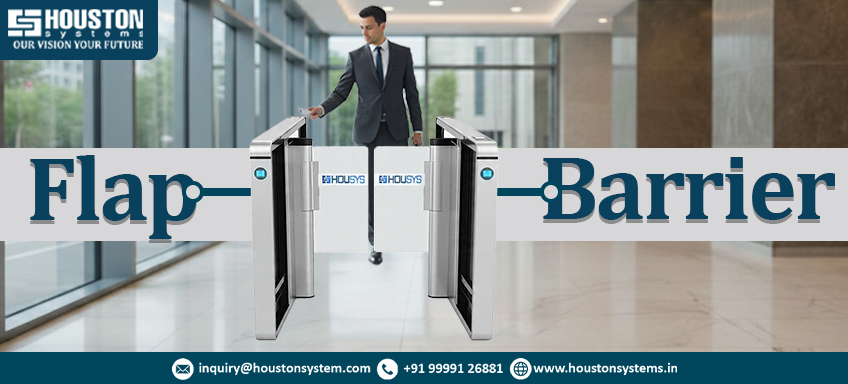
India’s rapid infrastructure growth has created a new demand for secure and efficient pedestrian access control. Metro stations, corporate offices, airports, and IT parks must manage thousands of people daily without compromising security or operational efficiency. This is where the flap barrier plays a crucial role.
A modern flap barrier system provides automated, controlled access that ensures only authorized individuals can enter restricted areas. Unlike manual security checks, flap barriers offer speed, precision, and reliability.
From metro networks to corporate campuses, the flap barrier turnstile has become an essential security solution across India in 2026.
What Is a Flap Barrier?
A flap barrier is an automated pedestrian access control gate designed to regulate entry and exit securely. It uses retractable glass or acrylic flaps that open when access is granted and close immediately after passage.
It is commonly referred to as:
- flap barrier gate
- flap barrier system
- flap barrier turnstile
Flap barriers are widely used in environments requiring high security and controlled pedestrian movement.
Key characteristics include:
- Automated access control
- Fast opening and closing
- Anti-tailgating protection
- Integration with RFID, biometric, or QR systems
Compared to manual gates, flap barriers provide significantly improved security and efficiency.
How Does a Flap Barrier System Work?
A flap barrier system operates through automated access control and sensor-based detection.
Step-by-Step Working Process
Step 1: User Approaches Gate
The user approaches the flap barrier gate.
Step 2: Credential Verification
Access is verified using:
- RFID card
- Biometric scan
- QR code
Step 3: Authorization
The system verifies user authorization.
Step 4: Flap Opens Automatically
Motorized flaps open to allow entry.
Step 5: Passage Detection
Sensors detect user movement.
Step 6: Flap Closes Automatically
The system closes securely after passage.
This process ensures secure and efficient pedestrian access.
Core Components of a Flap Barrier System
A typical flap barrier system includes:
1. Motorized Flap Mechanism
Controls flap opening and closing.
2. Infrared Sensors
Detect unauthorized entry and tailgating.
3. Control Board
Processes access authorization.
4. Access Reader Integration
Supports RFID, biometric, or QR authentication.
5. Stainless Steel Housing
Ensures durability and reliability.
These components ensure smooth and secure operation.
Types of Flap Barrier Systems Used in India
Standard Flap Barrier Gate
Used in offices and commercial buildings.
High-Speed Flap Barrier Turnstile
Used in metro stations and airports.
Glass Flap Barrier System
Premium installations in corporate environments.
Heavy-Duty Flap Barrier System
Used in high-traffic environments.
Each type serves specific operational requirements.
Real-World Example: Metro Station Deployment
A metro station in India deployed flap barrier turnstiles to improve passenger access control.
Challenges Before Installation
- Unauthorized entry
- Manual ticket checking delays
- Security inefficiencies
Results After Installation
- Faster passenger flow
- Improved security
- Reduced manpower dependency
Flap barrier systems significantly improved operational efficiency.
Key Benefits of Flap Barrier Systems
Security Benefits
- Prevent unauthorized entry
- Anti-tailgating protection
- Access tracking capability
Operational Benefits
- Faster pedestrian movement
- Automated access control
- Reduced manual intervention
Business Benefits
- Reduced manpower cost
- Improved operational efficiency
- Enhanced security compliance
Flap barriers provide both security and operational advantages.
Flap Barrier vs Other Access Control Systems
| Feature | Flap Barrier | Tripod Turnstile | Manual Gate |
| Security Level | High | Medium | Low |
| Speed | Fast | Moderate | Slow |
| Automation | Fully automated | Semi automated | Manual |
| Efficiency | High | Moderate | Low |
Flap barriers offer superior security and efficiency.
Flap Barrier Price in India (2026 Guide)
| Flap Barrier Type | Price Range |
| Standard flap barrier gate | ₹75,000 – ₹1.5 lakh |
| Premium glass flap barrier | ₹1.5 lakh – ₹3 lakh |
| High-speed flap barrier turnstile | ₹2 lakh – ₹4 lakh |
| Metro-grade flap barrier system | ₹3 lakh – ₹6 lakh |
Pricing depends on:
- Build quality
- Access control integration
- Installation complexity
- Traffic volume
ROI Table – Flap Barrier Investment Value
| Parameter | Manual Access | Flap Barrier System |
| Security level | Moderate | High |
| Manpower cost | High | Reduced |
| Entry speed | Slow | Fast |
| ROI timeline | — | 12–24 months |
Flap barriers provide strong return on investment.
Applications of Flap Barriers in India
Flap barriers are widely used in:
- Metro stations
- Corporate offices
- Airports
- Government buildings
- IT parks
- Commercial complexes
These systems enhance security and efficiency.
Flap Barrier India
Flap Barrier in Delhi NCR
Corporate offices use flap barrier systems for secure access.
Flap Barrier in Mumbai
Metro stations deploy flap barrier turnstiles for passenger management.
Flap Barrier in Bengaluru
IT parks use automated flap barrier gates.
Flap Barrier in Hyderabad
Corporate campuses deploy high-security flap barriers.
Flap Barrier in Chennai
Commercial facilities use flap barrier systems for controlled entry.
How to Choose the Best Flap Barrier
Consider:
- Security requirements
- Traffic volume
- Access control integration
- Budget
Choosing the right flap barrier ensures long-term performance.
Why Professional Installation Matters
Proper installation ensures:
- Accurate access control
- Reliable performance
- Long-term durability
Houston Systems provides reliable flap barrier solutions designed for Indian infrastructure.
FAQs
What is a flap barrier?
A flap barrier is an automated gate that controls pedestrian access.
Where are flap barriers used?
Metro stations, offices, airports, and commercial facilities.
What is flap barrier cost in India?
Typically ranges from ₹75,000 to ₹6 lakh depending on features.
Conclusion: Why Flap Barrier Is Essential for Metro and Office Security
A modern flap barrier system provides secure, efficient, and automated pedestrian access control. As India continues to modernize infrastructure, flap barriers are becoming essential security solutions.
Investing in a reliable flap barrier improves security, efficiency, and operational performance.