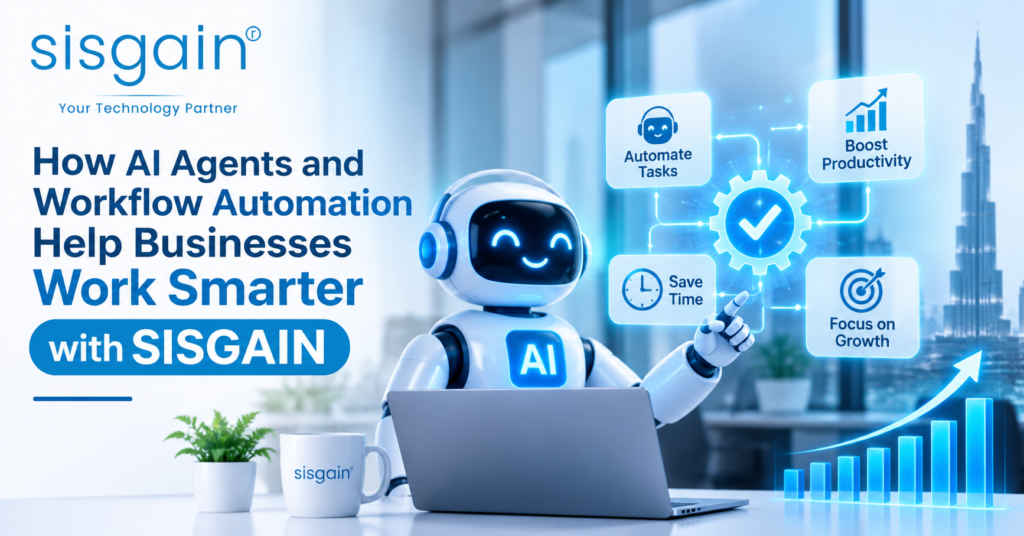
Businesses are no longer competing only on the quality of their products or services. They are also competing on how quickly they respond to customers, manage information, complete tasks, and make decisions. Yet, many organisations still depend on employees to handle repetitive activities across multiple applications. Following up on enquiries, preparing reports, checking documents, and updating records can take hours that could be spent on more valuable work. This is where AI Agent Automation is changing the way businesses operate. By combining artificial intelligence with automated workflows, organisations can build systems that understand requests, perform defined tasks, and coordinate activities across business applications.
For startups, working professionals, and established enterprises in the UAE, this creates opportunities to simplify operations without making every process more complicated. But what exactly are AI agents, how do they work with automation, and where can businesses use them? Let’s break it down.
What Is AI Agent Automation?
AI Agent Automation refers to using AI-powered software agents to perform tasks, interpret information, and take actions based on defined objectives and instructions. Unlike traditional automation, which generally follows fixed rules, AI agents can use artificial intelligence to understand context, process different types of information, and respond to changing situations within their permitted scope.
An AI agent typically works through a combination of several components:
- Input: It receives information from a user, application, document, or connected system.
- Understanding: It interprets the request using AI models and relevant business context.
- Planning: It identifies the steps needed to complete the assigned task.
- Action: It uses approved tools, APIs, or integrations to perform those steps.
- Feedback: It checks the result and determines whether another action or human review is needed.
For example, imagine a customer asking a company about the status of an order. An AI agent could interpret the question, retrieve the relevant order information from an authorised system, and prepare a response. If the request involves an unusual situation, it can direct the case to a human employee.
The important distinction is that an AI agent does more than trigger a predefined action. It can interpret information and select an appropriate action from the options it has been designed and authorised to use.
How Do AI Agents Work With Workflow Automation?
AI agents and workflow automation serve related but different purposes. An AI agent can understand a request or decide which action is appropriate, while workflow automation manages the sequence of tasks required to complete a business process.
Consider a recruitment workflow. When a company receives a job application, an AI agent may extract relevant information from the application and categorise it according to predefined recruitment criteria. The workflow can then store the application, notify the recruitment team, and schedule the next administrative step.
This combination creates a more connected process.
A typical system may include:
- Trigger: A new request, document, or customer interaction starts the process.
- AI interpretation: The agent understands the information and identifies the task.
- Workflow execution: The system routes information to the relevant application or department.
- Validation: Business rules check whether the required conditions have been met.
- Human approval: A responsible employee reviews actions that require judgement or authorisation.
- Completion: The system records the outcome and updates the relevant information.
This approach is useful because AI does not need to control every stage. Businesses can use intelligent interpretation where it adds value and rely on predictable automation for routine steps.
What Business Problems Can AI-Powered Automation Solve?
Many operational problems do not come from a lack of effort. They come from disconnected systems, repeated tasks, delayed communication, and unclear responsibilities.
1. Repetitive Administrative Work
Employees often spend time copying information between applications, organising documents, preparing routine updates, and responding to common requests.
AI agents can help interpret incoming information and prepare the required actions. Workflow automation can then move that information through the appropriate business process.
This reduces repetitive coordination and allows employees to focus on work that requires their expertise.
2. Delayed Customer Responses
Customers expect timely answers, even when a business receives enquiries outside regular working hours. Managing every interaction manually can become difficult as enquiry volumes increase.
An AI-enabled system can understand common questions, retrieve approved information, and direct complex requests to the appropriate team. This helps businesses manage routine enquiries more consistently while keeping human support available when needed.
3. Disconnected Business Applications
A company may use separate platforms for sales, customer support, accounting, inventory, and project management. When these applications do not communicate effectively, employees often become the connection between them.
Integrations allow agents and workflows to exchange relevant information across authorised systems. This reduces repeated data entry and helps teams work with more consistent records.
4. Inconsistent Task Follow-Ups
Some tasks depend on reminders and repeated communication. For example, an approval request may remain pending because the responsible person has not received a timely update.
Automated workflows can assign tasks, send notifications, and escalate overdue requests according to business rules. AI agents can also help interpret incoming updates and identify the next appropriate step.
5. Limited Operational Visibility
Managers need to understand what is happening across different departments. If information is scattered across spreadsheets, emails, and separate applications, identifying delays becomes difficult.
Connected systems can provide clearer task records and status information. This helps managers review progress, identify bottlenecks, and make decisions using more reliable operational data.
Which Business Processes Can Benefit From AI Agents?
The most useful applications depend on an organisation’s industry, systems, and operational requirements. Businesses should begin with processes where AI can solve a clearly defined problem.
Some practical applications include:
Customer support: Agents can classify incoming requests, retrieve approved information, and prepare responses for routine enquiries. Complex or sensitive cases can be escalated to employees.
Sales operations: AI can help organise incoming leads, summarise customer interactions, and prepare follow-up tasks for sales representatives.
Human resources: Systems can support administrative activities such as answering common policy questions, collecting onboarding documents, and routing employee requests.
Finance and accounting: AI can assist with extracting information from invoices, identifying missing details, and routing documents for approval. Financial decisions and payments should remain subject to suitable controls.
IT service management: Agents can categorise support tickets, suggest troubleshooting steps, and direct requests to the appropriate technical team.
Supply chain operations: Businesses can use connected systems to review inventory information, organise supplier updates, and notify relevant employees when predefined conditions occur.
For UAE businesses operating across several locations or departments, these applications can help create more consistent processes. However, every implementation should reflect the organisation’s actual needs rather than adopting AI simply because it is available.
How Should Businesses Choose the Right Tasks for Automation?
Not every business activity needs an AI agent. Some processes are already handled efficiently through simple software rules. Others require human judgement, particularly when decisions involve financial responsibility, customer commitments, or sensitive information.
A practical evaluation begins with a few questions:
- Does the task happen frequently?
- Does it consume significant employee time?
- Is the information required for the task accessible?
- Can the expected result be clearly defined?
- Are there established rules for handling exceptions?
- Would an incorrect action create financial, operational, or reputational risk?
Businesses should prioritise processes where the expected benefit is clear and the risks can be managed.
For example, automatically categorising support tickets may be a suitable starting point. Allowing an AI agent to independently approve large financial transactions would require a much higher level of control and may not be appropriate.
How Can Businesses Manage AI Agents and Their Actions?
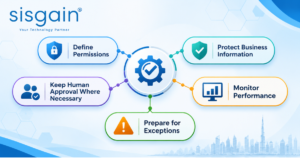
Giving an AI agent access to business tools requires careful planning. Organisations need to decide what information the agent can access, which actions it can perform, and when it must request human approval.
A responsible implementation should include the following controls:
Define Permissions
Agents should only access the information and tools required for their assigned responsibilities. For example, a customer support agent may need access to order status information but should not have unrestricted access to financial records.
Protect Business Information
Businesses should consider encryption, authentication, access management, data retention, and secure integration practices. They should also review applicable UAE data protection requirements and any relevant industry regulations.
Keep Human Approval Where Necessary
Certain actions should require employee confirmation. This may include approving payments, changing important customer records, or making decisions that could have significant consequences.
Monitor Performance
Organisations should maintain records of agent actions, review errors, and evaluate whether the system is following its assigned instructions. Regular monitoring helps identify problems before they affect wider operations.
Prepare for Exceptions
Business processes rarely run perfectly every time. An agent should have a clear way to pause, request additional information, or transfer an unusual case to an employee rather than making an unsupported decision.
How Can AI Expertise Support Business Transformation in Dubai?
Businesses often need technical guidance to decide which AI capabilities are suitable for their operational requirements. An AI Development Company Dubai can support this process by helping organisations evaluate use cases, design AI-enabled applications, integrate business systems, and develop solutions around specific requirements.
The important part is choosing technology based on business needs. A retail company may benefit from intelligent customer support, while a logistics organisation may focus on document processing and operational coordination.
Before implementation, businesses should assess data availability, existing infrastructure, security requirements, integration complexity, and the expected value of the proposed solution. This creates a stronger foundation for practical AI adoption.
How Can Organisations Combine Intelligent Agents With Existing Workflows?
Introducing AI does not mean replacing every application or rebuilding the entire technology environment. In many cases, businesses can connect intelligent agents with their existing software through APIs and suitable integration platforms.
For example, a company may already use a CRM system to manage customer records. An AI agent can help interpret incoming enquiries, while an automated workflow assigns the request to the appropriate sales or support team. The CRM remains the central place for managing customer information.
AI Agents and Workflow Automation can therefore work together to connect intelligent task handling with structured business processes. This combination is especially useful when organisations want to improve existing operations gradually instead of introducing a completely separate system.
A phased approach also makes testing easier. Businesses can begin with a limited use case, review its performance, collect employee feedback, and expand the solution once the process works reliably.
What Should UAE Businesses Look for in an Automation Solution?
The right solution should fit the organisation’s size, industry, existing systems, and long-term plans. A platform with many advanced features may not be the best choice if employees find it difficult to use or it cannot integrate with important applications.
Businesses should evaluate:
- Scalability: Can the solution support additional users, workflows, and business activities as the organisation grows?
- Integration: Can it connect with existing CRM, ERP, HR, and other business platforms?
- Security: Does it provide suitable access controls, monitoring, and data protection features?
- Flexibility: Can workflows be adjusted when business rules or operational requirements change?
- Usability: Can employees understand and manage the system without unnecessary complexity?
- Support and maintenance: Is there a clear plan for updates, monitoring, troubleshooting, and future improvements?
Organisations exploring business process automation solutions uae should also consider local business requirements, implementation support, and the ability to adapt the solution to their operational environment. A careful evaluation helps prevent businesses from investing in technology that looks impressive but does not solve their everyday challenges.
How Can SISGAIN Technologies Help Businesses Build Smarter Digital Solutions?
SISGAIN Technologies supports organisations through software development, custom application development, system integration, and digital transformation services. Its approach focuses on understanding business requirements and developing technology that supports practical operational goals. From planning application architecture to building connected software and integrating existing platforms, We can help businesses address complex technology requirements. For organisations exploring intelligent digital capabilities, selecting a development partner with an understanding of business processes and software integration can help turn an initial idea into a structured, usable solution.
Conclusion
AI agents and workflow automation are changing how businesses manage everyday operations. By combining intelligent information processing with structured task execution, organisations can reduce repetitive work, improve coordination, and make better use of their existing systems.
However, successful implementation requires more than choosing an AI tool. Businesses need clear objectives, reliable data, secure integrations, defined permissions, and human oversight for important decisions.
For UAE startups and established organisations, the practical approach is to begin with a specific operational challenge, test a suitable solution, and measure the results before expanding further. When technology supports real business requirements, AI Agent Automation can become a useful part of building more responsive, organised, and scalable operations.
Frequently Asked Questions
1. What is the difference between an AI agent and traditional automation?
Traditional automation follows predefined rules and instructions. An AI agent can interpret information, understand context, and select suitable actions within its assigned permissions.
2. Can AI agents work with existing business software?
Yes. AI agents can connect with existing applications through APIs and integrations, depending on the systems involved. This allows businesses to improve current workflows without necessarily replacing their entire software environment.
3. Which industries can use AI agent automation?
Industries such as healthcare, retail, logistics, finance, education, and professional services can use AI agents for suitable administrative and operational tasks. The applications depend on each organisation’s processes and compliance requirements.
4. Is AI agent automation suitable for startups?
Yes. Startups can begin with focused applications such as customer enquiry classification, lead organisation, or document processing. Starting small helps control costs and test business value before expanding.
5. How can businesses keep AI agents secure?
Businesses should apply restricted access permissions, secure integrations, activity monitoring, and appropriate data protection measures. Human approval should remain part of workflows involving sensitive or high-impact decisions.
6. How do businesses measure the success of AI automation?
They can measure task completion time, processing accuracy, response times, employee workload, and the number of manual steps reduced. Comparing these indicators before and after implementation helps evaluate the actual business impact.