The properties that are commonly tested on paint and protective coating include hardness and adhesion as well as corrosion resistance. Nevertheless, there are numerous instances of coating failures in actual industrial conditions, and this is not because of wear but because of instant mechanical forces.
Coated components could experience local impact loads during fabrication, installation, transportation, or standard service due to the use of tools, falling objects, or handling machines. Even comparatively minor impacts may produce high strain rates in the coating film, resulting in failure mechanisms including:
- Brittle fracture of the coating layer due to insufficient elongation capacity
- Interfacial delamination where the coating separates from the substrate
- Radial cracking caused by compressive stress at the impact point
- Microcracking that later accelerates corrosion propagation
These shortcomings are especially severe in industries like automotive manufacturing, structural steel fabrication, and industrial machinery and appliance production—all of which are major industries in South Africa.
Direct Impact Testing Method
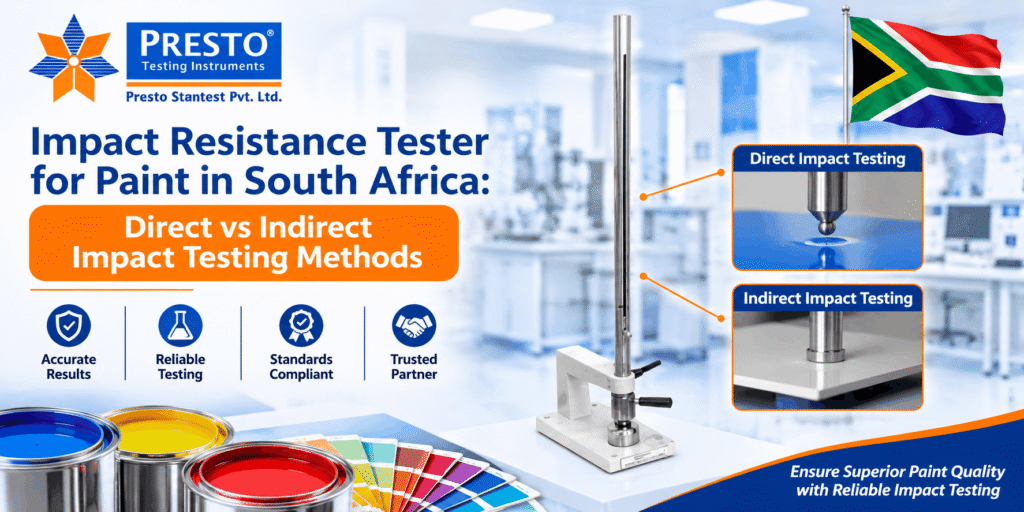
In South Africa’s direct impact testing, the falling weight strikes the coated surface directly through a hemispherical indenter.
Stress Distribution
When the impact occurs, the coating experiences:
- Localized compressive stress at the point of contact
- Radial tensile stress surrounding the impact zone
- Shear stress at the coating–substrate interface
Such combinations of stress usually cause surface cracking, coating fragmentation, or detachment localization.
Failure Modes Observed
Typical coating failures detected during direct impact testing include:
- Star-shaped surface cracks
- Chipping or spalling of brittle coatings
- Microfractures in thick coating films
- Immediate detachment at poorly bonded interfaces
Engineering Significance
Direct impact testing primarily evaluates the coating’s resistance to surface shock and localized mechanical damage.
This is particularly relevant for coatings applied to:
- Industrial machinery components
- Automotive body panels
- Powder-coated metal surfaces
- Protective coatings on equipment housings
Indirect Impact Testing Method
In indirect impact testing, the falling weight strikes the reverse side of the test panel, forcing the substrate to deform beneath the coating layer.
Stress Distribution
This configuration introduces a different stress profile:
- The substrate undergoes plastic deformation
- The coating is subjected to tensile strain as the metal panel bends
- Adhesion between coating and substrate becomes the dominant factor
Failure Modes Observed
Indirect testing often reveals:
- Coating delamination from the substrate
- Circumferential cracking around the deformation zone
- Loss of adhesion due to interfacial stress
- Flexural cracking in rigid coating systems
Engineering Significance
Indirect impact testing evaluates the flexibility and adhesion performance of coatings during substrate deformation, which is common in:
- Sheet metal forming processes
- Appliance manufacturing
- Structural panel applications
- Automotive component fabrication
Why Impact Testing Is Critical in Coating Development
Traditional coating tests such as hardness or adhesion provide valuable information but do not fully simulate dynamic mechanical shock conditions.
The impact resistance tester in South Africa allows engineers to measure the reaction of a coating to loads that are high in energy and short in duration.
This testing helps manufacturers:
- Identify brittle coating formulations prone to cracking
- Evaluate adhesion strength under mechanical shock
- Compare coating systems during product development
- Validate coatings for demanding industrial environments
With the manufacturers being able to detect weak formulations early, they are able to save on the expenses of defective coating failures once the product is installed or delivered.
Principle of working of an Impact Resistance Tester
An impact Resistance tester in South Africa operates using a controlled falling-weight impact mechanism.
Test Procedure
- A test panel made of coated metal is firmly attached to the test set.
- A mass is lifted to a predetermined height in the form of a cylinder.
- The weight is also released by use of a vertical guide tube, hence accurate positioning.
- The weight strikes the indenter, transmitting mechanical energy to the coated panel.
- Coating damage in the panel is observed in the form of cracking, peeling, or delamination.
Taller drop heights result in more deformation energy, thus allowing the engineer to establish the highest impact load that the coating will sustain without breaking.
Key Features and Benefits
Controlled Impact Energy
Adjustable drop heights allow precise simulation of different mechanical shock levels.
High Repeatability
Guide tubes ensure consistent weight alignment and repeatable testing conditions.
Versatile Testing Capability
Both direct and indirect impact testing methods can be performed using the same instrument.
Clear Failure Detection
Those defects that can be coated are those that crack or flake or lose adhesion and are easily observed after hitting.
Such features render the Impact Resistance Tester a necessary component of the current material testing equipment applied in the laboratory of coating.
Applications Across Industries
Impact resistance testing is common in South Africa industries that depend on the use of protective and decorative coatings, such as
- Automotive manufacturing
- Industrial equipment production
- Metal furniture manufacturing
- Construction and infrastructure coatings
- Appliance and electrical equipment coatings
Impact testing is used in these industries to ensure the structural integrity of the coatings of the products when subjected to abrupt mechanical loads.
Compliance with International Standards
The standards of impact testing of coatings include:
- ASTM D2794 – Standard test method for evaluating the resistance of organic coatings to rapid deformation
- ISO coating performance guidelines
- Testing recommendations from ASTM International and IEC
Adherence to these standards will guarantee the acceptance of test results in the world of industries.
Why Choose Presto Instruments
Presto Instruments manufactures the impact strength testers and the industrial test machines of the coating and material testing laboratories of the world.
Key strengths include:
- High-precision mechanical design
- Reliable and repeatable impact testing systems
- Compliance with international testing standards
- Calibration support and technical assistance
- Instruments designed for demanding industrial laboratories
The hardness and the adhesion are only two of the aspects of the coating durability, as well as the capacity to resist unexpected mechanical shock.
For detailed specifications, dart impact tester & impact resistance testing Machine price information, or to schedule a demonstration, contact Presto Instruments in South Africa today.
FAQs
- What is the difference between direct and indirect impact testing?
Direct impact testing is the one that injects the coated surface, and indirect impact testing is the one that injects the backside of the panel to determine the coating flexibility and adhesion in case the substrate is in deformation. - What affects coating impact resistance?
The resistance to impact relies upon the thickness of the coating, the conditions of curing, the substrate material, and the mechanical characteristics of the coating preparation. - What is the typical impact tester price?
The impact tester price varies according to the height of drop capabilities, testing setup, and precision characteristics of the manufacturer.