Choosing the right tool holder plays an important role in CNC machining accuracy, cutting performance, and productivity. A suitable holder secures the cutting tool, supports consistent machining, and helps reduce vibration. Selecting the correct Cat 40 Tool Holder requires attention to tool dimensions, holder length, machining requirements, and machine compatibility.
At Centaur Precision Tools, Inc., we manufacture and distribute precision tooling products for industrial machining applications. Our range of CAT 40 and CAT 50 V-flange tool holders includes end mill holders, coolant-through holders, Morse taper holders, Jacobs taper adapters, and shell mill holders.
Understand the CAT 40 Tool Holder System
CAT 40 tool holders, also known as Caterpillar V-flange tool holders, are commonly used in CNC milling machines. They connect cutting tools to the machine spindle and provide a stable interface for machining operations.
Before choosing a holder, confirm that your CNC machine uses a CAT 40 spindle. CAT 40 and CAT 50 holders have different dimensions and are not interchangeable. Selecting the correct taper helps maintain proper spindle engagement and machining stability.
Select the Correct Holder Type for Your Application
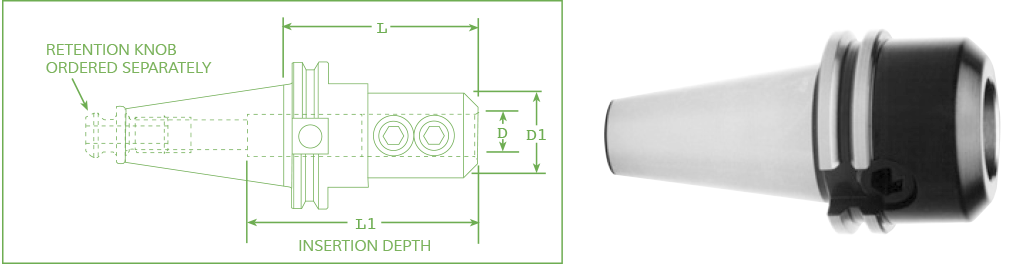
Different machining operations require different tool holder designs. Common CAT 40 options include:
- End Mill Holders: Secure end mills for milling operations and come in different bore diameters and lengths.
- Coolant-Through End Mill Holders: Deliver coolant through compatible cutting tools to support cooling during machining.
- Morse Taper Holders: Accommodate Morse taper tooling for applications requiring this connection.
- Jacobs Taper Adapters: Connect compatible Jacobs taper tools to a CAT 40 spindle setup.
- Shell Mill Holders: Secure shell milling cutters for face milling and other material-removal operations.
Centaur Precision Tools offers these CAT V-flange holder categories in different configurations to suit various machining requirements.
Choose the Correct Bore Diameter and Tool Size
Bore diameter is one of the most important specifications when selecting a CAT 40 end mill holder. It must match the cutting tool’s shank diameter to provide proper support and secure retention.
Centaur’s CAT 40 end mill holders include inch-size options such as 1/4-inch, 1/2-inch, 3/4-inch, and 1-inch bores. Metric options include 6 mm, 10 mm, 16 mm, 20 mm, and 32 mm, among other sizes.
Always check the cutting tool manufacturer’s specifications before selecting a holder. A correctly matched bore helps minimize tool movement and supports consistent machining results. Review the part number and dimensional specifications before ordering.
Consider Stub, Standard, and Extended Lengths
Tool holder length affects tool reach, clearance, and rigidity. The right length depends on workpiece geometry, machining depth, and available clearance.
- Stub-length holders provide a compact assembly that can improve rigidity and help reduce vibration.
- Standard-length holders balance tool reach and stability for general-purpose CNC milling.
- Extended-length holders provide additional reach for deeper areas or restricted spaces but may increase deflection and vibration.
Centaur’s CAT 40 end mill holder selection includes stub, standard, and extended-length options in inch and metric sizes. Compare their dimensions with your machine setup and workpiece requirements.
Check Retention Knob Compatibility
The retention knob, also called a pull stud, secures the tool holder inside the CNC machine spindle. Before purchasing a CAT 40 holder, verify the thread specification required by your machine.
Centaur’s CAT 40 end mill holders listed on our product page use a 5/8-11 retention knob thread. However, always confirm your machine manufacturer’s requirements. Also, check whether the retention knob comes with the holder or must be purchased separately. Centaur lists retention knobs separately for coolant-through holders.
Consider Machining Speed and Holder Balance
High-speed CNC operations require a properly balanced tool assembly to help control vibration and maintain consistent cutting performance. An unbalanced assembly can affect surface finish and increase stress on spindle components.
Consider the cutting tool, holder, retention knob, and other assembled components when reviewing balance requirements.
Centaur Precision Tools offers CAT 40 and CAT 50 holders balanced to 22,000 RPM upon request. Confirm that the selected configuration meets your machine’s operating specifications.
Review Construction and Dimensional Specifications
Before purchasing a Cat 40 Tool Holder, review its construction and dimensional specifications. Pay attention to:
- Part number and holder configuration
- Inch or metric dimensions
- Bore diameter and tool compatibility
- Stub, standard, or extended length
- Retention knob thread specification
- Coolant-through compatibility
- Balancing specifications for high-speed applications
Centaur’s product range includes detailed dimensional tables and part numbers for CAT 40 and CAT 50 end mill holders, helping buyers compare available configurations.
Match the Holder to Your CNC Machining Requirements
The best holder depends on the machining operation, cutting tool, material, and production environment. Standard end mill holders support general milling, while coolant-through models suit compatible setups requiring internal coolant delivery.
Shell mill holders support face milling operations, whereas Morse taper holders and Jacobs taper adapters accommodate specific tooling connections.
Before ordering, compare the holder specifications with your machine manual and cutting tool requirements. This helps prevent compatibility problems and unnecessary tooling changes.
Conclusion
Choosing the right CAT 40 holder involves more than matching the spindle taper. Consider holder type, bore diameter, length, retention knob compatibility, balancing requirements, and the intended machining operation.
At Centaur Precision Tools, Inc., we provide CAT 40 and CAT 50 V-flange tool holders in various inch and metric configurations. Reviewing product dimensions and application requirements helps CNC operators select tooling that supports accurate, stable, and efficient machining.