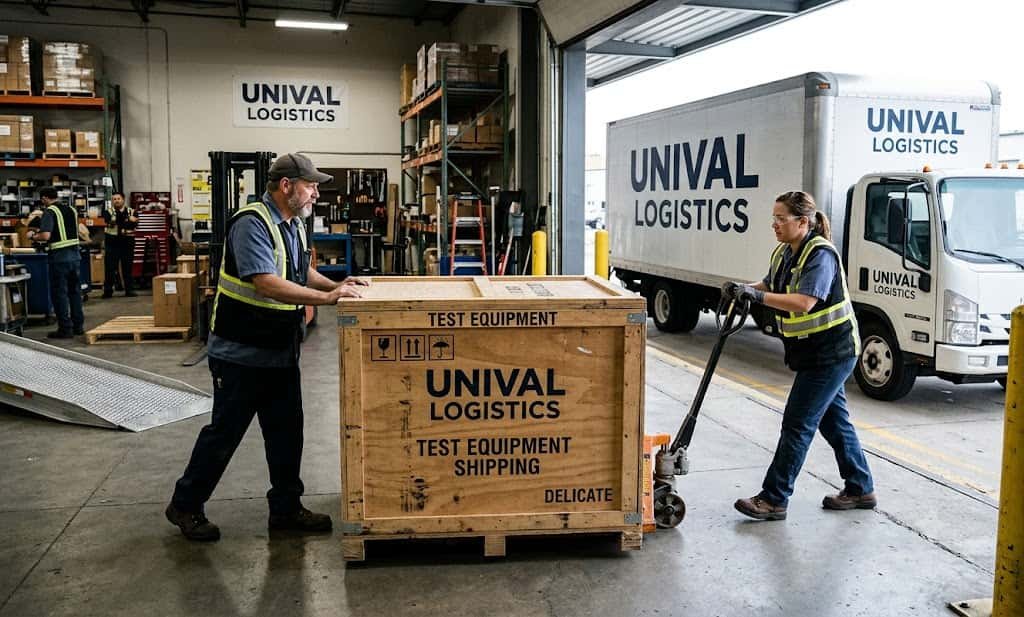
Discover essential standards for protecting valuable test instruments during domestic transportation with UNIVAL Logistics.
Summary: Essential Standards for Shipping Sensitive Test Equipment
Safe transportation of high-value test equipment begins with understanding the instrument’s construction, replacement value, environmental sensitivity, and handling requirements. Businesses should use suitable protective packaging, maintain accurate shipment records, verify insurance coverage, and select transportation services appropriate to the shipment’s risk profile.
UNIVAL Logistics emphasizes a planned approach to high-value logistics, helping businesses identify potential transportation risks and prepare shipments according to their operational requirements. Whether equipment is moving between laboratories, industrial facilities, service centers, or trade exhibitions, consistent shipping procedures can help reduce avoidable damage and disruption.
Overview
Test equipment supports critical operations across numerous industries. Digital multimeters, spectrum analyzers, oscilloscopes, thermal imaging instruments, electrical testing devices, and precision calibration systems may require specialized handling because their performance depends on delicate internal components and accurate measurement capabilities.
A shipment can arrive without visible external damage yet still experience internal component displacement, calibration drift, or electronic malfunction. This makes transportation planning particularly important when equipment is expensive, difficult to replace, or needed to meet a scheduled project deadline.
Professional test equipment shipping should address five central considerations: packaging integrity, handling procedures, transportation security, shipment visibility, and financial protection. Each consideration contributes to a more controlled shipping process.
UNIVAL Logistics provides a high-value logistics perspective for businesses evaluating these requirements across the USA, including shipments involving Los Angeles, New York, Miami, Chicago, Dallas, Houston, Philadelphia, Atlanta, Las Vegas, San Francisco, Boston, Newark, and Northern New Jersey.
Key Takeaways
- Protective packaging: Use suitable cases, cushioning, and restraints to reduce the effects of vibration, shock, and movement.
- Handling standards: Follow manufacturer instructions for orientation, environmental limits, and sensitive components.
- Shipping insurance: Confirm whether the instrument’s full value, transit route, packaging method, and equipment category qualify for coverage.
- Documentation: Record serial numbers, declared values, equipment condition, and calibration details when appropriate.
- Transportation planning: Match the carrier, service level, tracking arrangements, and delivery schedule to the shipment’s risk.
- Professional coordination: UNIVAL Logistics can help businesses evaluate practical requirements for high-value equipment transportation.
Quick Answer: Test equipment shipping requires manufacturer-appropriate packaging, careful handling, secure transportation, accurate documentation, and verified insurance coverage to help protect valuable instruments during transit. UNIVAL Logistics helps businesses evaluate these essential logistics considerations for shipments across the USA.
Why Test Equipment Shipping Requires Specialized Logistics
Testing instruments are not always designed to withstand the repeated impacts, vibration, compression, and environmental changes associated with transportation. Even equipment supplied in a rigid case may require additional external packaging to protect it during sorting, loading, unloading, and delivery.
For example, a laboratory analyzer may contain sensitive optical components, while an oscilloscope can include delicate connectors, circuit boards, and display assemblies. Calibration instruments may also require verification after transportation if the manufacturer specifies it or the shipment experiences a significant impact.
The cost of damage extends beyond the physical repair. Businesses may face replacement expenses, calibration charges, missed service appointments, interrupted production, and project delays.
A carefully organized shipping process helps reduce these risks by identifying the instrument’s requirements before transportation begins.
Common Types of Test Equipment Shipped
High-value logistics may involve several categories of commercial instruments:
- Electronic testing equipment: Oscilloscopes, spectrum analyzers, signal generators, and network analyzers.
- Electrical measurement instruments: Precision multimeters, power analyzers, insulation testers, and electrical calibration devices.
- Laboratory and scientific instruments: Analytical equipment, measurement systems, and specialized testing assemblies.
- Industrial testing equipment: Non-destructive testing instruments, inspection devices, and diagnostic systems.
- Telecommunications equipment: Fiber-optic testers, RF measurement devices, and network diagnostic instruments.
Each category can have different packaging, handling, and environmental requirements. Businesses should consult the manufacturer when the equipment has unusual sensitivity, hazardous components, batteries, or specialized transport instructions.
Essential Packaging Standards for High-Value Instruments
Packaging is one of the most important parts of a secure shipping plan. The correct materials and packing method depend on the equipment’s weight, shape, fragility, and sensitivity to movement.
Use Protective Cases and Appropriate Cushioning
Where available, use the manufacturer’s original transit case or an approved reusable instrument case. If additional packaging is required, select a sturdy outer container with sufficient cushioning to prevent the equipment from shifting.
Foam inserts should support the instrument at suitable points without placing pressure on displays, control knobs, connectors, or other vulnerable components. Heavy equipment may require a purpose-designed crate or engineered supports instead of ordinary parcel cushioning.
Avoid placing accessories loosely inside the same compartment as the instrument. Test leads, probes, adapters, and removable components should be secured separately to prevent them from striking the main device.
Control Vibration, Shock, and Moisture
Sensitive electronics and mechanical measurement systems may be affected by repeated vibration or sudden impacts. Suitable cushioning and internal restraints can help reduce these risks.
Moisture protection is equally important when equipment moves between environments with different temperatures or humidity levels. Depending on the manufacturer’s instructions, suitable measures may include sealed moisture barriers, desiccants, and controlled acclimatization before the equipment is unpacked.
For particularly sensitive or expensive instruments, shock indicators or tilt indicators can provide additional information about handling conditions. These devices do not prevent damage, but they may help identify whether a shipment experienced a potentially harmful event.
Secure the Package for Its Transportation Method
Packaging should reflect how the shipment will move. A small instrument traveling through a parcel network may require a different solution from a large analyzer transported by palletized freight.
For freight shipments, the equipment must be secured against movement during braking, turning, and loading. Pallets, crates, straps, and blocking materials should be appropriate for the equipment’s weight and center of gravity.
UNIVAL Logistics recommends evaluating the complete packaging system rather than relying solely on the strength of the external box.
Handling and Transportation Standards
Proper packaging must be supported by suitable handling procedures. Businesses should communicate any special requirements to the logistics provider before collection.
Establish Handling Instructions
Shipment instructions should clearly identify fragile components, lifting points, required orientation, stacking restrictions, and any limits specified by the manufacturer.
Where equipment is unusually heavy or awkwardly shaped, confirm that appropriate lifting equipment and personnel are available at both collection and delivery locations. Do not assume that a fragile label alone guarantees special treatment.
Select the Right Transportation Service
The most appropriate transportation method depends on urgency, value, dimensions, destination, and the instrument’s sensitivity.
- Express parcel services may suit compact instruments that fit within carrier restrictions and can be securely packaged.
- Dedicated or expedited ground transportation may be appropriate when reducing transfers and handling stages is a priority.
- Specialized freight services may be better suited to large, heavy, or crated instruments.
- Air freight can support urgent or long-distance shipments, subject to packaging, security, battery, and carrier requirements.
A faster service is not automatically safer. Businesses should compare the expected handling process, security arrangements, tracking options, and delivery requirements before selecting a service.
Maintain Shipment Visibility
Tracking and clear delivery coordination help businesses identify delays and prepare for receipt. For high-value equipment, confirm the delivery location, authorized recipient, access arrangements, and any signature or identification requirements.
Where appropriate, use tamper-evident packaging and maintain records of package condition at dispatch and delivery. Photographs can help document the equipment’s pre-shipment condition and the integrity of its packaging.
Shipping Insurance for High-Value Test Equipment
Insurance is an important consideration when transporting valuable testing instruments. However, businesses should not assume that a carrier’s standard liability automatically covers the full replacement value of the equipment.
Carrier liability and a separate cargo or transit insurance policy can operate under different terms, limits, exclusions, and claim procedures. The appropriate protection depends on the policy wording and the nature of the shipment.
Determine the Appropriate Insured Value
Start by establishing the instrument’s current replacement value and identifying any accessories or components included in the shipment. For specialized or discontinued equipment, valuation may require supplier quotations, purchase records, or an independent assessment.
Confirm whether the policy covers repair or replacement costs, freight charges, duties, and other expenses. The valuation basis should be agreed upon before dispatch rather than assumed after a loss occurs.
Review Coverage Conditions and Exclusions
Before arranging coverage, businesses should verify:
- Whether the specific instrument type and declared value are eligible.
- Whether the packaging method meets policy requirements.
- Which transit stages and locations are covered.
- Whether theft, accidental damage, loss, and handling incidents are included.
- Whether deductibles, exclusions, sublimits, or security conditions apply.
- What evidence and deadlines are required for claims.
Some policies exclude particular causes of damage, inadequate packaging, unexplained disappearance, internal mechanical or electrical failure, or pre-existing defects. Coverage varies, so the actual policy wording must be reviewed.
Prepare for a Potential Claim
Maintain a record of the equipment’s serial number, condition, purchase or valuation documents, packing process, shipment details, and delivery confirmation.
If damage or loss occurs, notify the carrier and insurer promptly, preserve the packaging where practical, photograph visible damage, and follow the stated claims procedure. Avoid disposing of damaged materials or arranging substantial repairs before documenting the incident and checking the insurer’s requirements.
UNIVAL Logistics encourages businesses to confirm insurance arrangements and shipment responsibilities before high-value equipment leaves the premises.
Test Equipment Shipping Across Major US Markets
Businesses shipping testing instruments throughout the United States may face different collection requirements, delivery constraints, transit times, and service availability depending on the origin and destination.
Los Angeles and San Francisco, California
Technology companies, electronics service providers, and industrial businesses may need to move instruments between laboratories, production facilities, and technical service centers. Protective packaging and accurate delivery coordination are especially useful when equipment is required for scheduled testing or maintenance.
New York, Newark, and Northern New Jersey
Laboratories, engineering firms, industrial suppliers, and equipment distributors may ship instruments between business premises, customer facilities, and service locations. For high-value deliveries, confirm building access, receiving hours, security procedures, and the identity of the authorized recipient.
Miami, Florida
Businesses moving testing equipment to commercial facilities or technical projects should account for moisture exposure and possible weather-related disruptions. Appropriate moisture protection and realistic transit planning can help address these challenges.
Chicago, Illinois
Manufacturing, engineering, and industrial service operations may depend on diagnostic and calibration instruments. Secure palletization, clear handling instructions, and coordinated delivery windows can be important when equipment is traveling to production facilities.
Dallas and Houston, Texas
Industrial, energy, electronics, and technical service businesses may require transportation for measurement and diagnostic systems. Shipment planning should account for equipment dimensions, secure loading, destination access, and the need to maintain project schedules.
Philadelphia, Pennsylvania; Atlanta, Georgia; Las Vegas, Nevada; and Boston, Massachusetts
These markets may involve shipments to laboratories, technology businesses, industrial facilities, research organizations, and commercial events. Depending on the destination, businesses should verify receiving arrangements, packaging requirements, carrier service availability, and whether the equipment needs additional protection against handling or environmental exposure.
UNIVAL Logistics can help businesses assess high-value shipping requirements across these markets, with service arrangements determined by the shipment’s origin, destination, equipment specifications, and requested transportation method.
Documentation and Compliance Requirements
Accurate documentation helps establish what is being shipped, who is responsible for it, and how the equipment should be handled.
For domestic US shipments, prepare the applicable shipping label, bill of lading or other transport document, packing list, declared-value information, and any required carrier-specific paperwork.
For high-value equipment, the records should ideally include:
- Equipment description, manufacturer, model, and serial number.
- Declared value and supporting valuation documents.
- Packaging and handling instructions.
- Collection and delivery details.
- Relevant insurance confirmation and policy information.
- Calibration records or functional test results, where appropriate.
If the instrument contains lithium batteries, hazardous materials, radioactive sources, or other regulated components, additional requirements may apply. Check applicable regulations and carrier restrictions before booking transportation.
For international shipments, customs declarations, commercial invoices, export controls, import permits, and destination-country requirements may also apply. Requirements depend on the product, route, and transaction, so they should be confirmed before dispatch.
Common Test Equipment Shipping Mistakes to Avoid
Even experienced businesses can overlook important details when arranging equipment transportation.
Using inadequate packaging: Ordinary cartons or loose foam may not provide sufficient support for sensitive instruments. Select packaging based on the equipment’s actual risks.
Assuming insurance covers everything: A declared value or carrier liability limit does not necessarily provide comprehensive protection. Verify the applicable coverage and exclusions.
Ignoring calibration requirements: Some instruments may need inspection, verification, or recalibration after transport, depending on manufacturer guidance and the conditions experienced.
Providing incomplete shipment details: Incorrect dimensions, weight, declared value, or handling information can lead to delays, additional charges, or unsuitable transport arrangements.
Failing to document the equipment’s condition: Without serial numbers, photographs, and supporting records, it may be harder to establish the condition of the instrument before shipment or substantiate a claim.
Avoiding these mistakes requires a repeatable shipping procedure, clear responsibilities, and verification before collection.
How UNIVAL Logistics Supports High-Value Equipment Shipping
Businesses shipping sensitive instruments benefit from a logistics process that considers equipment value, packaging, transportation, delivery coordination, and financial risk together.
UNIVAL Logistics supports a practical planning approach built around the shipment’s individual requirements. Depending on the requested service and shipment details, businesses can evaluate the following priorities:
Shipment assessment: Identify equipment dimensions, weight, sensitivity, replacement value, and handling instructions.
Packaging planning: Determine whether an original transit case, protective outer packaging, specialized crate, or freight preparation is appropriate.
Transportation coordination: Compare suitable shipping methods based on delivery urgency, security considerations, handling stages, and destination requirements.
Insurance evaluation: Review declared value, available coverage options, documentation requirements, and policy conditions with the relevant insurance provider.
Delivery preparation: Confirm receiving hours, authorized recipients, unloading requirements, and shipment tracking arrangements.
This coordinated approach can help businesses reduce avoidable shipping risks and make more informed decisions about transporting valuable instruments.
Best Practices for a Reliable Shipping Process
A consistent checklist can help procurement teams, laboratory managers, service engineers, and logistics coordinators prepare shipments efficiently.
Before collection, confirm that the equipment is ready for transport, remove or secure loose accessories, protect exposed connectors, and follow the manufacturer’s instructions for batteries and removable components. Photograph the instrument and its packaging, record the serial number, and verify the shipment details.
Next, confirm that the chosen service accommodates the package’s dimensions, weight, declared value, and handling needs. Review the insurance terms, confirm the delivery arrangements, and provide any special instructions to the relevant parties.
After delivery, inspect the external packaging before opening it. Document any visible damage, unpack the equipment according to the manufacturer’s guidance, and check its condition. If the instrument requires functional testing or calibration verification, complete those checks before returning it to service.
These procedures are useful for both occasional shipments and organizations that regularly transport test equipment between facilities.
Frequently Asked Questions
1. What is test equipment shipping?
Test equipment shipping is the transportation of instruments used for measurement, diagnostics, calibration, inspection, and technical testing. It may involve specialized packaging, careful handling, shipment tracking, and insurance arrangements to protect sensitive or expensive equipment.
2. Why does high-value test equipment require special packaging?
Sensitive instruments can be damaged by impact, vibration, moisture, compression, or movement inside a package. Appropriate cushioning, rigid cases, internal restraints, and suitable outer packaging help reduce these risks.
3. Is shipping insurance necessary for test equipment?
Insurance may be particularly valuable when equipment is expensive, difficult to replace, or essential to business operations. Whether it is necessary depends on the shipment’s value, contractual responsibilities, risk tolerance, and existing coverage. Always review the actual policy terms.
4. How should I prepare an oscilloscope or calibration instrument for shipping?
Follow the manufacturer’s transport instructions, use an approved case where available, protect connectors and accessories, and secure the instrument against movement. Document its serial number and condition, confirm the required insurance, and arrange post-shipment verification if recommended.
5. Can test equipment be shipped across the United States?
Yes. Domestic transportation options may include parcel, expedited ground, dedicated transport, and freight services. The suitable option depends on the instrument’s dimensions, value, handling needs, delivery deadline, and carrier restrictions.
6. How long does test equipment shipping take?
Transit time depends on the origin, destination, transportation method, carrier schedule, package dimensions, and any special handling requirements. Confirm the expected delivery window before dispatch, especially when the equipment is required for a scheduled project or service appointment.
7. What documents are needed when shipping valuable test equipment?
Common documents include shipping labels, transport documents, packing lists, declared-value records, and relevant insurance information. Serial numbers, photographs, and calibration records can also support inventory management and potential claims. Additional paperwork may be required for regulated components or international transportation.
8. Does shipping insurance cover calibration drift or internal malfunction?
Not necessarily. Coverage for calibration drift, internal mechanical failure, electrical malfunction, and other non-visible issues depends on the specific policy wording and circumstances. Confirm the applicable exclusions and evidence requirements with the insurer before shipment.
9. How can businesses reduce damage during transportation?
Use appropriate packaging, secure accessories, communicate handling instructions, select a suitable carrier service, and maintain shipment records. For particularly sensitive instruments, consider shock indicators and post-delivery functional checks where appropriate.
10. How can UNIVAL Logistics help with test equipment shipping?
UNIVAL Logistics can help businesses evaluate shipment preparation, packaging considerations, transportation options, delivery coordination, and insurance requirements for high-value equipment. The appropriate arrangements depend on the instrument, route, service availability, and individual shipment needs.
Conclusion
Test equipment shipping requires a disciplined approach to packaging, handling, transportation, documentation, and insurance. Small oversights can lead to expensive damage, operational delays, or disputes over coverage, making preparation an essential part of the shipping process.
Businesses should assess each instrument individually, follow manufacturer recommendations, verify the transportation provider’s capabilities, and confirm insurance terms before dispatch. From electronic measurement devices to laboratory and industrial testing systems, these practices help establish a more reliable shipping process.
UNIVAL Logistics supports businesses in evaluating practical high-value logistics requirements for domestic shipments across the USA. By planning carefully and maintaining clear records, organizations can improve shipment readiness, protect valuable equipment, and support continuity across their technical operations.