Hospital Information System Market
Market Overview
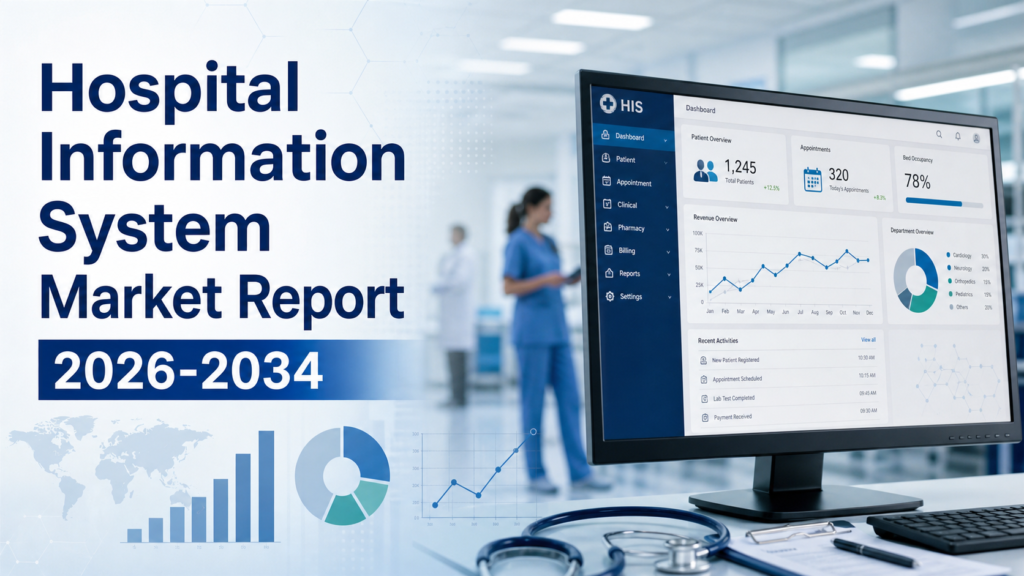
According to IMARC Group’s latest research publication, “Hospital Information System Market Size, Share, Trends and Forecast by Component, Deployment Type, System Type, End-User, and Region, 2026-2034“, the global hospital information system market size grew from USD 29.6 Billion in 2025 to USD 32.2 Billion in 2026. Looking forward, IMARC Group expects the market to reach USD 61.8 Billion by 2034, exhibiting a growth rate CAGR of 8.50% during 2026-2034, with the industry experiencing strong growth momentum. North America currently dominates the market, holding a share of over 45.8%, driven by the growing popularity of electronic health records, favorable government initiatives, ongoing technological advancement, and the increasing need for telemedicine and remote monitoring.
This detailed analysis primarily encompasses industry size, business trends, market share, key growth factors, and regional forecasts. The report offers a comprehensive overview and integrates research findings, market assessments, and data from different sources. It also includes pivotal market dynamics like drivers and challenges, while also highlighting growth opportunities, financial insights, technological improvements, emerging trends, and innovations. Besides this, the report provides regional market evaluation, along with a competitive landscape analysis.
How AI and Cloud Adoption are Reshaping the Future of the Hospital Information System Market
-
The high demand for electronic health records and streamlined data management within healthcare facilities are significant growth factors for hospital information systems.
-
Advancements in telemedicine and remote patient monitoring encourage HIS integration, since such systems support real-time data exchange and access to medical information remotely.
-
The need for regulatory compliance, along with patient safety issues, is driving the demand for HIS solutions among governments and healthcare organizations.
-
Cloud-based HIS seems to be the key emerging trend in this area by offering scalability, data security, and cost-effectiveness.
-
The increasing adoption of artificial intelligence and analytics is helping make more effective decisions and personalized care for patients.
Key Trends in the Hospital Information System Market
-
Rising Prevalence of Chronic Diseases: The growing prevalence of chronic diseases is driving the expansion of the hospital information system market. Chronic diseases like diabetes, cardiovascular diseases, and arthritis require continuous monitoring and continuous management, hence there is a need for advanced healthcare solutions. The National Council on Aging reported that 95 percent of people aged 60 and older have at least one chronic condition, and nearly 80 percent live with two or more. This reflects the rising trend in healthcare burdens for offering effective care and handling intricate patient data. HIS platforms enable centralization to store, analyze, and access patient information. It has continuous monitoring, personalized care plans for patients, and the following treatment protocol that contribute positively to the outcome for a patient. Moreover, growing old age and concomitant increase in chronic disease compel investment in robust healthcare infrastructures. HIS will support the sharing of information as well as health care data across the organization and provide maximum resource utilization with improved care.
-
Adoption of Digital Health Technologies: Hospitals see HIS as the solution to implementing digital health technologies due to these healthcare facilities’ growing demand to bring about efficiency and care service enhancements. Digital health solutions remove complex administrative tasks, minimize potential errors, and optimize workflows – necessary needs for modern healthcare. The digital health market was valued at USD 421.7 Billion and is expected to reach USD 1,794.7 Billion, according to IMARC Group. Such growth shows a trend of the entire health sector undergoing digital transformation. HIS plays a key role in this change through the integration of electronic health records, telemedicine, and remote patient monitoring systems. Such systems enhance interoperability, thereby making it possible for healthcare providers to deliver coordinated and timely care. Additionally, improvements in mobile health applications and wearable devices create real-time patient data that can be easily incorporated into HIS for better clinical decision-making.
-
Technological Advancements: Technological innovations in enhancing the functionality and adoption of the HIS market are reshaping this area. Emerging technologies include advanced data analytics, AI, and cloud computing, which have the power to enable better patient care while improving operational efficiencies. Recently, in August 2023, HCA Healthcare Inc. collaborated with Google Cloud to integrate generative AI technology into clinical documentation processes. This partnership will make complex tasks easier to manage and help doctors and nurses concentrate more on patient care. Scalability, data security, and cost-effectiveness have been making cloud based HIS solutions more popular in healthcare institutions. The ability of AI tools to analyze a huge amount of patient data, track trends, predict outcomes, and help in creating individualized treatment plans also makes it a favorite for healthcare institutions. These innovations enable smooth data management, better patient monitoring, and improved decision-making.
-
Growth of Cloud-Based Deployments: Cloud-based systems lead the HIS market with the highest share of 42.5% as they ensure scalability, cost-effectiveness, and access to the latest data. Cloud-based HIS solutions allow healthcare providers to access critical patient information remotely, supporting real-time decision-making and enhancing operational efficiency, unlike traditional on-premises systems. Systems that support seamless data integration across multiple locations are also suitable for large healthcare networks and multi-specialty hospitals. Enhanced data security measures, including encryption and updates, address concerns around breaches and compliance, further fueling adoption. Significant up-front infrastructure costs are avoided in cloud deployment, thus saving many healthcare facilities with minimal budget. The increasing popularity of telemedicine and patient remote monitoring has increased the adoption of cloud-based systems for interoperability between health applications.
-
Emphasis on Interoperability and Regulatory Compliance: The need for regulatory compliance, along with patient safety issues, is driving the demand for HIS solutions among governments and healthcare organizations. The growing emphasis on interoperability and compliance with healthcare regulations, such as the Health Information Technology for Economic and Clinical Health (HITECH) Act in the U.S., is further boosting the demand for robust software solutions. As healthcare systems become more data-driven, the adoption of cutting-edge technologies within HIS is expected to gain pace.
Growth Factors in the Hospital Information System Market
-
Growing Popularity of Electronic Health Records: The high demand for electronic health records and streamlined data management within healthcare facilities are significant growth factors. HIS platforms enable centralization to store, analyze, and access patient information, and the growing popularity of electronic health records is driving the market forward. In the United States, 96% of American hospitals adopted EHR, reflecting the scale of adoption across the healthcare ecosystem.
-
Favorable Government Initiatives: Government initiatives like the HITECH Act and investments in healthcare IT infrastructure are further accelerating HIS adoption. The need for regulatory compliance, along with patient safety issues, is driving the demand for HIS solutions among governments and healthcare organizations. Favorable government policies remain a foundational driver of market expansion.
-
Ongoing Technological Advancement: Ongoing technological advancement, including AI, machine learning, and cloud computing, is enabling better patient care while improving operational efficiencies. The ability of AI tools to analyze a huge amount of patient data, track trends, predict outcomes, and help in creating individualized treatment plans also makes it a favorite for healthcare institutions.
-
Increasing Need for Telemedicine and Remote Monitoring: The increasing need for telemedicine and remote monitoring is encouraging HIS integration, since such systems support real-time data exchange and access to medical information remotely. The increasing popularity of telemedicine and patient remote monitoring has increased the adoption of cloud-based systems for interoperability between health applications. Information from the Centers for Disease Control reported that 37.0 percent of adults used telemedicine in the past 12 months, with use increasing with age and women using it more (42.0%) than men (31.7%).
-
Rising Incidence of Chronic Diseases: The incidence of chronic diseases is rising and requires efficient data management for long-term care and planning. The growing prevalence of chronic diseases is driving the expansion of the hospital information system market, as chronic conditions require continuous monitoring and continuous management, hence there is a need for advanced healthcare solutions.
Leading Companies Operating in the Global Hospital Information System Industry
-
Agfa-Gevaert Group. (Dedalus Holding S.p.A.)
-
Allscripts Healthcare Solutions Inc.
-
Carestream Health Inc. (Koninklijke Philips N.V.)
-
Cerner Corporation
-
Comarch SA.
-
Computer Programs and Systems Inc.
-
Epic Systems Corporation (Compass Group plc)
-
GE Healthcare Inc. (Danaher Corporation)
-
McKesson Corporation
-
Medical Information Technology Inc.
-
Nextgen Healthcare Inc.
-
Wipro Limited
Hospital Information System Market Report Segmentation
Breakup By Component
-
Hardware
-
Software
-
Services
Software represents the largest segment with a share of 47.8%. Its growth is highly dependent on digitization happening in healthcare and the number of EHRs telemedicine platforms and other clinical decision support systems rising in numbers. Software applications are helpful in the management of patient data, efficient workflow improvement, and enhanced communication with different departments. The growing emphasis on interoperability and compliance with healthcare regulations, such as the Health Information Technology for Economic and Clinical Health (HITECH) Act in the U.S., is further boosting the demand for robust software solutions. Technological advancements, including artificial intelligence (AI) and machine learning, are enhancing software capabilities, enabling predictive analytics and real-time clinical decision-making. Besides, software systems in their flexibility and scalability fit every healthcare setting from small clinics to large hospitals.
Breakup By Deployment Type
-
On-premises
-
Web-based
-
Cloud-based
Cloud-based systems lead the HIS market with the highest share of 42.5% as they ensure scalability, cost-effectiveness, and access to the latest data. Cloud-based HIS solutions allow healthcare providers to access critical patient information remotely, supporting real-time decision-making and enhancing operational efficiency, unlike traditional on-premises systems. Systems that support seamless data integration across multiple locations are also suitable for large healthcare networks and multi-specialty hospitals. Enhanced data security measures, including encryption and updates, address concerns around breaches and compliance, further fueling adoption. Significant up-front infrastructure costs are avoided in cloud deployment, thus saving many healthcare facilities with minimal budget.
Breakup By System Type
-
Clinical Information System
-
Administrative Information System
-
Electronic Medical Record
-
Laboratory Information System
-
Radiology Information System
-
Pharmacy Information System
-
Others
The laboratory information system holds the largest hospital information system market share due to the diagnostic data that is used in laboratories which enhances the lab’s operational efficiency. These systems streamline workflows by automating processes such as tracking samples, generating results, and reporting data, hence diagnostics that are faster and more accurate. The LIS market is driven by the rise in chronic diseases and diagnostic tests, which in turn creates a need for better data management solutions. The integration of LIS with other hospital systems, such as electronic medical records (EMR) and radiology information systems (RIS), further supports cohesive healthcare delivery. With advancements in technology, such as AI and cloud-based LIS solutions, real-time data sharing and predictive analytics improve the decision-making capabilities of clinicians.
Breakup By End User
-
Hospitals
-
Insurance Companies
-
Others
Hospitals hold significant share in the market due to their extensive requirement to manage high volumes of patients’ data optimally and achieve streamlined process management. HIS solutions in hospitals integrate a variety of functions, which include clinical documentation, administrative processes, and financial management for efficiency and effective patient care. The rising volume of hospital admissions, especially of chronic diseases and critical care, requires powerful data management systems to share information amongst healthcare providers on time and accurately. Rising investments in hospital infrastructure and IT systems are further pushing HIS adoption in this segment. This means that the integration of HIS with advanced technologies such as AI, telemedicine, and remote monitoring allows hospitals to offer personalized care and maximize resource utilization.
Insurance companies rely heavily on accurate, real-time data for processing claims, reducing fraud, and managing costs. HIS solutions offer seamless integration of patient data, medical records, and billing information, helping insurers streamline these processes. By promoting the adoption of HIS, insurance companies gain a structured framework to evaluate medical services and ensure cost-effective care delivery. Also, HIS solutions provide insurers with valuable insights into patient health trends, treatment outcomes, and population health metrics, which aid in accurate risk assessment and policy pricing.
Breakup By Region
-
North America (United States, Canada)
-
Europe (Germany, France, United Kingdom, Italy, Spain, Russia, Others)
-
Asia Pacific (China, Japan, India, South Korea, Australia, Indonesia, Others)
-
Latin America (Brazil, Mexico, Others)
-
Middle East and Africa
North America held the largest market share of over 45.8%. Hospital information system market statistics reveal that the need for advanced technological solutions to improve patient care and operational efficiency is increasing in the North America region. The main driver behind this push for digitalization in healthcare to improve patient outcomes and operational efficiency is a significant force. For example, the United States digital health market size is expected to grow at a CAGR of 17.30%, said IMARC. HIS forms the core of this change. It enables data management seamlessly and integrates care. Secondly, there is a critical need to manage increasing healthcare expenses while preserving quality care delivery, and hospitals are using HIS to make operations smooth, minimize administrative overheads, and use resources effectively.
The growth in Asia Pacific HIS is attributed to increasing healthcare investment, adopting digital health technology, and enhancement of government efforts to build modern healthcare infrastructures. India and China are observing growth at considerable rates attributed to the escalating prevalence of chronic conditions and the mounting demand for EHR. HIS adoption is further fueled by the region’s large population and the improvement in healthcare accessibility coupled with advancements in telemedicine. Emerging technologies such as AI and cloud computing are also driving market expansion. The Ayushman Bharat Digital Mission is driving the demand for HIS as it intends to develop a unified health information infrastructure in India.
The HIS market in Europe is driven by stringent healthcare regulations, widespread adoption of electronic health records, and strong government support for digital healthcare transformation. Countries like Germany, the UK, and France are taking the lead since they possess a well-developed infrastructure for healthcare, along with a high level of investments in advanced technology. Growth in chronic disease and increased age population leads to efficient hospital management system demand. Additionally, initiatives by the EU toward interoperability and data exchange concerning cross-border health care facilitate HIS adoption throughout the region.
The Latin American HIS market is increasing due to growing investments in the healthcare IT infrastructure and surging demand for efficient management solutions in hospitals. Brazil and Mexico’s governments are encouraging digitization in healthcare so that the care provided can be improved and the administration can be made efficient. The increasing adoption of telemedicine and electronic health records is also driving the market. Besides, HIS implementation is gaining momentum as the region focuses on modernizing public healthcare systems and solving problems like resource optimization and chronic disease management.
The Middle East and Africa HIS market is growing due to increasing government initiatives to modernize healthcare systems and growing investments in healthcare IT. Countries like Saudi Arabia and the UAE are leading with ambitious digital health transformation programs. The increasing prevalence of chronic diseases and the need for better accessibility in healthcare are driving demand for HIS. In addition, the adoption of cloud-based systems and telemedicine is gaining momentum, supported by efforts from the region to improve interoperability and deliver effective healthcare services.
Recent News and Developments in Hospital Information System Market
-
July 2024: Makueni County has launched a digital health management information system to replace antiquated manual and inefficient practices. It will connect all healthcare facilities in the county, thus ensuring a continuous flow of information to improve patient care, streamline operations, and increase overall efficiency.
-
April 2024: Munich Re Life US and Clareto have launched Automated EHR Summarizer, a new digital solution that provides an intelligent and intuitive synopsis of electronic health record (EHR) data in two formats, an easy-to-use human-readable HTML report and structured digital data for use in rules, models, and analytics.
-
March 2024: The Department of Veterans Affairs and the Defense Department rolled out a new, interoperable Electronic Health Record, at the Capt. James A. Lovell Federal Health Care Center in North Chicago.
-
August 2023: HCA Healthcare Inc. collaborated with Google Cloud to integrate generative AI technology into clinical documentation processes, making complex tasks easier to manage and helping doctors and nurses concentrate more on patient care.
Note: If you require specific details, data, or insights that are not currently included in the scope of this report, we are happy to accommodate your request. As part of our customization service, we will gather and provide the additional information you need, tailored to your specific requirements. Please let us know your exact needs, and we will ensure the report is updated accordingly to meet your expectations.
About Us
IMARC Group is a global management consulting firm that helps the world’s most ambitious changemakers to create a lasting impact. The company provide a comprehensive suite of market entry and expansion services. IMARC offerings include thorough market assessment, feasibility studies, company incorporation assistance, factory setup support, regulatory approvals and licensing navigation, branding, marketing and sales strategies, competitive landscape and benchmarking analyses, pricing and cost research, and procurement research.
Contact Us
IMARC Group
134 N 4th St. Brooklyn, NY 11249, USA
Tel No:(D) +91 120 433 0800
United States: +1-201971-6302