Bike Parcel Service in Chennai
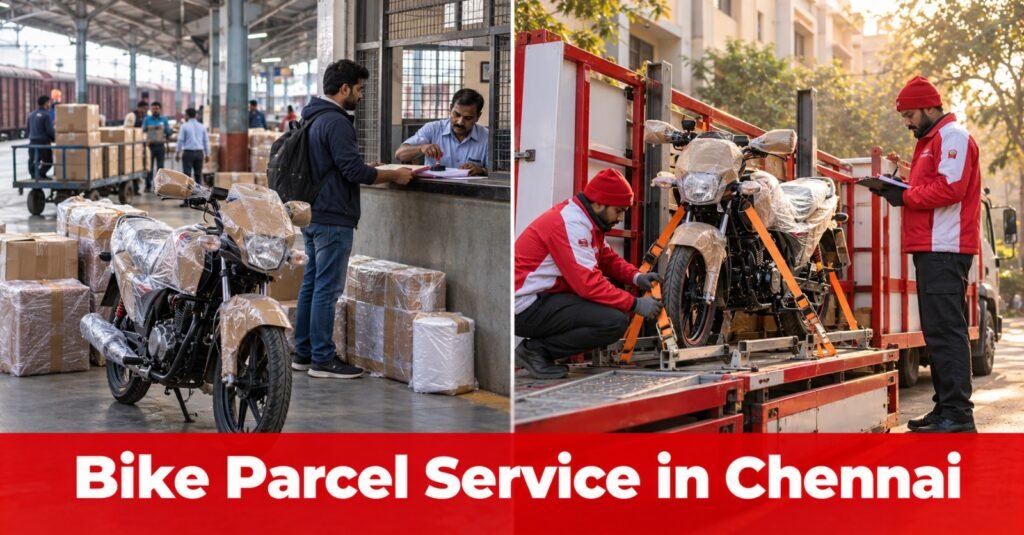
If you are looking to send a two-wheeler out of Chennai, you will come across the phrase “bike parcel service” more often than “bike transport”. The two are not quite the same thing. Parcel usually refers to booking your bike through Indian Railways, where it travels as freight without you. Road transport means a carrier company collects it and delivers it by truck.
Both work. They suit different situations, cost different amounts and involve very different amounts of your own time. This guide explains how railway parcel booking actually works, what road transport offers instead, and how to decide which one fits your move.
The Two Ways to Send a Bike from Chennai
Railway luggage. Your bike travels on the same train as you, booked against your passenger ticket. This only works if you are travelling, and it limits you to that train and that date.
Railway parcel. The bike travels separately as freight. You do not need a ticket and do not need to travel. This is what most people mean by bike parcel service.
Road carrier. A transport company collects the bike, usually secures it in a rack on a dedicated two-wheeler carrier, and delivers it. No station visits at either end.
The rest of this guide covers railway parcel first, since that is what the phrase usually means, then road transport as the alternative.
How Railway Parcel Booking Works
The process runs through the parcel office at a railway station, and it is more hands-on than most people expect.
- Take the bike to the parcel office at the station. Someone has to physically ride or push it there, which matters if you are in a part of Chennai far from a major station.
- Empty the fuel tank. Indian Railways does not accept a two-wheeler with petrol in it. This is not negotiable, and it is checked.
- Pack the bike. Headlamp, indicators, mirrors and exposed panels need protecting. Many people use a packing service near the station rather than doing it themselves.
- Complete the booking form with the bike details and declare its value. The declared value affects the charge and any compensation.
- Submit the documents and pay the charge.
- Collect the Parcel Way Bill, which is your receipt and what you produce at the other end.
- Mark the bike clearly for identification, since several bikes may travel together.
- Collect it at the destination station, producing the Parcel Way Bill.
Documents you need: the registration certificate, valid insurance, and photo identity. Carry originals and photocopies. Some sources also mention needing the booking receipt at collection, which the Parcel Way Bill covers.
Booking lead time: sources differ, giving anywhere from two to four days in advance. Parcel offices also keep fixed hours, unlike a road carrier that collects when convenient. Confirm the timing at your station rather than relying on a figure online.
What Railway Parcel Costs
This is where published figures get unreliable, so treat all of the following as a range rather than a quote.
The charge is calculated on distance and the weight of the bike, with additions on top. Published breakdowns suggest a base transport charge of roughly ₹300 to ₹2,000 depending on distance and train type, a service charge of around ₹50 to ₹200 for handling and paperwork, and an interstate surcharge that may add ₹300 to ₹1,000. One source puts the total range at roughly ₹200 to ₹5,000.
Those figures come from insurance and finance publishers rather than from Indian Railways directly, and they do not agree closely with each other. Railways publishes a charge calculation based on weight and distance, so the only reliable number is the one the parcel office gives you for your specific bike and route.
What is reasonably consistent across sources is the general point: railway parcel is usually less expensive than road transport. What it costs you instead is time and effort at both ends.
What Railway Parcel Does Not Cover
Three things are worth knowing before you choose it.
It is station to station, not door to door. Getting the bike to the parcel office in Chennai and collecting it at the destination station are both your responsibility.
Packing is usually your problem. The railway accepts the bike packed; it does not pack it for you.
Compensation is tied to the declared value, not the market value. Several sources stress keeping your own comprehensive two-wheeler insurance active during transit, because that is what covers damage properly. Declaring a low value to reduce the charge also reduces what you can claim.
Road Carrier: The Other Option
A road carrier collects the bike from where it is and delivers it to where you want it. On most routes out of Chennai, the bike travels secured in a rack on a dedicated two-wheeler carrier, strapped upright with padding around the tank and levers.
What you get for the higher price:
- Door to door. No station trips at either end.
- Packing included. The operator wraps and secures the bike.
- More flexible timing. Collection is arranged around you rather than parcel office hours.
- A condition record. A good operator photographs and documents the bike at pickup, which is your evidence if something is damaged.
What you give up is the lower railway fare, and you have to verify the operator yourself, since anyone can set up as a bike transporter.
Which to Choose
| Situation | Usually better |
|---|---|
| Sending a commuter bike, budget matters most, you have time | Railway parcel |
| You are travelling on the same train anyway | Railway luggage |
| You want it collected and delivered to your door | Road carrier |
| Premium, modified or imported bike | Road carrier |
| Tight timeline, or no one free to visit stations | Road carrier |
| Destination is not near a major station | Road carrier |
For routes out of Chennai, the practical question is usually how far the bike is from Chennai Central or Egmore at one end, and how far the destination is from a station at the other. Two station trips can easily absorb the saving.
If your bike is heading to Karnataka, it is worth comparing both options against what operators serving bike transportation in Bangalore quote, since a carrier already running that corridor often prices it keenly.
Preparing the Bike, Either Way
Most of this applies whichever method you choose.
- Wash it first. A clean bike makes existing scratches visible, which protects you in any dispute later.
- Photograph it in daylight. Both sides, the tank, the fairing, both wheels, the mirrors and levers, and the odometer.
- Empty or reduce the fuel. Railways requires an empty tank. Road carriers usually want it near-empty too.
- Remove accessories. Mobile holders, cameras, saddlebags and anything that can vibrate loose.
- Protect the vulnerable parts. Mirrors, levers, indicators and the exhaust break most often.
- Note the odometer reading in writing, so unexplained mileage is obvious on arrival.
- Keep your own insurance active. Transit cover and your own policy are not the same thing.
Checking the Bike on Arrival
Whether you collect from a parcel office or receive a delivery, inspect before you sign.
Walk both sides in good light and compare with your pickup photographs. Check the tank, fairing and side panels, which take the most strap damage. Check mirrors, levers, indicators and exhaust for cracks. Look at the rims and forks for ramp or rack scrapes. Compare the odometer. Start the bike before signing.
If anything is wrong, note it on the receipt before signing, photograph it, and raise it in writing the same day.
Checks Before Booking a Road Carrier
If you go the road route, these five checks separate a reliable operator from a risky one.
- GST registration, verified on the government portal, with the registered name matching the company.
- A written quote stating the transport method, route, delivery window and whether GST is included.
- The transit insurance certificate, obtained before loading rather than promised afterwards.
- Partial advance only, twenty to thirty percent at booking, the balance on delivery, paid to the registered business account.
- Route experience. Ask how often they run your route. A weekly operator knows realistic timings.
A quote far below every other usually means loose loading, no real insurance, or charges that appear later. The same checks apply at the destination end, so if you are sending a bike north, it is worth also comparing operators handling bike transportation in Delhi.
Frequently Asked Questions
1. Is bike parcel service cheaper than road transport?
Usually yes on the fare itself. Once you add two station trips, packing and your own time, the gap narrows considerably.
2. Does the fuel tank have to be empty for railway parcel?
Yes. Indian Railways does not accept a two-wheeler with petrol in the tank.
3. What documents do I need?
Registration certificate, valid insurance and photo identity, with photocopies. Keep the Parcel Way Bill safe, since you need it to collect the bike.
4. How far in advance should I book?
Published guidance ranges from two to four days for railway parcel. Confirm with your parcel office, since timings vary by station.
5. Who packs the bike for railway parcel?
You do, or a packing service near the station. The railway accepts it already packed.
6. Is my bike insured during transit?
The declared value governs any railway compensation, which is not the same as your bike’s worth. Keep your own comprehensive policy active, and with a road carrier ask for the transit insurance certificate before loading.
7. Can the bike travel with my household goods?
Generally not. Bikes travel on different vehicles from household loads, so ask for both quotes together and confirm the dates line up.
The Short Version
Bike parcel service in Chennai usually means railway freight: less expensive, more of your own time, station to station, empty tank, and a Parcel Way Bill you must not lose. Road transport costs more and does the work for you.
Choose on the basis of where your bike is, where it needs to end up, and how much of the job you want to do yourself. Whichever you pick, photograph the bike before it leaves, keep your insurance active, and inspect it properly before signing anything.
To compare verified road carriers on Chennai routes with free quotes and no obligation, ShiftEazy connects you with verified operators across Chennai and other major cities.