Capnography Device Market Overview
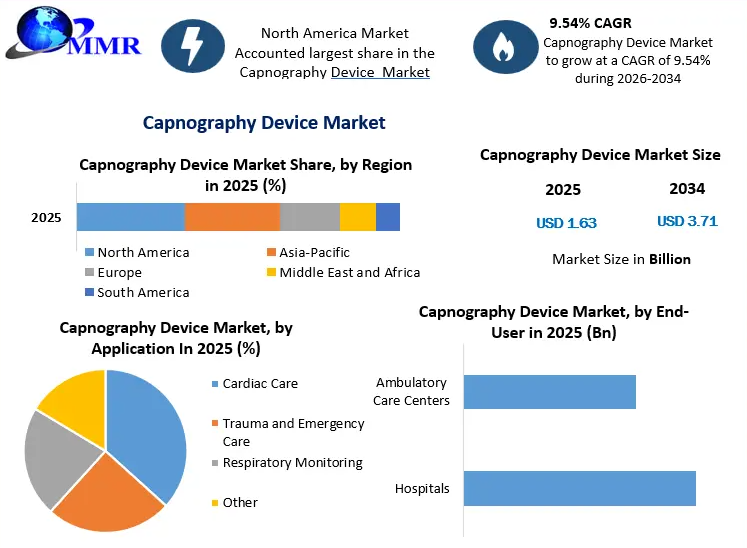
The Global Capnography Device Market was valued at approximately USD 1.63 billion in 2025 and is projected to reach nearly USD 3.71 billion by 2034, registering a compound annual growth rate (CAGR) of 9.54% during the forecast period from 2026 to 2034. The market is witnessing significant expansion due to the growing need for real-time respiratory monitoring, increasing surgical procedures, rising prevalence of respiratory disorders, and greater emphasis on patient safety across healthcare facilities.
Get to Know More About This Market Study: https://www.maximizemarketresearch.com/request-sample/35647/
Capnography devices are medical monitoring systems designed to measure and display carbon dioxide (CO₂) concentrations in exhaled breath. These devices provide real-time information about ventilation and respiratory function, helping healthcare professionals identify changes in a patient’s breathing status and respond to potential complications. They are widely utilized in operating rooms, intensive care units (ICUs), emergency departments, ambulances, and procedural sedation environments.
Capnography Device Market Analysis from 2025 to 2034
The market is expected to maintain a positive growth trajectory throughout the forecast period, supported by the increasing importance of respiratory monitoring in acute care and procedural settings. Healthcare providers are increasingly adopting monitoring solutions that enable the early identification of changes in ventilation, particularly among patients receiving anesthesia, sedation, or respiratory support.
The projected increase from USD 1.63 billion in 2025 to USD 3.71 billion in 2034 reflects growing demand for reliable monitoring technologies and the continued integration of capnography into clinical care pathways. Product innovation, improvements in sensor technology, and the expansion of emergency medical services are expected to remain important factors influencing market development.
Capnography Device Market Dynamics
Market Drivers
Increasing prevalence of respiratory disorders: The growing burden of chronic respiratory conditions, including chronic obstructive pulmonary disease (COPD) and asthma, is increasing the need for effective respiratory assessment and monitoring. Capnography devices help healthcare professionals evaluate ventilation and observe changes in exhaled carbon dioxide, particularly in critical care and emergency settings.
Get to Know More About This Market Study: https://www.maximizemarketresearch.com/request-sample/35647/
Growing demand for patient safety during anesthesia and sedation: Capnography is increasingly incorporated into anesthesia and procedural sedation workflows because it provides continuous information about ventilation. Its ability to identify changes in respiratory patterns can support earlier clinical intervention, especially during procedures involving sedatives or opioids.
Expansion of emergency and critical care services: Emergency departments, intensive care units, and ambulance services require dependable monitoring equipment to evaluate patients with respiratory distress, trauma, or altered consciousness. Portable capnography systems are particularly useful in pre-hospital environments, where rapid assessment and continuous monitoring can influence clinical decision-making.
Technological advancements in monitoring devices: Improvements in sensor performance, waveform visualization, connectivity, and multiparameter integration are enhancing the usability of capnography devices. These developments are encouraging healthcare facilities to adopt advanced systems that support efficient monitoring and data sharing.
Market Restraints
Despite its positive outlook, the market faces challenges related to the cost of advanced monitoring equipment, maintenance requirements, and the recurring expense of compatible sampling lines, cannulas, and sensors. Budget limitations may restrict adoption in smaller hospitals and healthcare facilities in developing economies.
The availability of trained healthcare professionals and the need for appropriate device configuration and interpretation can also affect implementation. Differences in clinical workflows, patient populations, and equipment compatibility may create additional barriers to widespread adoption.
Market Opportunities
The expansion of healthcare infrastructure in emerging economies presents considerable opportunities for capnography device manufacturers. Investments in intensive care, emergency medical services, surgical facilities, and neonatal care are increasing the need for reliable respiratory monitoring equipment.
Portable and wireless devices may also support broader use in ambulatory surgical centers, transport settings, and selected home healthcare applications. Furthermore, integration with connected patient monitoring platforms and hospital information systems can improve data accessibility and support more coordinated clinical care.
Capnography Device Market Key Trends
1. Rising Demand in Emergency and Critical Care
The growing emphasis on rapid respiratory assessment is increasing the use of capnography in emergency departments, ambulances, and intensive care units. These devices provide continuous ventilation information that can help clinicians monitor patients during resuscitation, airway management, and respiratory support.
2. Integration with Multiparameter Patient Monitors
Healthcare facilities are increasingly adopting integrated monitoring systems that combine EtCO₂ measurements with oxygen saturation, electrocardiography, and other vital signs. This integration can simplify bedside monitoring, improve access to patient information, and support clinical workflow efficiency.
3. Development of Portable and Compact Devices
Compact capnography devices are gaining importance in pre-hospital care, patient transport, and outpatient procedures. Their portability allows healthcare professionals to monitor respiratory status beyond traditional operating rooms and intensive care units.
4. Greater Focus on Sedation Safety
Increasing attention to patient safety during procedural sedation and opioid administration is supporting demand for continuous respiratory monitoring. Capnography can help identify ventilation abnormalities before certain changes become apparent through other monitoring methods.
5. Expansion of Neonatal and Pediatric Monitoring
The need for specialized monitoring in neonatal and pediatric care is encouraging manufacturers to improve sampling technologies and measurement performance for patients with low tidal volumes. Such developments may expand the range of clinical applications for capnography.
Capnography Device Market Segment Analysis
By Product
The Capnography Device Market is segmented into Handheld, Stand-alone, and Multi-Parameter devices.
The Multi-Parameter segment is expected to maintain a significant market position because these systems combine capnography with additional vital-sign monitoring capabilities. Their use in operating rooms, ICUs, and emergency departments enables healthcare professionals to monitor multiple physiological indicators through a single platform. Reduced equipment duplication and improved access to patient data further support demand.
The Handheld segment benefits from portability and convenience, making these devices suitable for emergency response, transport, and point-of-care applications. The Stand-alone segment serves facilities requiring dedicated carbon dioxide monitoring, particularly where specialized respiratory assessment is necessary.
By Technology
The market is categorized into Sidestream, Mainstream, and Microstream technologies.
The Sidestream segment has a strong position because of its versatility across intubated and non-intubated patients. These systems draw a small sample of exhaled gas through a sampling line for analysis, supporting use in operating rooms, emergency departments, general wards, and transport environments. Their adaptability to different patient-monitoring configurations contributes to adoption.
The Mainstream segment measures carbon dioxide directly in the breathing circuit and is commonly used in settings requiring continuous monitoring of intubated patients. The Microstream segment employs specialized sampling technology designed to measure low concentrations and small gas samples, making it relevant to selected patient populations and monitoring applications.
The suitability of each technology depends on patient characteristics, clinical requirements, equipment compatibility, and the intended monitoring environment.
By Application
The Capnography Device Market is segmented into Cardiac Care, Trauma and Emergency Care, Respiratory Monitoring, and Other Applications.
Respiratory Monitoring represents an important application area because capnography provides continuous information about ventilation and exhaled carbon dioxide. It is used in respiratory assessment, airway management, anesthesia, and critical care.
Trauma and Emergency Care represents another significant segment, supported by demand for rapid monitoring during resuscitation, patient transport, and emergency interventions. Cardiac Care applications include ventilation monitoring during resuscitation and selected cardiac procedures. Other applications include procedural sedation, post-anesthesia recovery, and specialized clinical monitoring.
By End-User
The market includes Hospitals, Ambulatory Care Centers, and other relevant healthcare settings.
Hospitals are a major end-user category due to the extensive use of capnography in operating theatres, ICUs, emergency departments, and post-anesthesia recovery units. Their need for continuous monitoring across different patient populations supports demand for both integrated and dedicated devices.
Ambulatory Care Centers are expected to contribute to market growth as outpatient procedures and same-day surgeries become more common. These facilities require dependable respiratory monitoring systems that can be incorporated into efficient procedural workflows.
Emergency medical services and other clinical environments also provide opportunities for portable devices, particularly where continuous ventilation monitoring is required outside conventional hospital settings.
Get to Know More About This Market Study: https://www.maximizemarketresearch.com/request-sample/35647/
Capnography Device Market Regional Analysis
North America
North America is expected to maintain a leading position in the Global Capnography Device Market, supported by advanced healthcare infrastructure, substantial investments in medical technology, and the widespread use of patient monitoring systems. The United States is a major contributor because of its established hospital networks, high volume of surgical procedures, and emphasis on patient safety during anesthesia and sedation.
The presence of established manufacturers, including Medtronic, Masimo Corporation, GE HealthCare, and ZOLL Medical Corporation, further strengthens the region’s competitive landscape. Regulatory oversight and growing awareness of respiratory monitoring practices also support demand for advanced capnography solutions.
Europe
Europe represents a significant market for capnography devices, driven by established healthcare systems, increasing attention to perioperative safety, and investments in critical care infrastructure. Germany, the United Kingdom, France, Italy, and other European countries contribute to regional demand.
Companies such as Drägerwerk AG & Co. KGaA, Koninklijke Philips N.V., and SCHILLER AG contribute to product development and the availability of advanced monitoring technologies. The adoption of integrated patient monitoring systems and improvements in emergency medical services are expected to support further regional expansion.
Asia Pacific
Asia Pacific is expected to offer substantial growth opportunities during the forecast period. Expanding hospital infrastructure, rising healthcare expenditure, growing awareness of respiratory monitoring, and increasing access to surgical services are contributing to market development.
China, India, Japan, Australia, and South Korea are important markets within the region. Healthcare modernization and the expansion of intensive care and emergency medical services are creating demand for both advanced monitoring platforms and cost-effective devices. Manufacturers that offer reliable products suited to different healthcare budgets may benefit from these opportunities.
South America
South America is experiencing gradual growth as healthcare providers invest in hospital modernization, surgical services, and emergency medical infrastructure. Brazil and Argentina represent important markets, while other countries offer opportunities as access to advanced patient monitoring improves.
However, budget constraints, uneven access to specialized healthcare facilities, and the cost of advanced equipment may influence adoption rates across the region.
Middle East and Africa
The Middle East and Africa market is supported by investments in hospitals, emergency care facilities, and specialized medical services. Countries such as Saudi Arabia, the United Arab Emirates, and South Africa are important markets for healthcare technology adoption.
Increasing investments in healthcare infrastructure and the modernization of critical care facilities are expected to create opportunities for capnography device manufacturers. Nevertheless, affordability, distribution networks, and the availability of trained personnel remain important considerations.
Capnography Device Market Competitive Landscape
The Global Capnography Device Market is characterized by competition among established medical technology companies and specialized monitoring equipment manufacturers. Companies are focusing on product innovation, integration with multiparameter monitors, distribution expansion, and improvements in measurement accuracy and usability.
Medtronic is a prominent participant in the market, with its Microstream capnography technology and Capnostream monitoring platforms supporting respiratory monitoring in acute care settings. Masimo Corporation focuses on advanced patient monitoring technologies, including solutions designed to support continuous monitoring and early identification of physiological changes.
GE HealthCare offers integrated patient monitoring systems that support respiratory assessment in hospital environments. Koninklijke Philips N.V. provides patient monitoring technologies for critical care, anesthesia, and other clinical applications. Drägerwerk AG & Co. KGaA is another important participant, with expertise in anesthesia workstations, respiratory care, and patient monitoring equipment.
ZOLL Medical Corporation serves emergency and acute care markets, where portable monitoring and resuscitation technologies are important. Nihon Kohden Corporation, Mindray Medical International, and Edan Instruments contribute to the broader patient monitoring market through their medical equipment portfolios.
Competition is expected to intensify as manufacturers prioritize connectivity, compact designs, improved sampling technologies, and integration with hospital monitoring infrastructure. Partnerships with healthcare providers, product development, regulatory compliance, and regional distribution capabilities are likely to remain important competitive factors through 2034.
Major Industry Players
The key companies operating in the Global Capnography Device Market include:
North America
- Medtronic
- Masimo Corporation
- Becton, Dickinson and Company (BD)
- GE HealthCare
- ZOLL Medical Corporation
- Nonin Medical, Inc.
- ICU Medical
- Avante Health Solutions
- Smiths Medical
- Hillrom / Welch Allyn
- CareFusion
- Infinium Medical
- Criticare Technologies
Europe
- Koninklijke Philips N.V.
- Drägerwerk AG & Co. KGaA
- SCHILLER AG
- Diamedica (UK) Limited
- Burtons Medical Equipment Ltd.
- HEYER Medical AG
- DiaSys Diagnostic Systems GmbH
Asia Pacific
- Nihon Kohden Corporation
- Edan Instruments, Inc.
- Mindray Medical International
- BPL Medical Technologies
- CONTEC Medical Systems
Other International Participants
- Bionics Co., Ltd.
Note: This list identifies companies active in the broader patient monitoring and capnography ecosystem. The precise availability of capnography products varies by company, product generation, and geographic market.
Capnography Device Market Recent Developments
Developments in capnography and connected patient monitoring are increasingly focused on portable monitoring, waveform analytics, integrated vital-sign measurement, and improvements in clinical usability.
Manufacturers are expanding monitoring platforms to support the early identification of respiratory deterioration in hospital and emergency environments. Improvements in sensor technology and sampling systems are also intended to support reliable measurements across different patient populations.
The integration of respiratory measurements into connected monitoring platforms is another important development area. Such systems can help clinicians access patient information more efficiently and support monitoring across operating rooms, recovery units, and critical care departments.
Specific company announcements, regulatory clearances, and launch dates should be verified against official company communications and regulatory records before publication.
Market Segmentation Summary
- By Product: Handheld, Stand-alone, Multi-Parameter
- By Technology: Sidestream, Mainstream, Microstream
- By Application: Cardiac Care, Trauma and Emergency Care, Respiratory Monitoring, Other Applications
- By End-User: Hospitals, Ambulatory Care Centers, Other Healthcare Settings
- By Region: North America, Europe, Asia Pacific, South America, Middle East and Africa
Frequently Asked Questions
1. What was the global Capnography Device Market size in 2025?
The Global Capnography Device Market was valued at approximately USD 1.63 billion in 2025.
2. What is the projected market size by 2034?
The market is projected to reach approximately USD 3.71 billion by 2034.
3. What is the expected CAGR of the Capnography Device Market during 2026–2034?
The market is expected to grow at a CAGR of 9.54% during the forecast period from 2026 to 2034.
4. Which region holds the largest share of the Capnography Device Market?
North America is identified as the leading regional market in the supplied market overview, supported by advanced healthcare infrastructure, established medical device manufacturers, and strong demand for patient monitoring technologies.
5. Which product segment is expected to hold a significant market share?
The Multi-Parameter segment is expected to maintain a significant position because it combines carbon dioxide monitoring with other vital-sign measurements in a single system.
Conclusion
The Global Capnography Device Market is positioned for sustained growth as healthcare providers increasingly prioritize continuous respiratory monitoring, patient safety, and early detection of ventilation abnormalities. The projected increase from USD 1.63 billion in 2025 to USD 3.71 billion by 2034 highlights the expanding role of capnography across hospitals, emergency medical services, surgical centers, and critical care facilities.
Connect With Us:
MAXIMIZE MARKET RESEARCH PVT. LTD.
2nd Floor, Navale IT park Phase 3,
Pune Banglore Highway, Narhe
Pune, Maharashtra 411041, India.
+91 9607365656
sales@maximizemarketresearch.com
About Maximize Market Research:
Maximize Market Research is one of the fastest-growing market research and business consulting firms serving clients globally. Our revenue impact and focused growth-driven research initiatives make us a proud partner of majority of the Fortune 500 companies. We have a diversified portfolio and serve a variety of industries such as IT & telecom, chemical, food & beverage, aerospace & defense, healthcare and others.