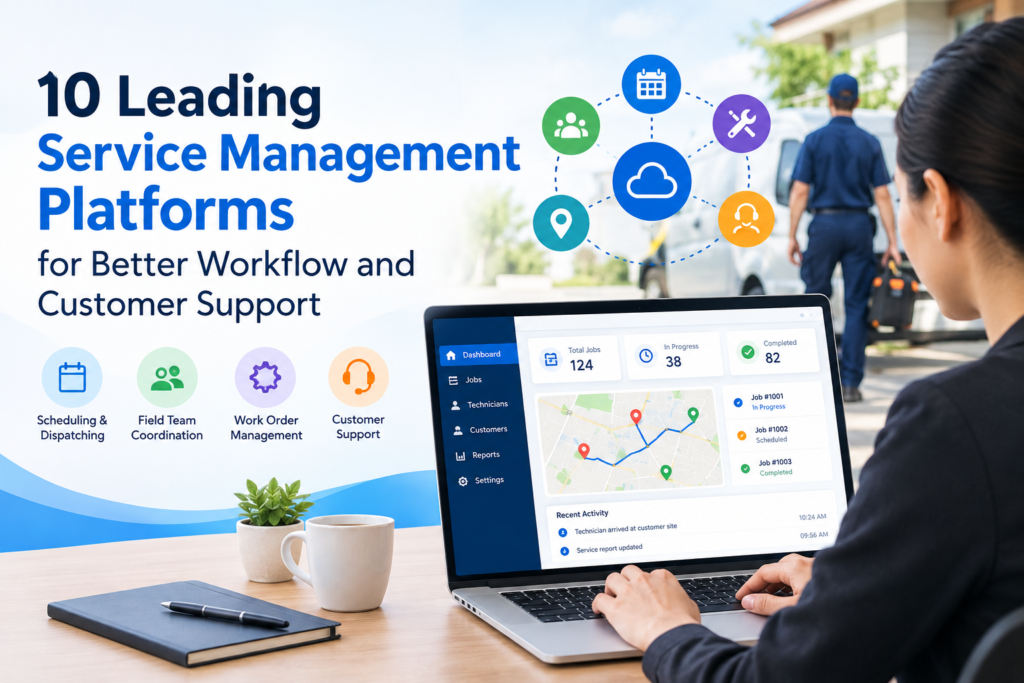
Efficient service request management plays a vital role in ensuring customer satisfaction and organizational efficiency. The inability to keep track of requests, work orders, customer data, and responsibilities becomes inevitable when these aspects are managed using separate applications.
Service management software enables organizations to centralize service requests, streamline workflows, monitor service delivery, and even evaluate service performance based on the vendor. Service management software may target IT support, customer service, or even field services depending on the vendor.
The following list contains ten companies providing service management solutions.
1. GenicTeams
GenicTeams is an AI-based solution that facilitates service request coordination, technician scheduling, job scheduling, and job completion among SMEs in Singapore. This software provides a platform for office teams and field technicians via solutions that increase visibility and streamline the process of service operations.
The solution includes AI-based scheduling and dispatching, route optimization, real-time job tracking, mobile technician workflows, customer communication, preventive maintenance, and workflow automation. These mobile workforce management capabilities help businesses manage service operations from the initial job request through completion while minimizing manual coordination.
This solution is very relevant for organizations providing services on-site and having to handle technicians, maintenance operations, and customer notifications within a single system.
Explore the platform: https://www.genicteams.com/
2. ServiceNow
ServiceNow provides solutions for service management of IT services, employee requests, customer workflows, and business operations. The system has modules for incident management, request management, workflow management, and performance management. The system would be ideal for organizations looking to streamline their processes in various departments.
3. Jira Service Management
The Jira Service Management application is useful for managing requests, incidents, changes, and support workflows. The application has collaboration capabilities that allow the connection between the teams providing services and those in charge of the technology to help resolve issues better.
4. Freshservice
Features of Freshservice include IT service management software that deals with incident management, service requests, IT asset management, and internal IT support. The automation capabilities in Freshservice assist the team in organizing recurring tasks. Organizations can leverage this platform for centralizing support processes and service performance tracking.
5. Zendesk
Zendesk focuses on customer service and support management. Its platform helps businesses manage customer enquiries through ticketing, knowledge bases, reporting, and automated workflows. It can support organisations seeking to organise customer interactions and improve response consistency across communication channels.
6. ManageEngine ServiceDesk Plus
ManageEngine ServiceDesk Plus supports IT service management, incident tracking, asset management, and service request workflows. It helps organisations maintain records of support issues and coordinate resolution activities. Its capabilities can be valuable for businesses seeking greater control over internal IT services.
7. BMC Helix
BMC Helix provides solutions to enterprise IT services management and operations management. Some of its features include incident management, workflow management, and service operations management. Enterprises of large sizes can consider this software when looking for processes for managing their IT infrastructure.
8. Zoho Desk
Zoho Desk is an application that enables companies to organize their customer support operations using ticketing, workflows, knowledge base management, and performance reports. The tool helps the company support its customer service operations in terms of responding to queries and follow-ups from customers.
9. Salesforce Service Cloud
The Salesforce’s Service Cloud offers capabilities such as case management, customer engagement, process automation, and analytics for handling customer services. Using Service Cloud, organizations can integrate customer information in one place and coordinate support activities among teams. This can be applicable for companies seeking customer service processes that are integrated into their overall CRM environment.
10. SolarWinds Service Desk
Service desk for SolarWinds includes the following management capabilities: managing services, managing incidents, managing service requests, managing assets, and managing the knowledge base. These capabilities allow the organization’s IT department to structure its internal process of service delivery and tracking pending requests.
Important Features to Compare When Selecting Service Management Software
The right appointment scheduling software should fit the type of service your business offers. Before making a decision, review these major capabilities.
- Request and Ticket Handling: Track requests and identify the responsible parties to fix the issues.
- Process Automation: Reduce the time you spend on repetitive administrative tasks and simplify standard operations.
- Customer Communication: Let customers know about the status of their request, scheduling, and resolution of issues.
- Service-Level Management: Monitor response time, resolution rates, and open requests.
- Analytics and Reporting: Track trends and discover opportunities to improve service delivery.
- Integrations: Search for software that can link with different business applications (CRM, accounting, communication tools, etc.).
- Mobile Access – Employees can access and update service data remotely.
- Job Management: Manage all tasks, resources, and job completion at site locations.
For companies that perform maintenance, repair, installation, and other types of on-site service, mobile workforce management features such as technician scheduling, dispatching, route optimization, and preventive maintenance are also worth a look.
Conclusion
The best service management software will depend upon whether the company manages its IT support, customers’ queries, internal requests, or its field service. Companies can evaluate automation, integration, reporting, and mobility features of different services to find the most suitable one for their processes.
GenicTeams offers a service which can help with scheduling, dispatching, work order management, and workflow automation for businesses having technicians who perform tasks on site.