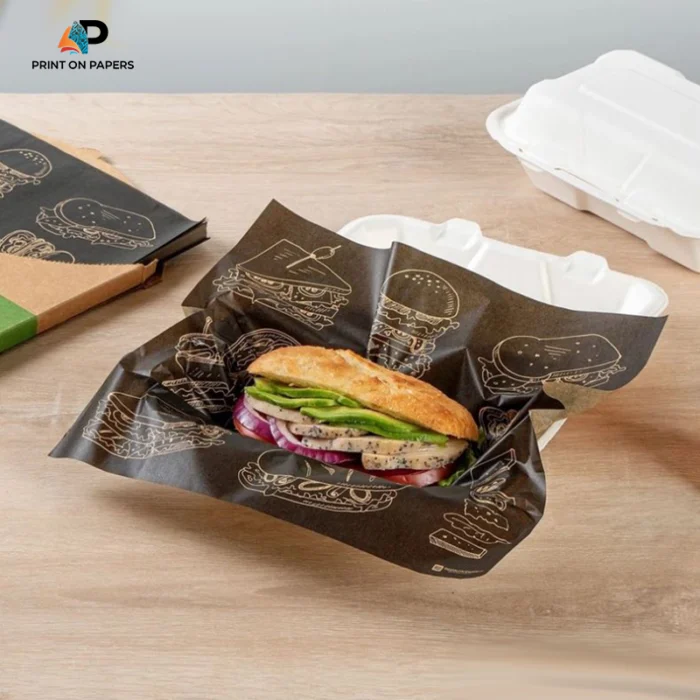
Make every serving memorable with custom printed food wrapping paper from Print On Papers. Perfect for restaurants, cafés, delis, and takeaway businesses.
Custom food paper sheets are pre-cut, printed papers that you wrap around food or lay in baskets and trays, with your logo on every piece. For restaurants and cafes, the right sheet keeps grease and moisture contained, speeds up service, and makes plain food look finished. This guide explains how to choose the paper, size, and print style for your menu. You can browse the full range on the Custom Papers page at Print On Papers.
What Are Custom Food Paper Sheets?
Custom food paper sheets are flat, pre-cut pieces of food-safe paper made to your size and printed with your own artwork. Staff grab a sheet, wrap the item, and hand it over, with no cutting from a roll.
You’ll also hear them called wrapping sheets, deli sheets, or food wrap sheets. Print On Papers makes them in more than 20 paper types, with dimensions you choose in inches.
Why Choose Sheets Instead of Rolls?
Sheets are faster when every item is a similar size, and they keep portions consistent. Rolls suit businesses that wrap many different sizes and want to cut as needed.
| Format | Best for | Main advantage |
|---|---|---|
| Flat sheets | Sandwiches, burgers, pastries, tacos | Grab-and-wrap speed, same size every time |
| Rolls | Mixed sizes, deli counters, bulk wrapping | Cut to any length, less waste |
Both formats are available, so you can match the one that fits how your team works.
Which Paper Is Right for Your Menu?
The right paper depends on how hot, greasy, or wet your food is. Print On Papers makes several types, each built for a different job.
| Paper type | Weight (GSM) | Good for |
|---|---|---|
| Deli paper | 30–45 | Sandwiches, cold cuts, light pastries |
| Greaseproof paper | 30–60 | Burgers, fried chicken, baskets, hot and oily food |
| Wax paper | 30–60 | Baked goods, candy, moisture-sensitive items |
| Kraft paper | 40–160 | Retail wraps, bags, market and takeaway items |
| Butcher paper | 40–90 | Meat wrapping, BBQ, heavy items |
| Parchment paper | 40–60 | Baking, confectionery |
GSM is paper weight, and a higher number means thicker paper. A cafe serving croissants and sandwiches can stay on the lighter end. A burger or wing spot should go heavier.
Which Paper Fits a Cafe?
Cafes usually do well with deli paper for sandwiches and paninis, wax paper for cookies and pastries, and a light greaseproof sheet for anything buttery.
Which Paper Fits a Restaurant?
Restaurants serving burgers, tacos, or fried food should look at greaseproof paper first, since it resists oil through its fiber structure instead of a wax or plastic coating. For wet fillings, ask about wax or PE coating options.
What Size Should the Sheets Be?
Measure your biggest item, then add enough paper to wrap it with a small overlap. Common sizes include 10×10″, 12×12″, and 15×15″, and you can order any custom dimension.
A few tips:
- Wrap a real sandwich or burger with a test sheet before you choose a size.
- Size for your largest item, not your average one.
- If you have several menu items, order two or three sizes in the same design.
How Should You Design Printed Sheets?
Keep the design bold and simple, because sheets get folded, creased, and wrapped. A repeating logo pattern looks good however the sheet is folded, while one large logo can fold out of sight. Choose colors with strong contrast against the paper.
Print On Papers prints in full-color CMYK and offers Pantone matching for exact brand colors. The two print methods are flexographic for large runs and digital for short runs and fine detail, both with soy-based and water-based inks. If you only have a basic logo file, free design support builds print-ready artwork, and you can request revisions until the proof looks right.
Are Printed Food Paper Sheets Food Safe?
They should be, and you should ask for the paperwork. Print On Papers states that its food papers meet FDA 21 CFR 176 food-contact standards, use PFAS-free coatings, and are printed on FSC-certified paper with food-safe inks.
PFAS matters more every year, since a growing number of US states restrict it in food packaging. Choosing PFAS-free sheets now means fewer changes later.
Are There Eco-Friendly Options?
Yes. Recyclable options are available, and compostable coating options are available on select paper types. If you print “recyclable” or “compostable” on your packaging, keep the wording accurate. The FTC’s Green Guides set the rules for environmental claims, so confirm what your exact paper qualifies for.
How Does Ordering Work?
Ordering takes three steps, and you don’t need design experience.
- Share your requirements. Tell the team your paper type, size, quantity, and branding details. If you aren’t sure which paper suits your food, they’ll recommend one.
- Approve your digital proof. You’ll see a full-color proof at actual scale, and nothing prints until you approve it.
- Production and shipping. Standard production is about 7–10 working days after proof approval, with rush production of 5–7 days available for most papers at an extra charge. Shipping is free and tracked through DHL, FedEx, or UPS.
The U.S. Small Business Administration notes that supplier lead times are a common pressure point for small businesses, so reorder before you run low.
What Does It Cost?
Price depends on paper type, weight, sheet size, number of print colors, and quantity. Print On Papers lists zero setup fees, so you pay for what gets printed. Larger orders lower the cost per sheet. Ask for a full quote with every cost listed, and confirm the minimum quantity when you request it.
Frequently Asked Questions
What are custom food paper sheets used for?
They wrap and line food like sandwiches, burgers, pastries, tacos, and basket meals. Printed with your logo, they also work as everyday branding.
How much do custom food paper sheets cost?
The price depends on paper type, weight, size, colors, and quantity. Larger orders lower the cost per sheet, so ask for a quote at a few quantities.
How do I order custom food paper sheets?
Share your paper type, size, quantity, and logo through the quote form. You’ll receive a digital proof to approve before printing starts.
What is the minimum order quantity?
Small cafes and large restaurant groups can both order. Confirm the exact minimum for your paper and size when you request a quote.
How long does it take to get my order?
Standard production is about 7–10 working days after proof approval, with 5–7 day rush production available for most papers. Shipping is free and tracked.
Which paper is best for greasy food?
Greaseproof paper is the usual choice, since it resists oil without a wax or plastic coating. Choose a heavier GSM for fried, oily foods.
Conclusion
Custom food paper sheets are a simple way to protect food, speed up service, and put your brand in front of every customer. Match the paper to your menu, size the sheet to your biggest item, keep your design bold, and check your proof before printing. A little planning means your sheets arrive before you run out.