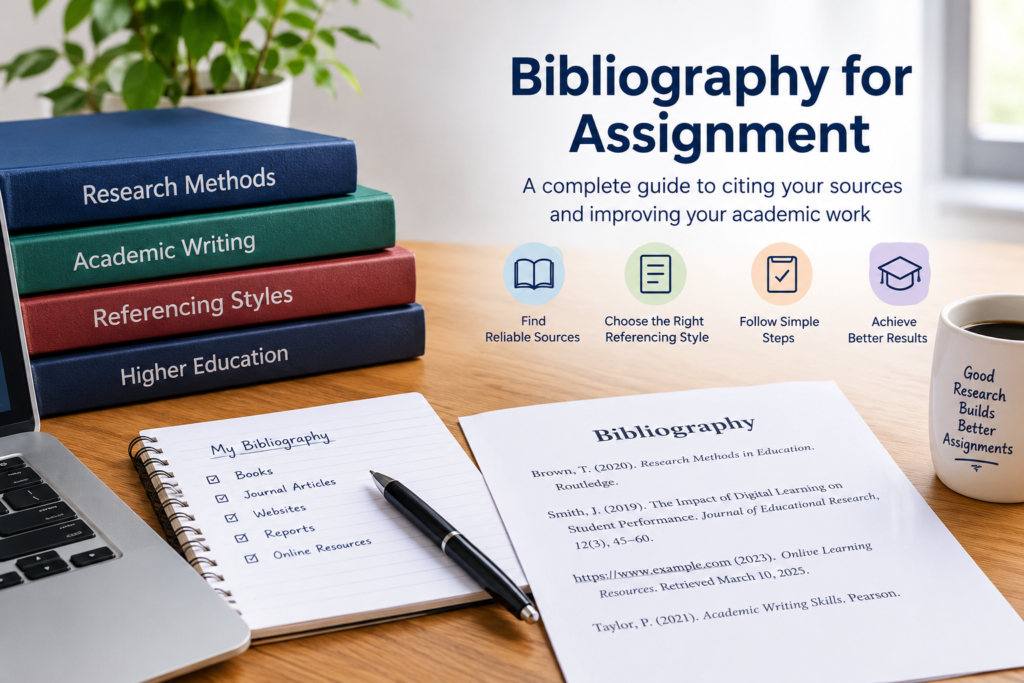
bibliography sample for assignment
Preparing an assignment involves more than collecting information and explaining your ideas. You also need to show where your research came from. A bibliography helps you acknowledge the books, journal articles, websites, and other materials you consulted while working on your topic. However, many students find it difficult to understand the correct format, especially when different referencing styles have different rules.
Looking at a bibliography sample for assignment can make the process much easier. Examples help you understand how to arrange source details, format titles, and organise references clearly. Whether you are writing a school project, college essay, university report, or research paper, learning the basics of bibliography writing can help you present your work professionally.
What Is a Bibliography in an Assignment?
A bibliography is a list of sources consulted during the preparation of an academic assignment. These sources can include printed books, online publications, academic journals, research reports, and reliable websites.
It is usually placed at the end of an assignment, after the main content and conclusion. Its purpose is to acknowledge the material that informed your research and help readers locate those sources.
A bibliography sample for assignment is not always the same as a reference list. A reference list generally includes the sources directly cited in your work, while a bibliography may also include relevant materials you consulted but did not cite directly. Your institution may use these terms differently, so check the instructions provided by your teacher or university.
Bibliography Sample for Assignment: Basic Examples
The format of a bibliography sample for assignment depends on the source you have used and the referencing style required. The following examples are illustrative templates. Replace the sample details with accurate information from the actual sources you consulted.
1. Bibliography Sample for a Book
Books are frequently used for background information, academic theories, and explanations of important concepts.
Example format:
Surname, Initial. (Year). Title of the book. Publisher.
Illustrative example:
Taylor, R. (2022). Introduction to Modern Business Studies. Greenfield Academic Press.
This example shows the general arrangement of an author’s name, publication year, book title, and publisher. The entry is fictional and should not be used as a real source.
2. Bibliography Sample for a Journal Article
Journal articles are useful when an assignment requires research findings, academic discussion, or evidence from subject specialists.
Example format:
Surname, Initial. (Year). Title of the article. Name of Journal, volume(issue), page range.
Illustrative example:
Morgan, L. (2023). Digital learning and student engagement. Journal of Contemporary Education, 8(2), 35–48.
This example demonstrates the structure of a journal reference. Always check the original article for the correct title, journal name, volume, issue, and page numbers.
3. Bibliography Sample for a Website
Online sources can provide statistics, guidance, reports, and other relevant information. Before using a website, check whether its publisher is reliable and whether the content is suitable for academic work.
General example format:
Author or Organisation. (Year or date). Title of the webpage. URL
Some referencing styles require additional details, such as an access date, while others follow different rules.
4. Bibliography Sample for a Report
Reports published by government departments, universities, and recognised organisations can support assignments with research findings or official data.
General example format:
Organisation or Author. (Year). Title of the report. Publisher, where required.
Use the details shown in the original report rather than guessing missing publication information.
Common Referencing Styles Used in Assignments
Before creating your bibliography sample for assignment, identify the referencing style required by your institution. Each style has its own rules for presenting authors, dates, titles, and publication details.
Harvard Referencing
Harvard is commonly used in UK academic settings. It typically includes an author’s surname, initials, year, title, and publication details. Exact formatting can vary between institutions.
APA Referencing
The American Psychological Association (APA) style is often used in psychology, education, and social sciences. It follows specific rules for author names, dates, titles, and publication information.
MLA Referencing
The Modern Language Association (MLA) style is widely associated with literature, languages, and humanities subjects. Its list of cited sources is usually titled Works Cited.
Vancouver Referencing
Vancouver is commonly used in medicine and health-related subjects. It links numbered in-text citations to numbered entries in a reference list.
Important: Do not combine different referencing styles in the same assignment unless your course instructions specifically require it.
How to Write a Bibliography for an Assignment
Creating a bibliography becomes simpler when you follow a consistent process. Use these practical steps to organise your sources correctly.
- Step 1: Collect source details. Record the author’s name, title, publication date, publisher, page numbers, and URL where relevant.
- Step 2: Check the required style. Review your assignment brief or university referencing guide before formatting any entries.
- Step 3: Organise your sources. Arrange entries alphabetically, numerically, or in another required order according to your chosen style.
- Step 4: Apply consistent formatting. Check punctuation, capitalisation, italics, and the order of details.
- Step 5: Review every entry. Confirm that names, titles, publication dates, and links match the original sources.
Keeping a record of your sources while researching is much easier than trying to recreate every detail just before submission.
Common Bibliography Mistakes Students Should Avoid
Even a well-written assignment can look incomplete if its bibliography contains errors. A quick final review can help you avoid common problems.
- Forgetting the publication year or other required source details.
- Including incorrect titles or author names.
- Using different referencing styles in one bibliography.
- Adding unreliable sources without checking their credibility.
- Copying a sample bibliography without replacing its details.
- Forgetting to follow the format required by your institution.
Remember that examples are helpful for learning a format, but the sources listed in your final assignment should accurately represent your own research.
Tips for Making Your bibliography sample for assignment
Use a notebook, spreadsheet, or reference management tool to record source information as you research. This helps you stay organised and reduces the risk of missing details. You should also check whether the sources are relevant, trustworthy, and appropriate for your assignment topic.
If you use a reference generator, review the output carefully. Automated tools can occasionally produce incomplete or incorrectly formatted entries. Your lecturer’s instructions should always take priority over a general online example.
Conclusion
Finding a suitable bibliography sample for assignment is a practical way to understand academic referencing. Examples show how to arrange details for books, journal articles, websites, and reports while helping you become familiar with different referencing styles.
To prepare a reliable bibliography, record your sources carefully, follow the required format, and check every entry before submitting your work. With regular practice and attention to detail, bibliography writing can become a straightforward part of your academic routine. Most importantly, use examples as guides and make sure your final bibliography reflects the real sources behind your research.